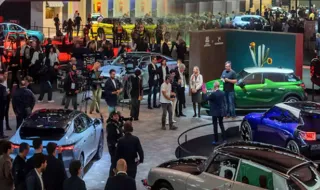
Paris, Porte de Versailles. Mobile.bg team from the event site
The Paris Motor Show in 2026 has once again established itself as a key global stage, where European manufacturers demonstrate both resilience in the face of new market realities and bold technological ambitions. This year's edition in the French capital offered a unique mix of pragmatic solutions, futuristic concepts and a serious presence of global giants, among which French brands took center stage.
The focus of the event was on the innovations of the Renault Group, which outlined the future of mobility through the return of iconic shapes and new electric architectures. Among the most significant highlights of the exhibition was the futuristic Renault E-Space concept, which rethinks the philosophy of family vehicles for the era of electricity, offering exceptional aerodynamics and comfort, commensurate with modern SUV trends. Along with it, the electric Twingo and the impressive Renault 8 Gordini Concept attracted well-deserved attention with their modern interpretation of classic lines.
The Romanian brand Dacia consolidated its leading role at the exhibition, proving that pragmatism and affordable mobility remain a winning formula. The company presented the new all-electric Dacia Spring, which is already produced in Europe, as well as the attractive new Striker model. The brand's management emphasized that the focus remains on practicality and the absence of unnecessary, complicated electronics, which meets the real needs of European drivers.
Along with the massive French premieres, the Paris Motor Show also offered interesting exotic surprises. The Smart brand caused a real sensation with the long-awaited return of the legendary urban format in a new, ultra-compact all-electric form under the name Smart #2, retaining its miniature dimensions and unique character. As a technological exotic, the futuristic Tesla Cybercab also stood out - a fully autonomous robotaxi without a steering wheel and pedals, which showed the future of unmanned transport, although still far from mass European road use.
Amid the strong Chinese wave that took over the exhibition with a record presence and dozens of new brands, the newly hatched Omoda 4 stood out as one of the most interesting offers on the market with its attractive design inspired by sports cars and an economical hybrid powertrain. Amidst Chinese competition, the Asian and European market clashes were balanced by the strong performance of Korean manufacturers, where the new Hyundai Bayon emerged as the most interesting car from Korean automotive in Paris with its more aggressive, square design and advanced hybrid engines.
Thus, this year's Paris Motor Show categorically proved that the automotive industry is in a period of profound transformation, where the clash between established European traditions, practical affordable solutions and the massive Chinese offensive will determine the market rules in the next decade.