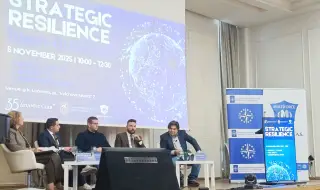
„Democracy is not just a system, it is a way of life“, said Calvin Chen-huan Ho, head of the Taiwanese mission in Greece, during an international conference held in Sofia. The forum was dedicated to security, disinformation and strengthening resilience in supply chains in the relations between Taiwan and the European Union.
During his speech, the ambassador stressed that Taiwan is ready to join the EU in order to „protect this path from the expansion of authoritarianism“. He recalled that the island nation is a world leader in semiconductor manufacturing, information and communication and green technologies. “Taiwan plays a key role in the semiconductor supply chain and is ready to cooperate with friendly partners to achieve the Sustainable Development Goals. This represents a clear opportunity for cooperation between Taiwan and the EU,“ Ho pointed out.
The diplomat emphasized that supply chain sustainability is no longer just an economic issue, but a geopolitical challenge that requires joint efforts of democratic societies.
Ho also shared that Taiwan has experienced large-scale disinformation campaigns and cyberattacks by external factors, but has gained valuable experience in countering fake news, deepfakes and manipulations on social media. “We are ready to share these strategies with the EU in the field of increasing media literacy and democratic sustainability,“ he added.
“Democracy in Taiwan is not an accident, but the result of decades of struggle and perseverance,“ Calvin Cheng-huang Ho also emphasized, calling for closer cooperation between the EU and Taiwan in the defense of free societies, technological security and sustainable development.
Taiwan is in fact an economically powerful country. With a population of 23.5 million people, it has a GDP of 769 billion USD, which puts the country in the TOP 20 of the most economically developed countries in the world. It delivers 70% of the shipments worldwide. This can be called a democratic monopoly, because Taiwan does not interfere with other countries in any way, the conference participants noted.
In 2020, Taiwan became the EU's 14th largest trading partner in the world.
In terms of disinformation, we can safely say that we are in a war for survival. It is necessary to work hard on the topic of digital security, the way we think about our physical security. "Last year I was in the same place here. Then we talked about the risks of disinformation. A year later we are talking about resilience, because disinformation is here. During this one year, we realized that we have lost and that we are losing in the fight against it," said IT expert Miroslav Yanev.
Nearly 60% of users of the social network "X" are not real. "This is why Elon Musk wanted to renegotiate the deal - it turns out that they are selling him 2 billion users, but in reality they are under 1 billion, since all the others are bots. After years, these bots turn into avatars and real people talk to them, thinking that they are real people, but in reality they are machines", explains Yanev.
The situation is similar with Google, but the largest search engine in the world will never reveal this data, the IT expert predicts. Realistically speaking, if you start talking to a person on the Internet and if you do not know him in real life, then in 50% of cases it is an avatar.
The problem with disinformation, bots and avatars, and in general with the question of whether you are talking to a real person or an avatar on the Internet, is growing with each passing day. However, how can we combat this and how can we learn from countries like Taiwan, which have been working to reduce disinformation for years?
First of all, a dialogue on digital sustainability between Bulgaria and Taiwan should be created. Second, all political parties should stand behind such a project. Third, citizens should learn to use data verification platforms. Fourth, a total change in the education system is needed. It is unacceptable for children today to receive the same education as what was 50 years ago. And fifth, but not least, it is necessary to lobby for close communications with Taiwan, the experts at the conference are categorical.