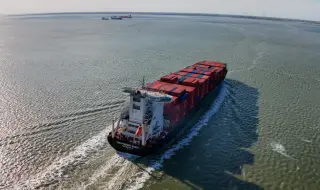
The need to clear mines in the Strait of Hormuz means that even if the ceasefire between Iran and the US holds, it will take months for shipping through this important sea route to return to pre-war levels. This was stated by Takaya Soga, head of Japanese shipping company NYK Line, in an interview with the British newspaper Financial Times.
“The routes available for shipping are extremely limited - they are very narrow corridors“, Soga noted. “We are still far from returning to the conditions that existed before the closure of the Strait of Hormuz.“
The newspaper explained that ships can only sail along two routes: near the Iranian island of Larak and along the coast of Oman. The article states that up to 80 mines may remain in the Strait of Hormuz.
“Even if ships can enter and exit the strait unhindered, shipping volume is likely to be less than half of normal levels for some time“, explained the head of NYK Line.
On February 28, the US and Israel launched a war against Iran. Major Iranian cities, including Tehran, were hit. The Islamic Revolutionary Guard Corps (Iran's elite military unit) announced a large-scale retaliatory operation, attacking Israel. US military facilities in Bahrain, Jordan, Iraq, Qatar, Kuwait, the UAE and Saudi Arabia were also hit. In addition, the Iranian authorities decided to close the Strait of Hormuz to ships affiliated with the US, Israel and countries that supported the aggression against the Islamic Republic. Approximately 25% of the world's oil trade and about 20% of liquefied natural gas are transported through the Strait of Hormuz.
In mid-June, Washington and Tehran signed a memorandum of understanding calling for an immediate cessation of hostilities on all fronts, including in Lebanon. On June 21-22, talks between the United States and Iran on the implementation of the memorandum were held in the Swiss resort of Bürgenstock, mediated by Doha and Islamabad. As noted in a joint statement by Pakistan and Qatar after the first round of talks, the meeting, which was attended by representatives of Iran and the United States, took place in a positive and constructive atmosphere, with encouraging progress being made, including the establishment of a foundation for further technical consultations.