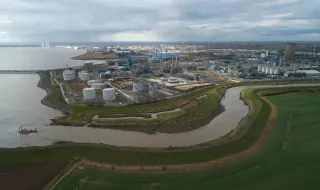
The European energy crisis is once again starting to be felt directly in the industry. In the UK, chemical giant Ineos announced a production halt at three of its Hull plants due to high gas prices as Europe heads into the winter season with lower-than-usual gas stocks.
Against this backdrop, the International Energy Agency (IEA) warned that a series of geopolitical and market shocks in 2026 had made the global gas market more vulnerable to further supply disruptions.
Ineos to shut three plants in England
Ineos, owned by British billionaire Jim Ratcliffe, announced it would temporarily shut down its three chemical plants in Hull.
Two of the sites have already stopped working, and the third is about to be stopped. The companies produce chemical raw materials used in the production of medicines, cosmetics, textiles, detergents and construction materials.
According to Reuters, the three plants provide jobs for nearly 4,000 people directly and in the supply chain. The plants themselves are part of an important production base for the British and European chemical industry.
The reason given by Ineos is simple: production is no longer competitive enough at current gas prices.
„We can't compete“
Ineos chief Jim Ratcliffe has been sharply critical of Europe's and Britain's energy policies.
According to data cited by Reuters, British gas is trading at around $23.51 per million British thermal units (MMBtu), while the US gas benchmark price is around $2.84.
Ratcliffe says European producers are at a huge disadvantage compared to their US and Chinese competitors due to the difference in energy costs. He also criticised the European carbon tax system, arguing that the combination of high energy costs and the additional costs of emissions undermines the competitiveness of European industry.
The British government, for its part, points out that it has already taken measures to support energy-intensive businesses, including financial relief and schemes to reduce electricity costs.
The problem is now bigger than one company
The Ineos case is indicative of a wider problem facing European industry.
High gas prices are increasing production costs for chemical, metallurgical, glass, ceramic and other energy-intensive industries.
The Guardian reports that British wholesale gas prices reached their highest level since 2022 in September, when Europe was at the height of the previous energy crisis. The issue is particularly sensitive for the UK, as the country has limited gas storage capacity and relies heavily on imports.
This means that the price shock could be passed on not only to industry but also to consumers if high energy costs persist.
Europe enters winter with lower stocks
The other problem is the amount of gas stored in European storage facilities.
Reuters reported last week that European gas storage facilities were approximately 69% full, with about 85% of the five-year average at this time of year.
The Guardian also reported that Europe is heading into winter with some of its lowest gas stock levels in more than a decade. According to the publication, storage facilities were approximately 67% full, while the seasonal average is around 80%.
This does not automatically mean that Europe will run out of gas. The problem is that lower stocks leave less of a buffer in the event of a sudden cold snap or another supply disruption.
IEA: Gas market more vulnerable
The International Energy Agency warns of this very risk.
In an analysis published in September, the IEA stated that the last two major gas crises have exposed structural weaknesses in the energy security system. The agency recommends that countries increase physical reserves, use more flexible contracts and develop liquefied natural gas infrastructure.
In its latest Gas Market Report, the IEA stated that the war in the Middle East has caused a serious shock to the global gas market. The closure of the Strait of Hormuz has affected liquefied natural gas flows, which before the crisis accounted for almost 20% of global LNG supply.
According to the agency, this has led to strong price volatility and higher natural gas prices in both Europe and Asia.
Europe remains dependent on LNG
Europe has gradually reduced its dependence on Russian pipeline gas since the start of the war in Ukraine, but this change has increased the role of liquefied natural gas gas.
The IEA indicates that in the winter of 2025/26, LNG imports into Europe reached a record level, compensating for lower pipeline deliveries and falling domestic production.
Thus, the European market finds itself increasingly closely linked to the global LNG market. Any major disruption to production or transport in a key region could also push up prices in Europe.
The danger to industry
The Ineos case shows how this dependency can become a real industrial problem.
If gas remains permanently more expensive in Europe, producers may be forced to reduce production or move investments to regions with cheaper energy.
This is particularly sensitive for the chemical industry, as natural gas is not only a source of energy, but in many industries it is also the main raw material.
The shutdown of Ineos' plants therefore has implications beyond the company itself — it shows how the price of energy is starting to affect the ability of European industry to produce competitively.
Winter will be decisive
Europe still has the potential to make up some of the shortfall through LNG, additional imports and greater market flexibility. But low supplies mean that prolonged cold weather or another geopolitical shock could quickly increase tensions.
The IEA is stressing the need for better preparation for such disruptions and greater system flexibility.
Sources: Reuters, International Energy Agency