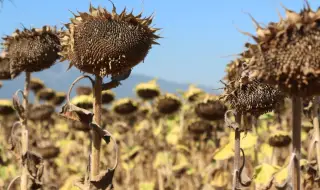
A new price spike for oil is coming in the fall, warn producers. The reason - the sunflower harvest will be half as small as last year due to the prolonged drought and high temperatures that burn crops and interrupt their development.
“Everything is wilted, dried up and gone”, says Kalin Yovchev. Even before the first combines entered the sunflower fields, the farmer realized that this year's yields would be low. He grows 1,000 acres of sunflowers on Rakovski's land. The drought ruined his harvest.
”There were three heat waves. At the beginning of June, when the sunflowers were blooming, that was the worst time for such heat waves, with temperatures above 40 degrees. Its vegetation stops, the sunflower starts to shed its leaves instead of photosynthesizing and feeding the fruit, the sunflower seed. Small, disproportionate cakes with unnourished grain inside them. Lack of seed, lack of oil, butter. This is - a low yield with poor quality”, says Kalin Yovchev, quoted by Nova TV.
Not only is 50% of the sunflower currently dried up, but two weeks ago hail hit the area and knocked some of the plants to the ground. So instead of 350, he expects to harvest 100 kilograms per decare. Therefore, he estimates that he will be able to cover only part of the costs for fertilizers and preparations.
“The losses will be large. If we focus on a yield of 100 kilograms and an average price, which is currently being discussed at around 70 stotinki per kilogram, the losses will be between 100-120 leva per decare,” Yovchev calculates.
Less sunflowers will lead to a deficit, and hence to a jump in the price of oil, claim the producers.
Zhaneta's store sells between 20 and 30 bottles per day. “It is one of the most sought-after household items. Last year, its price was around 4 leva, since sunflowers were nowhere to be found. Currently, it fluctuates at a price of 3 leva here. I assume and hope that there will be no price increase, as there will be dissatisfied customers both among us and among our customers,” says Janet Georgieva.
Consumers hope that Ukrainian sunflower imports will compensate for the Bulgarian deficit in order to maintain the current price of oil. And producers whose harvest was destroyed by drought do not count on compensation from the state, but expect it to help with irrigation, as climate change is becoming a systemic problem for farmers.
“Sunflowers can be watered, wheat can be watered, everything can be watered. There is not enough water,” says Kalin Yovchev.