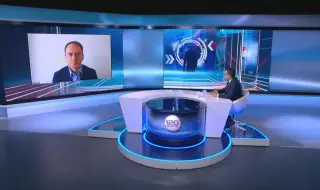
Investigative journalist Hristo Grozev has been researching the mechanisms for influencing public opinion for years. This week it became clear that he has been invited to support the activities of the mechanism created by the caretaker government at the Ministry of Foreign Affairs (MFA) to counter disinformation and hybrid threats in connection with the upcoming elections.
The journalist commented on a publication by The Washington Post about alleged Russian scenarios, including a staged assassination attempt on Viktor Orban.
„It is authentic to the extent that leaked documents of Russian foreign intelligence describe such plans. A year and a half ago, we obtained documents that describe the so-called „active actions under a false flag“ – "panic operations in the pre-election period," he announced.
According to him, the goal is to create an atmosphere of fear, in which the party that promises order and security receives an electoral bonus.
“Creating fear - whether economic or from terrorism - makes people withdraw into themselves. Then the population loses interest in global problems and becomes a very convenient resource for populist regimes“, the journalist added.
The journalist warned of a new, more dangerous phase of disinformation: “The most dangerous social network in the near future will not be TikTok or Facebook, but the agents of artificial intelligence themselves“.
According to him, a targeted campaign is already underway to influence AI systems – a huge amount of content is created not for people, but to be read by these systems.
“This way, you can influence what answer you will get when you ask which party is the best“, the journalist specified.
With regard to Bulgaria, Grozev made a distinction between internal and external influence: “It is legitimate for every party to try to convince voters. It is illegitimate when the influence comes from outside“.
According to him, the specific sources are not only Russia, which is certainly trying to influence, but also from Iran and China.
Grozev emphasized that modern disinformation does not always aim at direct support for a particular party, its goal may be to prevent people from going to the polls at all.
As the most effective measure against disinformation, he pointed to the disclosure of participants in such networks.
“When you start publishing their names and sanctioning them, this acts preventively. It is more effective to attack the centers of disinformation – servers, networks, IP addresses – "than to refute every fake news," the investigative journalist explained.
Grozev also stated that he had information about such networks, including those linked to Bulgaria, and expressed confidence that the authorities would take action in the coming weeks.