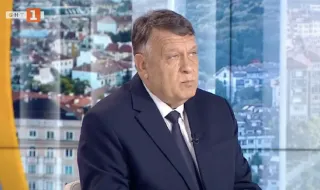
The education system has grown with many aids that refuse children to think, said the Minister of Education Prof. Dr. Georgi Valchev in the studio of "The Day Begins".
"When we were students, our generations, had a textbook and two notebooks – one for work in class, one for homework. Gradually, the system has grown with many aids that refuse children to think. They offer them ready-made solutions, an easy path and the reluctance to ask questions. The system kills curiosity. The system must begin to stimulate children to discover the world, to assemble the world in their imaginations. To kill this natural curiosity means to cause harm."
About the PISA results, the Minister of Education said:
It is no coincidence that after PISA showed poor results for Bulgarian students, goals and measures were set that remained in the folders. We need to change the programs - new content, new textbooks. That is the time to change this trend of textbooks that are written in a language that is incomprehensible to students. Students speak the specialized language that should be taught at the university. That is where the problems related to writing textbooks are locked, and I think that by going in this direction, we will be able to solve this problem as well."
About the "money follows the student" system, the Minister of Education commented:
"We have given ourselves a year to be able to change this model very carefully. He has completely exhausted his philosophy. It is no coincidence that so many adjustments have been added to the basic formula over the years. This model condemns small schools to survival, not development. We will adjust the formula so that teachers feel secure in their status, not in the number of children enrolled in their school. The main problem is related to a change in social legislation - you can't teach a child if he doesn't attend school. The current system encourages teachers to cover up these absences precisely because their children have to form the budget. Within the next year, we will propose and introduce a new financing model so that the system is calm, focused on doing its main job, not on survival."
On private lessons and parents' trust in the education system, the minister commented:
"Even good students, when they have to prepare for higher education, are increasingly turning to private lessons. There is nothing wrong with a child using private lessons, but on such a scale it means that there is a problem somewhere. Standard, normal families have withdrawn, because the feeling remains that the system looks at them like a piggy bank. If we do not restore trust between the family and the education system, there can be no success."
About the subject "Virtues and Religion" Minister Valchev commented:
"Traditional values and virtues have been formed in religions for millennia. It is no coincidence that we offer it this way – we have two components: “Virtues“ and “Religion“. Each family can choose which component to focus on, and both components are focused on virtues. One is explained through religion, the other – as part of public life. If we do not create in children from their childhood the ideas of good, bad, compassion, and the need to be sensitive to the pain and successes of our comrades, it will be difficult for us to overcome this crisis of values. This is just one element of everything we need to do in the education system. We hope to start next school year, but the legislative process must pass. Bulgarian education retains its secular character."
Regarding the problems in higher education, the minister stated:
"We have created a working group to prepare texts for change. Then we will discuss it with the rectors of higher education institutions in Bulgaria. A significant part of the problems that exist in preschool and school education also exist in higher education. What we need to continue to do is to raise the quality of higher education. Getting a degree in a specialty that has no cover is much more harmful than anything else an education system can do. These people can enter high positions in the relevant professional field, decide the fate of other people, and if they are not well prepared, our country will not be able to keep up with the modern world."