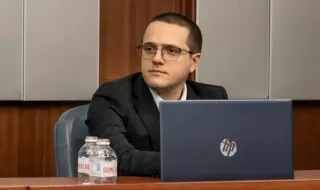
The "Petrohan" case continues to raise more questions than it answers. After the last briefing by the Ministry of Interior and the Prosecutor's Office, the institutions presented details about the cameras, weapons, gunpowder particles and the behavior of the deceased, but at the same time it became clear that some of the expert reports are not yet ready. What was left unsaid after the briefing, was a definitive version presented before the end of the expert reports… Vladislav Krastev, a doctoral student at the Sofia University "St. Kliment Ohridski" and an associate fellow at the Center for the Study of Democracy, spoke to FACTI.
– Mr. Krastev, what do you think was left unsaid at the last briefing of the Ministry of Interior and the Prosecutor's Office on the "Petrohan" tragedy?
– I would emphasize more on the way the entire case was told, and not so much on what was left unsaid. In this case, a private expert took over the role of spokesperson for the prosecutor's office and used emotionally charged language to explain a serious criminal case. Institutional spokespersons should use more neutral language and have a more moderate behavior. This is how trust is created and tension in society is relieved. We saw and heard the opposite.
– Many details were presented about the cameras, weapons, gunpowder particles and the behavior of the deceased, but what are the big questions that the institutions have not yet answered?
– They gave more such details than was necessary. I emphasize again that when institutions communicate, the way and the medium matter, i.e. exactly who is saying it. In this case, there are more adequate ways to share this information. It could have been to wait for the conclusion of the pre-trial proceedings. Otherwise, I am inclined to believe the version presented. There is no indication that these murders bear the signature of those committed by organized crime.
– If the institutions really had information about a paramilitary structure, sexual assaults and a specific closed environment around “Petrokhan“, why was this group allowed to function for years? There are signals – the Ministry of Internal Affairs, the National Security Agency, the prosecutor's office nothing… Why?
– We can only speculate whether this is a matter of deliberate negligence, or simply negligence.
– It is already known that SANS submitted materials to the prosecutor's office back in January 2025. So what of it...
– I was impressed that the briefing host said that the signals were not addressed correctly, which was a mistake on the part of the submitters. This is not true. When an institution receives a signal about a crime that is not within its prerogatives, it forwards it according to its competence. In this sense, this was done by SANS and the signals were forwarded to the prosecutor's office. The end result is clear.
– At the briefing, the prosecutor's office explained that during inspections for unlawful actions against children, it encountered “refusal to cooperate“ from parents. Is this a sufficient explanation when it comes to data about possible crimes against children?
– No, this is categorically not an adequate reason for the institutions not to take action. When there are suspicions that serious criminal offenses are being committed, the police have the right to act in an emergency. There were previous signals and data about this person, and over the years there have always been children around him. The State Agency for Child Protection (SACP) has the authority to conduct on-site inspections. In general, there were many ways to act and many channels to understand that there was a problem. For example, the fact that one of the boys was enrolled in school, but did not attend it. Even from there, one could have started to unravel the case, a kind of awake conscience and will, if the school board had signaled to the right person.
– The Ministry of Interior is checking two district departments for the issued weapons permits to members of the group. What will these checks show us now, after we have killed people?
– If they have issued permits, they most likely formally met the criteria. I do not believe the checks will show anything else. I am not aware of anyone from the group having been convicted of an intentional crime, and this would be a reason to deny them permission. Otherwise, there is a mechanism by which the Ministry of Interior can seize weapons when there is evidence that they could be used to commit a crime. A large number of weapons belonging to Ivelin Mihaylov were seized by the Ministry of Interior, and subsequently the court ruled that they were seized unlawfully, but such a mechanism exists anyway.
– Why do you think the briefing paid so much attention to the allegations of a sect, sexual assault, the mental state and behavior of the deceased, given that the investigation itself has not yet been completed? It was announced that 12 more expert reports were pending...
– For a number of reasons, the most important of which is certainly that the majority of people are excited and interested in the case. Secondly, perhaps a political effect was sought right now. Again, even if it was not deliberately sought, such an effect was produced. Political talk prevailed over expert talk. This undermines the authority of the institutions and people lose trust in them.
– How do you view the fact that the prosecutor's office emphasized that the investigation is ongoing and the expert reports have not been completed, but at the briefing there was a public presentation of a very categorical version of the motive, the sequence of actions and the lack of external interference?
– As confirmation of my previous statement that perhaps a political effect was sought. It would be most appropriate to wait for the conclusion of the pre-trial proceedings. The termination is made by the prosecutor. Under the Criminal Procedure Code, victims of a crime have the right to disagree with the termination and state in writing what exactly they want to be further clarified and investigated. If the prosecutor's office does not grant the request, the next step is to go to court. This is a process that takes time, which in turn would have cooled the passions surrounding the case, to put it in slang. Separately, they could have spoken to the relatives of the murdered. Keep in mind that this is a big shock and blow for them as well. Even if there is hostility and distrust between the two parties, i.e. between the relatives and representatives of the institutions, there are ways to communicate with them. I don't know if it was done before the briefing, but I assume it wasn't. The work at the Ministry of Internal Affairs is hard and some employees lose empathy, even for victims of crimes. I assume that for them this is a kind of defense mechanism. Also, for both the Ministry of Interior and the Prosecutor's Office, this is an unprecedented and difficult case.
– Do you see a risk that this will narrow the direction of the investigation in advance?
– There is always such a risk when the main version is released on the day of the crime itself. I assume that after the bodies were found, the signals were summarized and reported to the leadership of the Prosecutor's Office and from there, accordingly, immediately shared in the media.
– The way in which the institutions communicate the case creates space for conspiracy versions and further divides society. What specifically needs to be brought out and verified publicly in order to restore trust in the institutions?
– Hire people who understand so-called strategic communication. Train spokespersons and let them alone speak when there is such a socially significant case. This takes time, i.e. it must be done systematically. The press center of the Ministry of Internal Affairs employs people who understand this well. The political leadership should listen to their expertise, of course, if they seek it and want it.
--------------------------------------
Vladislav Krastev is a doctoral student at the Sofia University “St. Kliment Ohridski“ and an associate fellow at the Center for the Study of Democracy. His academic interests are in the field of criminology and political science. He has professional experience in conducting field research, in-depth interviews and analysis of cases related to radicalization, extremism, conventional and organized crime. He is the founder of the expert research hub Polity.