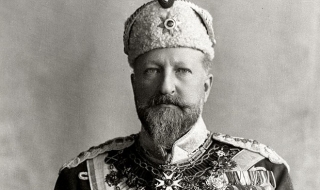
On August 2, 1887, the German prince Ferdinand I of Saxe-Coburg-Gotha was crowned in Veliko Tarnovo as Prince of the Bulgarians.
Ferdinand Saxe-Coburg-Gotha was born in Vienna on February 26, 1861. His election as Bulgarian prince took place after the abdication of Prince Alexander I of Battenberg on August 26, 1886 and the acute political crisis that arose. The Regency, consisting of Stefan Stambolov, Sava Mutkurov and Georgi Zhivkov, began to search for a new Bulgarian ruler, the website Istoria.bg recalls.
The Grand National Assembly convened on October 15, 1886, elected Valdemar of Denmark as Bulgarian prince, but he refused to accept the crown at the suggestion of Alexander III. Russia proposed the candidacy of the Georgian Prince Mingreli, but it was not accepted by the Grand National Assembly. This led to the severance of diplomatic relations between the two countries.
The Grand National Assembly sent a three-member delegation to Vienna to search for a prince. There, the Austrian officer Ferdinand Saxe-Coburg-Gotha was proposed. After consulting Germany, Great Britain and France, the candidacy was accepted without seeking Russia's consent. On July 7, 1887, the Grand National Assembly elected Ferdinand Saxe-Coburg-Gotha as Prince of Bulgaria.
On August 2, 1887, the new Bulgarian prince solemnly took the oath before the Grand National Assembly in Tarnovo. Russia considered the election of Prince Ferdinand illegal, and him - a usurper. He really has no political past, but on the other hand he has family ties with all European dynasties.
In the first years, Ferdinand left Stefan Stambolov to govern and modernize the country, while he took up traveling and settling his personal affairs. In 1893, he married the Italian princess Maria-Louise. The birth of the heir to the throne, Prince Boris Tarnovsky, further strengthened the throne.
In the following years, Ferdinand began behind-the-scenes contacts with Russian diplomacy. On May 19, 1894, Stambolov was overthrown. A government was formed, headed by Dr. Konstantin Stoilov.
The prince achieved his international recognition through reconciliation with Russia. In connection with the funeral of Alexander III, a Bulgarian delegation, led by Metropolitan Clement, was solemnly received by the new Russian Emperor Nicholas II on July 4, 1895. One day earlier, Stefan Stambolov was beheaded in Sofia, marking the new political course of Bulgaria.
On February 2, 1896, the Crown Prince Boris Tarnovsky converted to Orthodoxy and Emperor Nicholas II became his godfather. Ferdinand was now officially welcomed in all European capitals and received the highest orders.
As commander-in-chief of the army, the monarch undertook its modernization and armament and the creation of an elite officer corps.
The prince supported modernization in all areas - the construction of post offices, railways, stations, ports. He was a lover of automobiles, trains and airplanes, and built palaces, parks and gardens.
In his foreign policy, Ferdinand achieved not only reconciliation, but also rapprochement with Russia. In 1902, a secret military convention was concluded between the two countries.
The restrictions of the Treaty of Berlin, according to which Bulgaria was a vassal principality, prevented the ruler and the country from fully developing their capabilities. Therefore, Ferdinand accepted the idea of independence.
On September 22, 1908, Bulgaria solemnly declared its independence in the old Bulgarian capital of Veliko Tarnovo. Prime Minister Alexander Malinov presented Ferdinand with the crown and the title of ”tsar” and thus restored the dignity of the Bulgarian rulers. The act was a brilliant demonstration of national unity and the achievement of international prestige.
The political successes of Tsar Ferdinand reached their peak during the Balkan War in 1912. The Tsar had imperial ambitions, and the people and the army were overwhelmed with enthusiasm to free their enslaved brothers from Macedonia and Thrace. The Bulgarian troops performed miracles and pushed the Turks miles from Constantinople. Blinded and impatient, Ferdinand easily ruined what he had won.
Ferdinand's first failure as commander-in-chief came during the Allied War, when he issued an order to attack the former allies without diplomatic and military support. This led to a catastrophe. However, the throne was saved due to the general expectations of retribution.
The second failure was Bulgaria's participation in World War I on the side of the Central Powers. Then a large part of the political factors declared themselves against Ferdinand's actions. The war ended with a second national catastrophe.
On October 3, 1918, Prime Minister Alexander Malinov offered the monarch the only way out - abdication. He handed over the throne to his son Boris III and left the country.
As early as 1915, Tsar Ferdinand secured a field marshal's pension from the German and Bulgarian armies. He died in his homeland in 1948, outliving both his sons - Tsar Boris III and Prince Kiril. His last wish was to be buried in Bulgaria, where he had reigned.