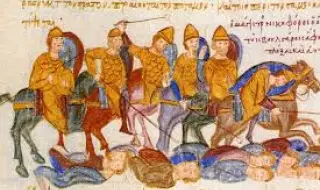
The Battle of Velbuzhd took place on July 28, 1330, in the vicinity of Velbuzhd (day . the city of Kyustendil), between the Bulgarian army led by King Michael III Shishman Asen and the Serbian army led by King Stefan Uros III Dechanski. It ends in defeat for the Bulgarians.
The Serbian kingdom, taking advantage of the feuds in Bulgaria and Byzantium, as well as the incessant clashes between them, managed to conquer part of their territories. Michael III Sishman began preparations for the conquest of Serbia, whose ruler was the former Michael Shurei Stefan Dechanski. For some historians, Mikhail Shishman was the only Bulgarian king (after the death of Ivan Asen II) who tried to stop the “Serbian expansion” and to return its western territories to the borders of Bulgaria, even though they were conquered by Byzantium.
For this purpose, in the spring of 1330, he concluded an anti-Serbian alliance with the Byzantine emperor Andronicus III Palaeologus. According to most assumptions, the ultimate goal was the complete destruction of the Kingdom of Serbia and the division of its lands between Bulgaria and Byzantium. Mikhail Shishman attracted the rulers of Wallachia, Moldavia and the Black Yasi to the coalition.
On June 19, 1330, the Bulgarian troops left Tarnovo, but instead of heading straight for the Serbian border, they passed through Vidin and Sofia. The reason for this unusual detour is usually attributed to Mikhail Shishman's desire to unite his army with that of his brother Belaur, but as his brother arrived after the battle was over, it appears that the Tartar mercenaries of Kara Kishek, son of Chaka, joined in Vidin . The Wallachian Duke Ivanko I Basarab, who is the father-in-law of the hunting despot Ivan Alexander and an ally of the Bulgarian king, also joins Shishman's army.
Andronicus III entered Macedonia, capturing four small fortresses (Debritsa, Dobrun, Gabalarion and Siderokastron) and settled in a camp near Bitola, waiting for the further development of events. From Sofia, the Bulgarian army heads to the Zemen fortress and captures it.
Stefan Dechanski initially waited for his former father-in-law on the Dobrich field at the confluence of the Toplitsa River with the Bulgarian Morava River, and subsequently sent his army along the course of the Morava River and through Staro Nagorichane, where in the church of “St. Georgi“ prayed for peace, settled in a camp in the vicinity of Velbazhd. Most researchers assume that the armies of the two rulers were approximately equal in number. According to Nikifor Grigora, Mikhail Shishman had 12,000 Bulgarians and 3,000 "Scythians" at his disposal. (Tatars, Yasi, Alans and Vlachs).
Stefan Dečanski had 14,000 men at his disposal, who were later joined by 300 (according to Cantakuzin) or 1,000 (according to Grigora) Catalans from the famous Catalan Company (Spanish mercenaries from the region of Catalonia).
Precisely waiting for them, on July 24, Stefan Dechanski offered Mikhail Shishman a one-day truce. The king receives us because there is a lack of provisions for the army. It is established that Belaur does not join his brother, nor does Ivan Alexander. Since the Bulgarian army suffers from a lack of food, on the day of the armistice, it disperses to the surrounding villages to procure it.
Taking advantage of the favorable situation, Serbian crown prince Stefan Dušan broke the truce and attacked the Bulgarian camp. Mikhail Shishman's attempt to organize an effective resistance was unsuccessful. Mikhail Shishman's army was defeated, and the king himself was seriously wounded and died three days later in captivity. He was buried at the request of his nobles in the church of “St. George” in Staro Nagorichane, today in North Macedonia. Michael III Shishman was the last Bulgarian ruler, leading a policy towards the establishment of military and political hegemony of the Kingdom of Tarnovo on the Balkan Peninsula.