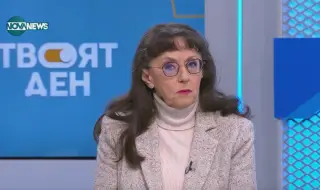
People's representatives should set as their first task the election of members of the SJC. Neli Kutskova, former president of the Union of Judges, called for this on the air of BNR.
"The Supreme Court cannot resign and dissolve because the whole system remains without leadership. I think he will continue to work with all the accusations that he is illegitimate until a new one is elected".
She also noted that she could have waited with the election of the chief prosecutor.
"In any case, Mr. Sarafov is in charge of the prosecution. Possibly to form a new SJC. The Constitutional Court could be asked whether the SJC with an expired mandate has the right to elect the so-called three big ones. The feeling is that something is wrong. Even if it is legal, it does not create a sense of legality.
Kutskova believes that it is necessary to consider changing the SJC.
"It has to go through constitutional changes".
She commented on the selection of the three constitutional judges who will be sworn in on November 12.
These are Dr. Nevin Fetti and Prof. Sasho Penov from the President's quota, as well as Judge Galya Toneva-Dacheva from the Criminal Board of the Supreme Court of Cassation.
"I read their biographies and they are impressive. I hope they turn out to be quality and principled constitutional judges.
The election of a judge from the two supreme courts was quite civilized. The gentleman's agreement, which has been in place for years, when a supreme judge is elected, one time to be from the Supreme Administrative Court, the other time to be from the Supreme Court of Cassation, is observed.
For none of the three candidates from the Supreme Court of Cassation, sinister things such as connections with notaries, dwarfs and other similar criminal structures have been heard. This is good news, albeit a tiny one.
She also analyzes the possibility that the chairman of the Supreme Administrative Court, Georgi Cholakov, will remain in office even after the end of his mandate, which expires in November.
Kutskova recalled a case from 2005 and a decision of the Constitutional Court on a similar situation.
"Does a person elected with a 7-year mandate, which is under the Constitution, have the right, after his mandate has expired, to continue to perform his functions, no longer as an incumbent, but as an acting person? In this constitutional decision, it is said that the exercise of the powers given to him by mandate is inadmissible.
If someone's term has expired, they have substitutes. It is normal for the SJC to appoint one of them as acting until a new incumbent is elected.
Administrative courts control both local and central executive power. They rule on many crucial issues.