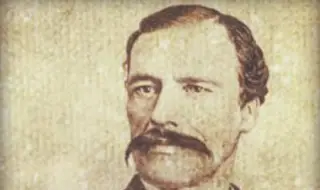
On April 2, 1821, the Bulgarian revolutionary Georgi Rakovski was born. He is recorded in the church registers as Sabi Stoykov Popovich, but is also known as Georgi Sava Rakovski. He is a Bulgarian revolutionary and a revivalist. Rakovski is the founder of the organized national revolutionary struggle for the liberation of Bulgaria, a democrat, publicist, journalist.
In the period 1828-1834, Georgi Rakovski studied at the monastery school in his hometown, where in addition to Bulgarian, he also studied Greek. In 1834, he entered the school in Karlovo, where his teacher was Rayno Popovich. Rakovski left Karlovo in 1836 due to the plague epidemic that was raging at the time.
At the end of 1837, he and his father left for Constantinople, where he continued his education at the elite Greek school in Kuruchushme. There, Georgi Rakovski studied philosophy, eloquence, theology, mathematics, Latin, physics, chemistry, French, Persian, Arabic and other subjects. During his stay in Constantinople, Rakovski became a co-founder of the “Macedonian Society“, which aimed to liberate the Bulgarians from Turkish rule. Under the influence mainly of Neophyte Bozveli, but also of Hilarion Makariopolski and Sava Dobroplodni, Rakovski joined the struggle for church independence.
In the summer of 1841, Georgi Rakovski left Constantinople and went to Braila, where he prepared for a rebellion. There, with the help of friends from Kotel, Rakovski became a teacher of Greek and French. Upon his arrival in the city, Rakovski managed to obtain a Greek passport from the Greek consul in the city and began to act under the name Georgi Makedon. For his participation in the Braila uprising of February 1842, he was sentenced to death by the local authorities, but as a Greek subject he was handed over to the Greek authorities to carry out the sentence. Assisted by the Greek ambassador in Constantinople, Mavrokordatos, Rakovski managed to escape and settled in Marseille, where he spent a year and a half. He established contact with Bulgarians studying in Athens and founded the Macedonian Society and the Slavic-Bulgarian Society of Scholars.
After returning to Kotel, together with his father, Georgi Rakovski participated in the struggle of the local guilds against the chorbadjii. Slandered before the Ottoman authorities as rebels, they were arrested, sentenced to 7 years in prison and taken to Constantinople to serve their sentence. Rakovski spent time in prison from 1845 to 1848.
Upon his release, he continued his revolutionary activities. In 1851-1854 he wrote several texts, preserved in manuscript to this day: “Three Dreams“, “An Innocent Bulgarian“ and “Diary of the Platoon“. After the outbreak of the Crimean War (1853), Rakovski, together with a group of Bulgarians, created the Secret Society in Svishtov, whose task was to collect money for the liberation and information about the Ottoman troops and to pass them on to the Russian military command. The newly created Secret Society adopted the tricolor as the flag of the future Bulgarian Republic — white, green and red. To carry out this task, Rakovski and his comrades acted as translators in the Turkish army. However, their activities were discovered and he was arrested again. However, when he was taken to Constantinople, he managed to escape. The members of the Secret Society continued to collect funds, contributing 20 percent in the form of donations for a community center, and 80% went to armaments. At that time, Svishtov had the status of a free region based on the Treaty of Szigit, concluded on August 4, 1791 between Austria and Turkey, in which only a valide hanum - the mother of the sultan - could rule the city.
In June 1854, Rakovski organized a detachment of twelve people and wandered with it through the Eastern Balkan Mountains. Then he tried to contact the Russian troops, who had crossed south of the Danube River at that time. In the fall, the Russian army withdrew across the Danube and Rakovski disbanded his detachment. For some time he hid in Kotel, where he wrote about his experiences in the Constantinople prison. At that time he also wrote the first edition of his poem "Forest Traveler".
At the end of 1855, Georgi Rakovski settled in Bucharest, where he completed the second edition of the poem "Forest Traveler", but the very next year he moved to Novi Sad, Austria-Hungary, where he published "Predvestnik gorskago patnika". Here he also began editing the newspaper "Bulgarian Diary". He also published the trial issue of the newspaper "Danubian Swan". In 1857, Rakovski began printing the poem "Forest Traveler". In the same year, at the insistence of the Ottoman authorities, he was expelled from Novi Sad and transferred back to Wallachia. He lived for some time in Galați and Iași, where he participated in the preparations for the establishment of the Bolgrad High School, which today bears his name.
On March 7, 1858, Rakovski crossed from Moldova to the Russian Empire, as the Ottoman government exerted strong pressure on the Moldavian prince Nikola Bogoridi, a representative of the prominent Kotel Bogoridi family, to extradite him. After a short stay in Chisinau, at the end of March he arrived in Odessa, where he was received at the home of the prominent Bulgarian merchant Nikola Toshkov. With the assistance of Nikolay Palauzov, he was appointed supervisor of Bulgarian students at the Odessa Seminary, but his radical views caused discontent and at the insistence of Stefan Toshkovich, he was dismissed.
With the assistance of the Odessa Bulgarian Board of Trustees, Rakovski made unsuccessful attempts to start publishing a Bulgarian newspaper in Odessa, and in 1859 he published the ethnographic book "Index or Guide How to Request and Search for the Oldest Traces of Our Life, Language, Generations, Old Government, Glorious Progress, etc.", which he dedicated to Nikola Toshkovich.
In the autumn of 1860, Rakovski moved to the capital of the Serbian Principality - Belgrade, where he continued his historical research. Here, the publication of the newspaper "Danube Swan" began, which dealt with topics of a political, educational and economic nature, but also those related to the church-national struggle, the unity of the Bulgarian people, etc.
At this time, the last significant resettlement of Bulgarians in Ukraine began, initiated by the Russian diplomatic missions and affecting mainly the Vidin, Belogradchik and Lom regions. Rakovski began an energetic campaign against the de-Bulgarization of the region and in 1861 published the brochure "Resettlement in Russia or the Russian Murderous Policy for the Bulgarians", in which he sharply criticized Russian policy. In addition, he maintained a lively correspondence on the issue with public figures, such as Pandeli Kisimov and Krastyo Pishurka, and published in his newspaper "Danube Swan" dozens of articles against the resettlement, as well as correspondence about the difficult conditions in which the settlers were placed in the Russian Empire. As a result of Rakovski's campaign, the refugee wave quickly subsided, in Lom, Russian agents were expelled from Bulgarian villages, and in Vidin, crowds of peasants besieged the Russian consulate, demanding to get their passports back.
In 1861, Rakovski prepared the “Plan for the Liberation of Bulgaria“ and “Statute for a Temporary Bulgarian Administration in Belgrade“. These two works marked a new stage in Rakovski's ideological development. In them, he first came up with the idea of creating a “command center of the struggle”, as well as organizing an army on the territory of the Serbian Principality that would cross into Bulgaria and incite the Bulgarian population to revolt. To lead the uprising, Rakovski envisioned a Provisional Bulgarian Government, which was established in June 1862 in Belgrade under his chairmanship.
It was entrusted with the management of all matters relating to the “general Bulgarian uprising“. In the spirit of these understandings, Rakovski also took up the organization of the revolutionary army, and such an army was established in 1862 in the form of the First Bulgarian Legion in Belgrade. In June 1862, the Legion participated in the fighting with the Turkish garrison of the Belgrade fortress of Kalemegdan. Its disbandment (after the normalization of relations between Serbia and the Ottoman Empire) showed the weak side of Rakovski's plan. Placing the leadership center outside the country, as well as building a revolutionary army on foreign territory, made the national-revolutionary movement dependent on the policies and goals of other countries. At the same time, the tense relations between the Ottoman Empire and the Balkan states gave Rakovski reason to believe that it was possible to build a Balkan union in which the Bulgarian people would also be given a place.
In the spring of 1863, with the consent of the Serbian government, Georgi Rakovski began talks in this direction in Athens and Cetina with prominent public and political figures. After the failure of his mission at the end of 1863, Georgi Rakovski settled again in Bucharest, where he hoped to find better conditions for the implementation of his ideas. There, in March 1864, he began publishing the newspaper “Buduštnost“. After the newspaper was suspended on July 19, 1864, Rakovski published the only issue of the newspaper “Branitel“ in Bulgarian and Romanian with the aim of creating a Bulgarian-Romanian union. At the same time, he managed to complete and publish in 1865 the magazine "Bulgarian Antiquity", which had been prepared in Odessa.
At the end of 1866, Georgi Rakovski formed the “Supreme Bulgarian People's Civil Authority“ in the person of the Secret Central Bulgarian Committee (TCBK). According to Hristo Makedonski, the TCBK was created without the knowledge and approval of Georgi Rakovski. The leadership of the new organization consisted of seven members: a chairman, a vice-chairman and five more members. Its task was to coordinate, organize and send detachments to enslaved Bulgaria, thus putting an end to the indiscriminate transfer of such detachments to Bulgarian lands.
In 1866, Georgi Rakovski again visited the Russian Empire, spent some time in Chisinau, the Cyprian Monastery and Odessa and passed through the Bulgarian colonies in Southern Bessarabia. His goal was to raise money to organize armed detachments, as well as to prepare the participation of Bessarabian Bulgarians in them. He did not achieve much success in finding money, due to the pressure of the Russian police on the Bulgarian community in Odessa.
On January 1, 1867, the new organization issued the “Temporary Law on the People's Forest Troops for the Summer of 1867“, which recorded the organizational principle of the formation of the troops and the rights and obligations of the chetniks themselves. Rakovski firmly believed that with the creation of well-organized troops, it would be possible to raise the people to fight and achieve their liberation.
In the spring of 1867, the troops were transferred to Panayot Hitov and Filip Totyu. On October 9 of the same year, Georgi Rakovski died of tuberculosis.