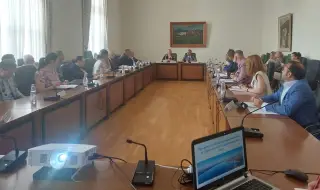
“Next year, the Danube River will be not only a geographical axis, but also a political, economic and cultural line of attention. In the context of the increased efforts for convergence and reduction of economic, social and territorial disparities, Bulgaria has a chance to put important topics for the development of the Danube Region on the agenda - a region of which we are an integral part.“ This was stated by the Minister of Regional Development and Public Works Ivan Ivanov at the opening of the meeting of the National High-Level Group on the Danube Strategy. The Minister pointed out that the Coordination Mechanism, which Bulgaria has built to ensure the effective participation and representation of our country in the Danube Strategy, is an instrument with long-term value and meetings such as today's are not only a working format, but also an opportunity for strategic planning, coordination of visions and strengthening cooperation between institutions. Minister Ivanov thanked the members of the National Coordination Group for the prepared priorities of the upcoming presidency, as well as for the received proposals for events that will be implemented in 2026, which reflect not only the current needs and opportunities of the region, but also Bulgaria's aspiration to be an active and constructive participant in European processes.
In 2026, our country assumes the presidency of the EU Strategy for the Danube Region for the second time. The macro-regional strategy is a cooperation tool that covers over 100 million people or one fifth of the EU's inhabitants.
The National Coordinator of the Danube Strategy for Bulgaria, Vyara Mincheva, presented to the participants in the meeting the motto under which the Bulgarian Presidency will take place: “Connected regions, more cohesion: A stronger Danube for all“. As a main emphasis in the political focus of the presidency, she highlighted the reduction of disparities through increased cohesion and integration with a main emphasis on regional inequalities as a challenge for competitiveness and stability; recognizing the role of cities as a driving force for reducing disparities and achieving progress in social cohesion, skills and cultural connectivity.
The Deputy Minister of Regional Development and Public Works, Dora Yankova, expressed satisfaction with the agreement reached on the political and thematic priorities presented by the participants in the National High-Level Group. He added that this is a sign of institutional unity and commitment, on which the success of the upcoming presidency depends.