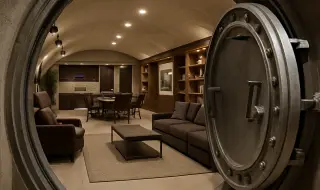
The turbulent times in which the world is living today are leading to a change in a number of habits, even among the richest. If until now they were looking for luxury in the form of yachts, villas in exotic destinations, private jets, then after the pandemic caused by the coronavirus and the wars that we have witnessed in recent years and especially months, the bunker has become one of the most sought-after properties not only among the rich around the world.
In 2025 and in the first months of 2026, the European bunker market no longer looks like an exotic periphery of luxury properties. It is taking shape as a dual market: on the one hand, countries are returning the topic of civil protection to the center of politics; on the other hand, private customers are looking for their own shelters because of the war in Ukraine, and last month in Iran, the growing sense of insecurity and the increasingly frequent talk of “resilience“ and “preparedness“ in the European institutions. The European Commission officially adopted the Preparedness Union Strategy in March 2025, and in July last year it also raised the issue of a “comprehensive European approach to shelter during emergencies“ within the framework of the strategy for stocks and material preparedness. Today, the bunker is no longer just a private product, but part of the broader security architecture.
The change is most clearly visible in Germany. There, in November 2024, ag. Reuters reported that the Interior Ministry was working to expand the network of shelters by converting basements, underground garages and subway stations, as well as through an app that would show the nearest shelter. At the time, Germany had 579 public shelters with a capacity for around 480,000 people. In September 2025, the agency also announced a 10 billion EUR plan for civil protection by 2029, including new shelters, sirens and digital warning systems. This means that in 2025 the market has moved beyond purely commercial logic: state policy is starting to create new demand, standards and infrastructure pressure.
At the other extreme is Switzerland — not as a new market, but as a mature benchmark. The Federal Civil Protection Service says the country has around 9 million places in approximately 370,000 private and public shelters, i.e. coverage of over 100% of the population. The Swiss example is not just a statistic; it is a model for where more and more European countries are looking: not towards single mega-bunkers, but towards a network of dispersed, standardized shelters, often integrated into residential and public buildings.
Finland shows a similar but more pragmatic logic. According to the Finnish Ministry of the Interior, the country has around 50,500 shelters with space for 4.8 million people. What is important here is not only the scale, but the philosophy: under normal conditions these spaces are used as gyms, metro stations, parking lots or warehouses, but they must be able to be made ready within 72 hours. In January 2026, the Finnish government published new guidelines for the maintenance and commissioning of shelters, emphasizing that owners must plan the technical systems, equipment and procedures in advance. This is probably the most important architectural trend in Europe: dual use — the bunker should not sit idle as a dead asset, but should function as part of the everyday urban fabric.
In the private market, Spain has become one of the showcases of the boom. Euronews reported in April 2025 that private bunker construction in the country had increased by 200% in 3 years, with a typical bunker reaching a price of around 150,000 EUR, while luxury models from companies such as VIP Bunker exceed 350,000 EUR. This is a price range that transforms the product from a purely “prepper“ product into a premium segment of residential security. In other words: there is no massification, but there is a visible expansion of solvent demand.
In the second half of 2025, more specific price guidelines also appeared from various European suppliers. In the United Kingdom, Burrowed LTD offers prefabricated “luxury“ bunkers for around 181,000 EUR, and in Germany BunkerBauer advertises a 9.6 sq m shelter for 79,000 EUR. The same article states that in Sweden around 170,000 EUR can provide a 54 sq m bunker for at least six people. These numbers are not equivalent products, so they should not be read as a direct comparison “price per square“, but they outline a real market range: in Europe in 2025, basic private solutions start at tens of thousands of euros, and personalized and more habitable models easily exceed 150,000-350,000 EUR.
Detailed statistics on average property prices in Bulgaria by cities and neighborhoods can be seen at imot.bg