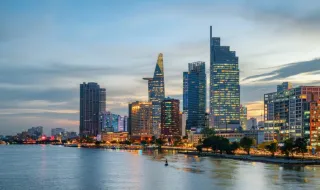
Ho Chi Minh City is preparing a large-scale strategy to expand its maritime economy and strengthen its integration with international trade routes. The plan includes new port facilities, road and rail links, a free trade zone and the development of logistics and financial services.
One of the key projects is the Can Tho international transshipment port, for which investments of over 128 trillion Vietnamese dong are planned. The goal is for its capacity to reach 16.9 million TEUs per year by 2047. The port is to work in coordination with the Cai Mep deep-sea complex – Thi Vai, which already handles large ocean-going container ships.
To make the new port efficient, the city plans to significantly improve transport links with existing ports, Long Thanh Airport, industrial zones and logistics centers in the southeast of the country. Among the most important projects is the Can Tho - Vung Tau seaway, which is over 14 km long and has six lanes. The preliminary cost of the project is over 93 trillion VND.
The construction of the Can Tho bridge is also planned, which should replace the current ferry connection and provide a direct land corridor between the central part of Ho Chi Minh City and the coastal area. The Ben Luc - Long Thanh and Bien Hoa - Vung Tau expressways, as well as the future railway to the port complex, will be of additional importance.
The strategy targets Can Tho and Cai Mep - Thi Vai to function as a single port-logistics cluster. The former is to specialize in international container transhipment, while the latter will continue to serve direct import and export and ocean lines.
The economic impact could be significant. According to Vietnamese experts, better coordination between ports and transport infrastructure could reduce logistics costs for businesses and increase export competitiveness. Currently, logistics costs in Vietnam are estimated at around 16-18% of GDP, which remains high compared to many developed economies.
The plans are not limited to transport infrastructure. Ho Chi Minh City is also preparing a free trade zone around the port complex, which should promote logistics, trade, marine insurance and financial services. Simplified customs procedures and a model in which goods can be stored, packaged, processed and re-exported under more flexible conditions are being discussed.
City authorities expect better connectivity with Long Thanh Airport and industrial zones to increase the interest of foreign investors in sectors such as electronics, mechanical engineering, automotive industry, textiles, warehouse logistics and cold storage facilities.
Detailed statistics on average property prices in Bulgaria by city and neighborhood can be seen at imot.bg