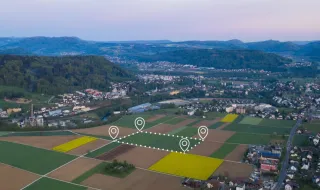
Australia is emerging as one of the most attractive markets for institutional investment in farmland. Big funds see opportunities in the scale of local agriculture, the diversity of crops, the focus on exports and the ability to build a relatively diversified agricultural portfolio through a single market.
This trend is the focus of an analysis by The Weekly Times of the investment strategy of Nuveen Natural Capital, one of the world's largest farmland managers. The company manages agricultural assets worth about $12.1 billion across eight geographic regions and more than 60 crop types.
Big investors are turning to land
The interest in farmland is not just an Australian phenomenon. According to a study by Nuveen among 800 institutional investors, in 2026 46% of participants who invest in alternative assets already have exposure to agricultural land. In 2022, their share was only 15%. The data is from the company's own research and should be viewed in this context.
The reason is that land is increasingly seen as a long-term real asset, capable of generating income from agricultural activity and at the same time preserving capital value. For large pension and investment funds, an additional plus is the relatively low dependence of agricultural assets on movements in traditional financial markets.
However, this does not mean guaranteed profitability. Nuveen itself warns that investments in alternative assets can be illiquid, carry significant risk, and are not suitable for every investor.
What makes Australia so interesting
One of Australia's main advantages is the scale and diversity of agricultural production. Grains, cotton, grapes, nuts, and other perennial crops are grown in different parts of the continent, and livestock farming is also of great importance. This allows large investors to spread their capital across different regions and industries, rather than relying on one crop or one climate zone.
Diversification is especially important in Australia, where droughts, floods, and sudden changes in rainfall can significantly change the results of an agricultural year.
The official forecast of the Australian Bureau of Agricultural and Resource Economics and Sciences, ABARES, shows this dependence. After a record-breaking 2025-2026, the value of agricultural output is expected to fall by 5% in 2026-2027 to A$98.3 billion. Despite the decline, this would be the second highest level on record.
The value of agricultural exports is forecast to fall by 9% to A$74.8 billion, mainly due to weaker volumes for some crops and livestock products.
Climate is both an asset and a risk
Australian agriculture is highly oriented towards international markets, but production remains dependent on natural conditions. A drier seasonal outlook is already influencing farmers’ decisions more than rising fuel and fertilizer prices. For 2026-2027, the value of crop production is expected to fall by 8% to 50.9 billion Australian dollars.
That's why institutional investors don't look at agricultural land simply as a large area purchase. What matters is the availability of water, soil quality, infrastructure, access to markets and the ability to grow different crops.
Water rights are particularly important in Australia. They may constitute a separate asset, and foreign investors are required to register the acquired water rights and water use rights in the official foreign property register.
Foreign investors are under scrutiny
Australia welcomes foreign capital, but agricultural land falls under a special regulatory regime.
As a general rule, a foreign investor must notify the Australian government when the total value of the planned purchase and the agricultural land already owned exceeds A$15 million. Different thresholds may apply to investors from certain countries with free trade agreements.
For foreign state investors, the threshold is zero, meaning that their investments are subject to notification regardless of the value. Agricultural land transactions must also be registered with the Register of Foreign Ownership of Australian Assets.
Agricultural land becomes an institutional asset
Nuveen’s scale shows how seriously big capital is now taking this segment. The entire Nuveen Natural Capital platform manages about $14 billion in assets, including farmland, forests and investments related to the restoration of natural capital. The portfolio covers about 2.6 million acres and over 580 properties in 11 countries.
Australia is part of this global strategy, but interest in the country must be considered along with the risks. Drought, water resources, commodity prices, production costs and foreign ownership regulations can significantly change returns.
However, the fundamental reason for interest remains simple: arable land is a limited resource, while global food demand remains resilient. It is the combination of large-scale production, exports and the opportunity for diversification that makes Australia one of the key markets monitored by major international investors.
Detailed statistics on average property prices in Bulgaria by city and neighborhood can be seen at imot.bg