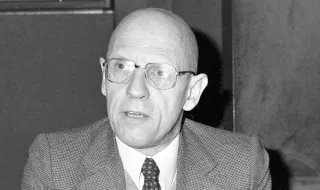
Imagine a prison in which no one knows when they are being watched, but everyone behaves as if they are constantly being watched. It is this model of the Panopticon, conceived by Jeremy Bentham, that makes Michel Foucault one of the most recognizable thinkers of the 20th century. In his book “Discipline and Punish“ he not only tells the history of prisons, but also shows how discipline penetrates the school, the barracks, the factory and the hospital.
Foucault was born on October 15, 1926 in Poitiers. His father was a surgeon and expected his son to take the medical path, but the young Paul-Michel chose philosophy and psychology. He studied at the Ecole Normale Supérieure in Paris, where he received an agrégation in philosophy in 1951. Years of work and teaching followed in Sweden, Poland, Germany, Tunisia and France.
From Madness to the Medical Gaze
Foucault's first major book was “History of Madness in the Classical Age“, published in 1961. In it, he traces how different societies define what is sane, what is abnormal and who should be isolated. Two years later, “The Birth of the Clinic“ was published, dedicated to the change in the way medicine sees the human body and illness.
He is widely known for “Words and Things“ from 1966. The book explores how the conditions under which a given era accepts something as knowledge change. Three years later, “Archaeology of Knowledge“ developed his method for analyzing discourses, that is, the rules and practices that determine what can be said and accepted as true.
Power is not only in the state
In 1970, Foucault was elected professor at the Collège de France, where he taught until his death. In his lectures and books, he viewed power not as something possessed solely by the state or the ruler. According to his approach, power is distributed in a multitude of relations and institutions, and knowledge often participates in its construction.
“Where there is power, there is resistance.“This short formula from “History of Sexuality“ summarizes one of his most famous ideas. For Foucault, power does not only produce prohibitions. It creates categories, norms, and ways in which people understand themselves. In the first volume of “History of Sexuality,” published in 1976, he challenged the notion that modern society has simply been silent about sex. He argued that it has both increasingly spoken about sexuality and organized it through medicine, education, law, and administration.
A philosopher who remains in the present
Foucault is not just a desk writer. In 1971, he co-founded the Groupe de l’Information sur la Prison (Groupe de la Information sur la Prison) with the historians Pierre Vidal-Naquet and Jean-Marie Domenac. The organization collects testimonies from prisoners and questions the way institutions talk about punishment and order.
His latest books turn to antiquity and to the question of how one shapes one’s own life through practices of self-discipline and self-care. The volumes "The Use of Pleasures" and "The Care of the Self" were published in 1984, shortly before his death on June 25 in Paris.
One hundred years after his birth, the Collège de France is dedicating an exhibition and a series of lectures to Foucault. The exhibition "Foucault: An Intellectual Adventure at the Collège de France", organized with the National Library of France, is scheduled from September 30, 2026 to January 15, 2027.
This attention is not only for the anniversary. The questions that Foucault asks about surveillance, the norm, medicine, the prison, sexuality, and the production of truth continue to describe a world in which power often operates not through command, but through rules, measurements, and invisible expectations.
Sources: lemonde.fr, radiofrance.fr