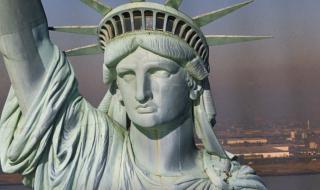
On June 19, 1885, the Statue of Liberty arrived in New York as a gift from the French people.
It was transported to America in 350 pieces, assembled on site, and in October 1886 it was officially inaugurated by President Grover Cleveland.
It aims to perpetuate the friendship between France and the United States, as well as to celebrate the centennial anniversary of the young American state.
The statue is 46 m high, and together with the pedestal - 93 m.
It was designed by Frédéric Auguste Bartholdi, and its internal structure was designed by Gustave Eiffel. The statue copies the model of the classical sculptures from the Roman period of the goddess Libertas.
In her raised right hand, the woman holds a torch, to which the American flag has been added. In her left hand is the Declaration of Independence, proclaimed on July 4, 1776. At the bottom, at the feet of the Statue of Liberty, are the broken chains of slavery.
A little-known fact is that before sailing for the United States, the Statue of Liberty was to be placed on the Suez Canal.
Frédéric Bartholdi himself was tempted by the Middle East and the examples of Greco-Roman sculpture found there. In 1869, the Egyptian government expressed interest in designing a lighthouse for the Suez Canal. Impatient and excited, Bartholdi designed a colossal statue of a veiled woman holding a torch, which he called Egypt (or Progress), which brings light to Asia. However, when he attended the opening of the canal, Bartholdi was informed that he would not be able to continue his work on the lighthouse.
Thus, inspiration found a mooring on Liberty Island in the United States.
There is a duplicate of the Statue of Liberty in Paris, in fact there are two. One of them is located in the Luxembourg Gardens. The information panel on the pedestal says that this bronze model by Bartholdi is part of the preparatory work for the statue sent to New York. The date inscribed on the statue is November 15, 1889 - the date of its dedication. The other duplicate is located on the Île Saint-Louis or the Isle of Swans in the Seine River. The statue looks out over the Atlantic Ocean and its "bigger" sister, located in New York Harbor. There are two dates inscribed on it - July 14 - the storming of the Bastille and July 4 - the day of the United States' independence.