On November 3, 1903, Panama declared independence from Colombia following an uprising supported by the United States. The new republic emerged at a time when Washington was seeking control over the future route of an interoceanic canal across the Isthmus of Panama.
Until then, Panama had been a department of Colombia. In January 1903, the United States and Colombia signed the Hay–Herrán Treaty, which was intended to grant Washington the right to build a canal. However, the Colombian Congress rejected the agreement, considering it unfavorable and detrimental to national sovereignty.
On November 3, Panamanian rebels took control of key locations, and a provisional government junta was established. American warships arrived off Panama City and Colón. According to the United States Department of State, this effectively prevented Colombia from sending enough troops to suppress the uprising. Colombian forces also faced serious difficulties moving through the jungles of the Darién Isthmus.
Recognition in exchange for canal rights
The United States recognized Panama’s independence on November 6, 1903, just three days after it was declared. Diplomatic relations were established on November 13, and on November 18, U.S. Secretary of State John Hay and Philippe Bunau-Varilla signed the Hay–Bunau-Varilla Treaty. Bunau-Varilla was a French engineer associated with the previous unsuccessful attempt to build a canal across the isthmus, and he became the diplomatic representative of the new Panamanian state in Washington.
Under the treaty, Panama granted the United States rights over a 10-mile-wide zone necessary for the construction, operation, and protection of the canal. In return, Panama received $10 million and an annual payment of $250,000, which was initially scheduled to begin nine years after the treaty’s ratification. The United States also undertook to guarantee Panama’s independence.
Washington’s role remained controversial from the very beginning. Later, President Theodore Roosevelt defended his actions by saying: „I took the isthmus, started the canal, and left Congress to debate not the canal but me.“ The phrase openly sums up the American approach: the political change in Panama was used to remove the obstacle standing in the way of the United States’ strategic project.
The canal changes the meaning of independence
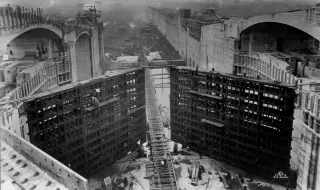
Construction of the Panama Canal began in 1904, and the waterway opened in 1914. For decades, the United States administered the zone surrounding it. In 1977, Washington and Panama signed the Torrijos–Carter Treaties, which provided for the gradual transfer of control. On December 31, 1999, Panama assumed full responsibility for the canal’s administration and operation.
Thus, the event of November 3, 1903, was not merely an act of separation from Colombia. It marked the beginning of a state whose independence was linked from the outset to one of the most important transportation projects in world history.
Sources: history.com, apnews.com, pbs.org