Comment by Emilia Milcheva:
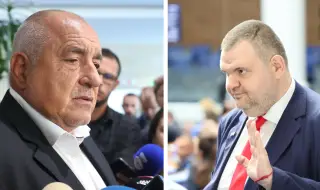
A heretical question, unthinkable until years ago, is circulating today in parties and studios: who is the real strong man in power - Boyko Borisov or Delyan Peevski? The dilemma stings the ego of the GERB leader and shakes the perception of his power, because it seems that the chairman of the "new beginning" in the MRF is in a stronger position.
Borisov himself seems to confirm the difficult and subordinate position of GERB with the words that he has rented out his party "so that there is stability". But only 9 months ago, when the negotiations for a government were underway, he said the opposite: “Since I don’t have enough support, I won’t rent the party to myself.” Today, Borisov and GERB have both support and dependence - and these visible results are the price of power.
Similar subordination existed in the governments headed by Borisov, but since Peevski was behind the scenes at the time, the GERB leader seemed like the man behind the wheel of power. The appointments linked to Peevski, for example, of Emil Karanikolov, former head of the Privatization Agency and Minister of Economy in Borisov’s third cabinet, did not acknowledge such connections. Karanikolov himself was listed as an “Attack” quota member.
And now no one admits that he is on Peevski’s team. Regardless of his new role as party leader, governing partner and politician, who gives orders every morning on how to run the country. Is this because of formal hygiene for “clean hands” or concerns about toxicity that would harm public masks?
Borrowed power
The oligarch, whose business dominance and growth in politics occurred through networks of influence and a launch pad - NMSV and Saxe-Coburg-Gotha, DPS and Ahmed Dogan, continues the same tactic. Kept isolated from the political scene for a long time, today he appears on its illuminated part and it seems that he likes it more than behind the scenes.
The mythology of his power is nurtured in the same way as that of the skillful strategist Ahmed Dogan. Even the mouthpieces reproducing the greatness of one, and subsequently of the other, are the same. Dogan helped redistribute state assets in the transition, Peevski expanded and strengthened the spheres of influence that protect the interests of the new oligarchic capital.
But left without a party and support, the honorary chairman of the MRF ingloriously collapsed along with his tower.
The person sanctioned under the “Magnitsky” for significant corruption is strong when he is a partner in power. On his own, he cannot form a majority - no one imagines that the MRF-New Beginning can negotiate to form a government. Nor to govern the state - he needs GERB or another party/parties to turn his economic resources and influence in the prosecutor's office and services into visible influence on the state.
In this sense, the PP-DB idea of a “sanitary cordon” was a way to limit Peevski's influence, although it did not eliminate the networks of influence he controlled. But the PP-DB launched it only after the collapse of the "assembly" in which they governed together with GERB-SDF and the support of the MRF.
Today, Peevski is already in the role of a systemic politician who seems indispensable in the calculations for a majority and the longer this continues, the more difficult it will be to go back. Instead of isolation, the chairman of the MRF-New Beginning enjoys media presence, and his brutality and frantic pursuit of recognition of his authority is becoming part of the "new normal", against which few protest. The rest of society is apathetic - or aggressive and ruthless, which is why these shocking political norms seem to it to be the order of things.
International partners are watching the situation with attention. Stability is paid too dearly with concentration of influence, erosion of institutions and the overall decline of democracy. If geopolitical tensions intensify, the government cannot be dependent on Peevski's party and its "strategic" decisions. What matters to the EU and NATO is a clear pro-European orientation, not a government that relies on shadowy mechanisms of power.
Who is more dependent on whom?
Is Boyko Borisov able to free himself from Peevski's support - or is he afraid of compromising material, revenge, loss of a working status quo. If he loses his political backing, Peevski will not hide behind the curtains. On the contrary, he would use all his resources to find a new one and punish the one who "betrayed" him.
Peevski dictates how the government should act not only domestically, but also in foreign policy, which is beyond common sense. A few months ago, he insisted that Prime Minister Rosen Zhelyazkov not participate in the meeting in Paris dedicated to supporting Ukraine and ensuring the security of the country attacked by Russia. Because “the prime minister should be here and doing his job, not dealing with other countries”. Zhelyazkov left for Paris, but did not dare to remind Peevski that foreign policy is the job of the executive branch.
At the same time, Borisov is earning certain dividends, as he seems gentle and wise against the backdrop of Peevski's excesses.
The leader of the DPS-New Beginning will continue to test the limits of what is permitted. “I talk to the ministers every day, I put to them the topics that the people in the country put to me”, he said recently. The “umbrella” that GERB and the rest of the government have stretched over Peevski is already a parody of politics. And none of the participants feel ashamed before the voters.
It got to the point that GERB municipal councilors Anton Hekimyan and Vanya Tagareva turned a meeting of the Sofia Municipality Security and Public Order Commission into a defense plea for Peevski’s actions on September 18. Then, prevented by PP deputies from driving to the parliament’s official parking lot, he walked to its entrance in a specially cordoned off perimeter by the security forces and escorted by guards.
The commission was convened by Tagareva, who is its chairwoman, with the motive of riots in the center of Sofia and blockades, attributed to “We Continue the Change”. The riots turned out to be phantom. She received the signals through social networks, but was not obliged to inform the members of the committee about them.
However, the advisor testified about Peevski: “I saw this MP on the sidewalk, walking among the people.” With such conviction, she can claim that he walks on water.
Borisov paternally edifies, while GERB is placed at the service of Peevski. The party did not make such efforts for the former Second Tsvetan Tsvetanov, whom Borisov ruthlessly threw out of GERB (the intervention of the DPS is still suspected). Because of these dependencies, in addition to the PP-DB, the smallest parliamentary force “Majesty” openly mocks the largest - GERB.
“I will let them climb on my back until we enter the eurozone, then you will see what my reaction will be”, Boyko Borisov said nearly six months ago.
Let's see.