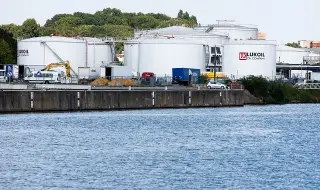
The deal for "Lukoil" is not an ordinary sale, but a test of whether Bulgaria will protect its national or foreign interests. It would be good if the government defined what the national interest is. We are all aware of the private ones.
The Bulgarian state will have the right to veto a deal with a private company for at least 1 billion dollars, and not just any company, but the largest private Russian oil company "Lukoil". The legislative proposal in the Investment Promotion Act, submitted after the end of working hours on Tuesday, passed quickly through two parliamentary committees and received approval in less than 24 hours. At the first reading today, 114 deputies from the ruling majority in the 51st National Assembly voted for it. Its final adoption will be next week, as the deadline for proposals between the two readings was shortened to 3 days.
Why did this rapid change happen?
Anticipating a deal for the Burgas refinery, owned by "Lukoil" since 1999, the authorities decided to put a filter on the candidate buyer. Deputies from the ruling coalition - GERB-SDF, DPS-New Beginning, BSP and "There is Such a People" (ITN), prepared the project, and one of them - Delyan Dobrev, explained the rush with a sense of a deal.
"Imagine that there is an immediate danger of concluding such a deal in the coming days, that would explain the urgency", said yesterday the former GERB Minister of Energy. A little over 2 months ago, the Russian ambassador Eleonora Mitrofanova also hinted at an upcoming deal, motivating it with pressure on "Lukoil" in Bulgaria.
The change proposed by the deputies obliges counterintelligence "to conduct a preliminary investigation and provide a written opinion on dispositional transactions with companies or parts of them, as well as with assets located on the territory of the Republic of Bulgaria, controlled by Lukoil OAO, Russia". If such transactions are carried out without the approval of the National Security Agency and the Council of Ministers, they will be considered null and void.
The leader of GERB Boyko Borisov defined the option of checking the buyer as "absolute insurance" for Bulgaria, a kind of prevention against high fuel prices. But he did not explain how this would prevent it. And in the plenary hall there was not a word about the dominant position of "Lukoil" on the wholesale fuel market, nor on how to improve competition.
Bulgarian screening
A screening regime for foreign investments is already in place in Bulgaria, introduced with a bill proposed in June 2023 by the MRF in the person of the then chairman Mustafa Karaday and Delyan Peevski, who was sanctioned for corruption under the "Magnitsky" case. They submitted a proposal for prior verification and approval of investments, as established by EU Regulation 2019/452 and is in force in 18 of the member states. The MRF's arguments at the time were that the goal was "to protect the economy from corrosive Russian capital" and in general, investments that could harm national security or public order in Bulgaria - and in a broader sense, the security of European and Euro-Atlantic partners. Screening of investors in "activities related to oil and oil products" is mandatory.
This year, the Interdepartmental Council to the Council of Ministers was also established, without which the law could not work, and its chairman is Deputy Prime Minister Tomislav Donchev. Its 17-member composition includes most ministries, as well as the National Security Agency and intelligence.
The urgency of the legislative change can be explained by an upcoming deal, about which the government probably has information. After all, the state owns a "golden share" in the refinery, and the law also obliges candidate investors who are subject to screening to first submit an application to the Bulgarian Investment Agency, which notifies the Interdepartmental Council for the Screening of Foreign Direct Investments. The Council, in turn, is in contact with the European Commission for its opinion.
The assessment is in the hands of the National Security Agency
The quickly approved legislative change, however, concentrates the main judgment in the hands of the State Agency for "National Security", and not the Interdepartmental Council. SANS is headed by Acting Director Denyo Denev, considered a favorite of Peevski. After President Rumen Radev refused to issue a decree appointing him to the position, the ruling majority quickly changed the law and took away his authority. SANS prevented the implementation of Emilian Gebrev's gunpowder factory in 2024, changing its positive opinion to a negative one. But in 2018, when Ginka Varbakova with the company "Inercom" was a candidate buyer of CEZ - the largest electricity distribution company in Bulgaria, not counterintelligence, but a Czech newspaper reported that almost half of the money for the deal was provided by loans related to offshore companies. SANS did not intervene in the BTC deal in 2016, finalized with a loan from the Russian state-owned Vneshtorgbank (VTB), known as "Putin's bank", and one of the shareholders in the bankrupt Corpbank.
Now, however, the authorities are apparently determined to influence the still unknown public decision of "Lukoil" on the chosen buyer. Three candidates have been put forward for the refinery - an Azerbaijani-Turkish consortium between SOCAR and Cengiz Holding, as well as ΜΟL (Hungary) and KazMunayGas (Kazakhstan). SOCAR supplies nearly 2 billion cubic meters of gas to Bulgaria under a 25-year contract, and Azerbaijan is a key EU partner for diversifying supplies of energy raw materials that do not come from Russia. (Some analysts point to the fact that the president of "Lukoil" Vagit Alekperov is of Azerbaijani origin).
The German experience
A measure to protect the national interest is for the state to check in advance which investor is buying a strategic asset (in energy, telecommunications, ports, etc.). In developed democracies, mechanisms operate under which institutions can set additional conditions or prohibit transactions if they are deemed to threaten national security and public order. In Germany, for example, every foreign investment, especially when it comes from a country outside the EU, undergoes strict control. If a foreign investor buys at least 10-25% of the voting shares in a German company, the Ministry of Economic Affairs and Energy (BMWK) can require notification and stop the transaction until it has carried out an inspection. In sensitive sectors such as the arms industry, IT security or critical infrastructure, notification is mandatory, and the threshold is only 10%.
The process has two phases: an initial review (up to 2 months) and an in-depth analysis (up to several months if necessary). At the end of the procedure, the state can approve the deal, impose conditions or completely prohibit it. In this way, Germany protects its strategic industries without stopping the flow of investment. For example, the German government has blocked several deals, mainly with Chinese companies. These include the sale of the gas turbine business of MAN Energy Solutions (part of Volkswagen) to CSIC Longjiang GH Gas Turbine Co., as the turbine technology may have applications in defense. In 2022, the acquisition of the Elmos chip factory in Dortmund by Silex Microsystems (a Swedish company owned by the Chinese Sai Microelectronics) was also stopped due to concerns that the technology and production capacity could be strategically important. The deal for another chip factory, ERS Electronic, was also terminated. Five years ago, the German government banned the sale of IMST GmbH, a company specializing in satellite and radar communication, to a Chinese company due to security concerns.
Political reactions
Despite criticism from both wings of the opposition - PP-DB and "Vazrazhdane", the bill is about to be adopted. PP-DB attacked it with the argument that it was being done because of Peevski, while "Vazrazhdane", in addition to lobbying, also disputed the lack of criteria for approving or rejecting the deal. "Since the main "D" is not in the deal and controls SANS, this change is being introduced so that this deal can be concluded with his permission. Without his permission, this deal cannot be concluded,” said the co-chairman of "Yes, Bulgaria" (DB) Ivaylo Mirchev. According to Radoslav Ribarski (PP), the refinery is being placed under political control. "You are giving the right to SANS to be above the government of Bulgaria", Krasimir Manov (MECH) addressed the ruling party.
Peevski's deputies have bet on Euro-Atlanticism. "The buyer must be from a country that is our ally and is part of NATO, and not serve the interests of Russia. The current screening does not guarantee a refusal when there is a hidden buyer, and legal changes are required", motivated Yordan Tsonev (DPS-NN). Stanislav Anastasov (DPS-NN) told how during the time of Prime Minister Nikolay Denkov, PP-DB tried to sell "Lukoil". "They dragged in all sorts of investment intermediaries. How are they looking for a buyer on behalf of the Russian company "Lukoil"?!”.
Will Bulgaria protect its national interest?
The deal for the largest refinery in the Balkans is not a simple sale of a business, but a strategic test of whether Bulgaria will protect its national or foreign interests. The European Commission with its Directorate General for Competition will also have a say.
In fact, it would be useful for someone in power to define what the national interest is in the deal for the refinery. We are all aware of the private ones.
This comment expresses the personal opinion of the author and may not coincide with the positions of the Bulgarian editorial office and the State Gazette as a whole.