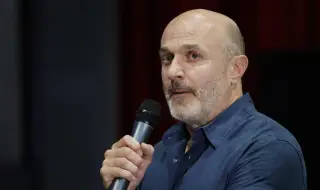
Author: Alexander Detev
DV: bTV has parted ways with Veneta Raykova. How do you comment on this news?
Georgi Toshev: I am glad that bTV - the media outlet where I spent over 20 years, made the right decision for the show "Before Lunch". Viewers deserve good content, presented by people they trust.
DV: Currently, major television stations are flooded with reality formats of questionable quality, to say the least. Why is the level like this?
Georgi Toshev: Bulgarian television stations are stagnating. They do not offer alternatives, but are afraid to miss out on the little advertising that is left. 12 years ago, a major BBC producer was in Bulgaria and wanted to get acquainted with the television market. At that time, we analyzed a wider range of media and I was very interested when he said that very soon there would be two major television stations in Bulgaria. I did not think that this day would come in Bulgaria, but it is becoming more and more tangible. If some have a competitive reality show, others do the same, only abroad. Even in reality formats, there is very rarely an alternative. And it leads to oversaturation.
DV: And a drop in the level. In prime time, we have been hearing sexist and racist statements lately, which would be absolutely unacceptable in major media with Western pretensions.
Georgi Toshev: There is no body in Bulgaria that would monitor - and when necessary, sanction - the lack of socially acceptable language. The role of the media is to inform and entertain us, but also to educate us. This does not mean that we learn math lessons on the air, but in the time of fake news and overinformation, there should be formats and channels that help us learn things that make our lives more comfortable and more aware. The state has not created a body that can regulate this content based on standards. We have a formal body - the CEM, which cannot do anything, even if the best specialists work there. When I left bTV because of my disagreement with the change in the content of a program that I created - "Before Lunch", the television did not react. It chose the other side in this debate.
DV: What was this debate about?
Georgi Toshev: It's very simple. The debate is not between Georgi Toshev and Veneta Raykova. I didn't know this woman who has been in this business for 30 years, although I know who she is. She had the chance, working with me and my team, to rise to another level as a TV presenter. She worked in a format that was successful back then, but times are different today. She had the chance, if she knew the standards of modern television well, to develop as a different type of presenter with different standards in this time zone.
DV: Are these standards still in place today?
Georgi Toshev: No, they don't exist. Television standards depend on the company, especially in private television stations. Although they must also meet certain standards by law - for example, they must offer cultural content. "Cultural content" is not two-minute content broadcast in a socio-political polythematic morning block. No, cultural content is having at least three programs that are entirely culturally and educationally oriented. If in the past, television stations were careful about this - I'm talking about bTV then - over the years, formats like "The Other Bulgaria" have disappeared. Only BNT today allows itself to invest in documentaries. In shows like "Who Knows" and "Get Rich" there is undoubtedly an educational element, but this is not enough.
Who watches television? Nobody analyzes. Last year, "Before Lunch" had a rather controversial format that started after Desi Stoyanova quit for her own reasons. We started with people who had never worked in television. My attempts to have this analyzed on television, because this is not only important for Georgi Toshev and the team of "Before Lunch", but also for television, never received a response.
DV: What is this due to?
Georgi Toshev: Irresponsibility. Not answering emails in a corporation, I work with many world televisions after all, it doesn't happen - even the most insignificant productions are analyzed. We're talking about squares here - television programs have long had no strategy, as it used to be in bTV. "We will launch new formats in Bulgarian series" - then "Glass House", "The Family", "Revolution Z" appeared. This created standards. And suddenly it disappeared, and television is not made by visionaries - it is made to fill something. I ask a program director if he saw a presenter summon the spirit of a singer's dead mother on air. He answers me: "I don't watch it". When the program director doesn't watch the production, we have a problem.
DV: We have a problem with standards and not only that. I will pay attention to journalism and more specifically - to the news. Bulgarian news portrays Bulgaria as a soulless island. Almost all the news is everyday, simple, closed within the borders of the country. Is this purposeful?
Georgi Toshev: I cannot speak conspiratorially and say that it is about a secret plan. I think that is the level. I will give an example: bTV has one of the best international reporters - Desislava Mincheva-Raul. She covers the standards of France, which is far ahead in terms of media. If I were doing news, she would be present every other day, because she has something to tell me about Europe and the European Union with those reports that really explain to me what will happen to us, to the euro. Reports that are needed so that there are no pathologies on the street from people who do not know what will happen.
The lack of production necessity for the content to put Bulgaria on the world map is a problem. Sensitivity and awareness are needed to understand how the processes in Europe and the world affect the processes in Bulgaria. We cannot look at disasters and floods as extreme events, these things happen. We must look at processes such as radicalization and the growth of far-right forces, for example, as a common problem. This process is very important and reaches Bulgaria.
DV: "That's the level." But then the people who can do more find themselves expelled either from the profession or from the big television stations.
Georgi Toshev: We recently spoke with colleagues in Prague about this topic. The situation will change. The ownership of bTV will be changed very soon. It is clear that you have to feed, it is clear that the offers and options are not many. But in the media business, processes are observed in which other people come in. They gradually begin to change the face of the media. Bulgaria is at the end of the ranks - it neither has large revenues, nor is it that important to them strategically, but sooner or later the generations change.
The dependencies of the Bulgarian media are either at a high level or in the middle echelon. They are, for example, who gets a format. It is no secret that there are "returners" in Bulgarian television. No one has forced me to give back, but I know from colleagues what the ways are - I give you a budget, you return part of it in an elegant way. This probably happens everywhere in the world, but it is practice here.
DV: Are there ethical norms?
Georgi Toshev: There should be. There are such in France and Sweden. The narrowing of the market in Bulgaria is related to dependencies. If you are a competitive player, then everyone is playing against you - the youngest, the most unknown, the most established and the most experienced. Every good television manager will take both the experienced and one younger person, because tomorrow he will be loyal to him. Bulgarian media works piecemeal - let's make this season work, and then we'll see. If you know what the policy of television is - family profile, public profile, journalism at the expense of entertainment - then you know what kind of television you will be. At the moment, the profiles are blurred.
DV: Why are there no evening shows, why is there no political satire?
Georgi Toshev: I was engaged to look for a replacement for Slavi Trifonov before Nikolaos Tsitiridis was elected. I did the casting, then I was elegantly removed. I said that there should be a figure there who is highly conflicted politically. I am proud and very grateful that my friend Milen Tsvetkov, who had difficulty going to castings, showed up. I convinced him, he came. But I think they were scared by his biography. Immediately, people in Bulgaria tried to suggest to those on whom the choice of presenter depended that his biography would create problems for television, and they most often say about such people: "He is uncontrollable". But unlike Ms. Raykova, he was uncontrollable in line with his journalistic standards. Milen Tsvetkov knew what he was talking about and knew how to provoke, but he did not cross the line. This is an increasingly rare occurrence. The big problem of Bulgarian journalism is self-censorship. I know exceptional colleagues who say: "Why now? This will only create problems for me". And these are people who have had problems.
DV: And their moral compass has broken.
Georgi Toshev: It breaks when they kick your ass. First, second time.
DV: Are you optimistic about Bulgarian journalism then?
Georgi Toshev: There is still journalism in Bulgaria - what you do at DV, what colleagues do in alternative forms on YouTube, there are journalists in the mainstream media - "24 Chasa", "Kapital", "Dnevnik", "Mediapool", "Offnews" - I can't say that everything is broken. I discover texts, I discover new names of colleagues who are interesting to me with the positions they take and the way they develop topics. An exceptional actress who is not a journalist, Elena Telbis does something in "Toest" that is incomparable. I really wanted to have Mimi Shishkova as the host, but we got separated.
DV: The audience obviously wants these people because they are very successful on social networks, but the national media do not give them airtime.
Georgi Toshev: If I were (and sooner or later I will be) the head of a major television station, I would first look for those who are viral in order to bring the audience back to the television stations. They need this because they have sunk into conformism and comfort.
A scandalous journalist will not ask how much your shoes cost, a scandalous journalist can provoke a public debate. The public debate right now is whether children should be taught religion or something else, so that they can be empathetic, not fight in front of discos, not drag one girl by the hair of another. Before religion, which is a personal experience, is the question of how to make our children good people.
DV: As a person who cares about language and is involved in culture: aren't you bothered by the level of political and media debate?
Georgi Toshev: For me, the biggest problem is how we speak and how we listen. The media should be the public regulator of language. As a teacher, I would give public speaking an average of 3. The tone, of course, is set by politicians, but it is also set by journalists. In the good years of "Before Lunch", good Bulgarian was spoken and we respected our guests. This is the minimum. When they tell me: "They hate you here, doesn't it offend you?", it is very important to me how they wrote it. Because when it's not in the language that I consider normal, they can't offend me.
How have I worked at bTV for 25 years? There are many decent people working at bTV, I have very good colleagues - Zlatomir, Maria Tsantsarova and many others - these are serious colleagues. They make extraordinary efforts to comply with certain standards. The question is how you use these journalists and their potential - from Georgi Milkov to Konstantin Valkov to Georgi Donkov - they and their production skills remain on the periphery. I in "Before Lunch" I gathered a team of seemingly incompatible people - political journalists like Desi Stoyanova, Diana Alexieva, Yana Doneva, Tsveta McGregor, Simona Milkova - different people and exceptional journalists, in order to unite around one standard of journalism.
DV: What's next for Georgi Toshev?
Georgi Toshev: I'm going on a mission with "Greenpeace", which I'll tell you about later, because it's extremely interesting. I'm leaving for two universities in Japan - in Kyoto and Osaka, where I'll give a lecture on the Four Gospels and show one of my films. I'll film an exceptional professor who teaches Bulgarian language, history and literature there. After November 5th, I'll think about how and where to return to the media. However, there is also something very sad that happened to me: I was the most searched name on Google not because of a book about Nevena Kokanova or a film about Sylvie Vartan, but because of a scandal with Veneta Raykova. And Veneta Raykova also raised my price. This is symptomatic of the level of Bulgarian journalism.