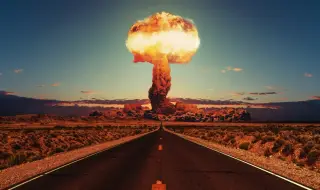
President Donald Trump's comments today, in which he hinted that the US would resume its nuclear weapons tests, overturn decades of US policy on atomic bombs. But they came as Washington's rivals conduct their own nuclear tests and increase their arsenals, writes BTA, citing AP.
Nuclear weapons policy, once considered a relic of the Cold War, is increasingly coming to the fore after Russia repeatedly made nuclear threats to both the US and Europe during the war in Ukraine. In addition, Moscow this week admitted to testing a nuclear-powered missile called the "Burevestnik", which can carry nuclear warheads. In NATO codification, this missile is called "Skyfall".
China is building more silos for ground-based nuclear missiles. Meanwhile, North Korea has just announced plans to test a new intercontinental ballistic missile, part of its arsenal, capable of carrying nuclear warheads and possibly reaching the continental United States.
The threat is also beginning to be reflected in popular culture, the most recent example of which is the new film by director Kathryn Bigelow "House of Dynamite".
But what does Trump's statement mean, and how will it affect the current nuclear tensions? Here's what you need to know on the subject.
The US president posted his comments on the social network "Truth Social" just before his meeting with Chinese leader Xi Jinping. In his post, Trump noted that other countries were conducting nuclear tests and added: "I have instructed the Department of War to begin testing Nuclear Weapons on an equal footing. This process will begin immediately".
The president's post raised some immediate questions. The US nuclear arsenal is maintained not by the Department of Defense, but by the US Department of Energy and a semi-autonomous agency within it, the National Nuclear Security Administration.
The Department of Energy has overseen nuclear weapons testing since its inception in 1977. Before that, testing was conducted not by the Department of Defense, but by two other agencies.
Trump also said that the US "has more nuclear weapons than any other country."
According to the Washington-based Arms Control Association, Russia has 5,580 nuclear warheads, while the US has 5,225. The two countries have nearly 90% of all nuclear warheads in the world.
Since the detonation of the nuclear bomb "Trinity" Between 1945 and 1992, the United States tested 1,030 atomic bombs, the most of any country. This number does not include the two atomic bombs that America used against Japan in Hiroshima and Nagasaki at the end of World War II.
The first American nuclear tests were carried out in the atmosphere, but later they began to be carried out underground to limit the fallout of radioactive particles. Scientists began to call these tests "shots". The last such "shot", codenamed "Divider" as part of Operation "Julin", took place on September 23, 1992 at the Nevada National Security Site - a huge test site located about 105 km from Las Vegas.
America suspended its tests for two reasons. The first was the collapse of the Soviet Union and the end of the Cold War. In addition, in 1996 the United States signed the Comprehensive Nuclear-Test-Ban Treaty. However, nuclear tests were conducted even after the treaty was signed by the world's newest nuclear powers - India, North Korea and Pakistan. The United Kingdom and France also have nuclear weapons, and Israel has long been suspected of possessing atomic bombs.
But more generally, the United States also has decades of test data. This allows them to use computer modeling and other techniques to determine whether a weapon will be successfully detonated.
Every president since Barack Obama has supported plans to modernize the US nuclear arsenal, which will cost nearly $1 trillion to maintain and upgrade over the next 10 years, according to estimates by the Congressional Budget Office.
To deter other countries from using their nuclear weapons against America, the US relies on the so-called "nuclear triad" - land-based intercontinental ballistic missiles with nuclear warheads, nuclear-armed strategic bombers and nuclear-launched ballistic missiles launched from submarines.
It is not immediately clear what the US would achieve by resuming its nuclear tests. Non-proliferation experts have warned that any scientific intentions would be undermined by the backlash of the test, and it is also likely to encourage other major nuclear powers to begin their own large-scale tests.
"Resuming the US nuclear testing program could be one of the Trump administration's most consequential policy moves. A U.S. test could set off an uncontrollable chain of events, with other countries responding with their own nuclear weapons tests, destabilizing international security and sparking a new arms race, experts warned in an article published in February in the Bulletin of the Atomic Scientists.
"The purpose of an accelerated nuclear test can only be political, not scientific... This would give Russia, China and other nuclear powers the freedom to resume their own nuclear testing programs without any significant political or economic repercussions.
Any future U.S. test would likely take place at the Nevada Test Range, but it would likely take a lot of work to prepare those sites, given that more than 30 years have passed since the last test.
In 2018, the National Laboratory in Los Alamos gave a presentation with a series of slides describing the challenges, noting that in the 1960s, the city of Mercury, Nevada, where the test sites are located, was the second largest city in that state. Typically, about 20,000 people worked on site to organize and prepare for the tests. That capacity has been reduced in the decades since.
"It took two to four years to plan and execute an effective "shot". These were enormous undertakings," the presentation said.".