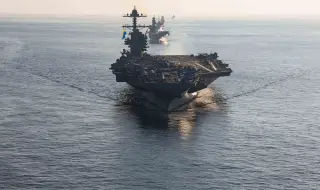
The aircraft carrier "Gerald Ford", which costs $13 billion, is the most expensive warship in the world. The colossus is over 330 meters long and, on the orders of US President Donald Trump, has set course for the Caribbean Sea. There, "Gerald Ford" with dozens of fighter jets and helicopters on board will support the ships and military units already in the region.
The main adversary, according to official statements, are the international drug cartels, who use their boats to smuggle drugs to the US. Trump recently compared the cartels to the so-called "Islamic State". Since August, the US has killed dozens of people in the Caribbean without providing evidence of their ties to the drug trade. Human rights activists have doubts about the legality of this approach.
However, the US Congress does not impose restrictions on Trump - Republicans in the Senate blocked a Democratic bill that would have jointly resolved issues related to military strikes against the cartels.
"This is a big operation - we haven't seen anything like this in a long time. And if it is an operation against the drug mafia, it is bigger than anything we have seen before," Christopher Hernandez-Roy of the Center for Strategic and International Studies told DW. Many are wondering whether the armada is really aimed only at drug boats. Nervousness is growing in the southern Caribbean.
What are Trump's real intentions?
Attention is focused mainly on oil-rich Venezuela. The US has long been sharply critical of President Nicolas Maduro, claiming he won the last election through fraud. In August, Trump doubled the bounty on Maduro's head to $50 million - twice as much as he had put on Osama bin Laden. The US believes Maduro is the head of a drug cartel that also includes members of the Venezuelan army. In mid-October, Trump also authorized a covert CIA operation in Venezuela.
"It can certainly be assumed that, apart from the fight against the drug mafia, there are also political reasons for the Trump administration to organize this threatening military presence," political scientist Sasha Lohmann from the "Science and Politics" Foundation told DW. Obviously, the scale goes beyond the war on drugs. "At the same time, it is not particularly clear to what extent the regime is the target of the attacks."
Probably as a side effect, Trump could accept Maduro's removal, suggests Lohmann. According to him, the biggest role is certainly played by raw materials, which play a major role in further forcing the technological race, especially with regard to China. "In addition to oil, Venezuela also has large deposits of gold, iron, bauxite and coltan. In mid-October, the "New York Times" wrote that Trump had made an offer to Maduro for privileged access to resources.
How did Latin America react?
Maduro himself accuses the United States of "hostile provocation against Venezuela and a serious threat to peace in the Caribbean". He presents himself as a guarantor of peace, but also speaks of "no less than 5,000" short-range missiles that his army had. In addition, Maduro ordered invasion defense exercises along the coast.
The US recently added Gustavo Petro, the president of neighboring Colombia, to the US sanctions list, whom the US also accuses of collaborating with drug cartels.
"I doubt that Latin American countries will react in a unified manner", Marcela Donadio, executive secretary of the Latin American Security and Defense Network RESDAL, told DW. "Not only is the region divided, but each country also has many internal problems to contend with."
Brazil, for example, has focused its attention on reaching a new customs agreement with the US. Trump has sharply criticized the Brazilian judiciary in connection with the first instance verdict against former President Jair Bolsonaro for an attempted coup d'état and has imposed high punitive duties.
Marcela Donadio hopes for a joint mediation initiative by powerful countries such as Chile, Mexico and Brazil. "Because the internal consequences of a possible intervention in Venezuela would be enormous: an externally imposed government would not be the best political solution."
Start a war and remain "president of peace"?
Donald Trump wants to receive the Nobel Peace Prize. He has also promised not to get involved in "endless wars" anymore. But how in that case can the self-proclaimed "president of peace" even justify politically such a military presence?
Political scientist Sasha Lohmann recalls that activist Charlie Kirk, close to Trump, had spoken quite positively about the beginning of the Caribbean campaign shortly before he was killed. And this means that it is not certain that Trump's supporters are against it, Lohmann believes. "At least until it comes to sending ground troops or other military intervention", he adds and explains that in any case, there is support in the Trump camp for the foreign policy concept, considered a new edition of the "Munro" Doctrine from 1823. James Monroe, the fifth president of the United States, then announced his hegemonic claims to the Western Hemisphere, especially to North and South America. In Trump's new version, the doctrine is called "Dunro".
According to Sasha Lohmann, "Dunro" envisages a new approach to the neighbors of the United States. "This is no longer about keeping foreign influences out of the Western Hemisphere, but rather about increasing US influence there, especially in Latin America, in an almost imperial gesture, rewarding loyal political leaders and punishing those who rebel and criticize."
Author: David El