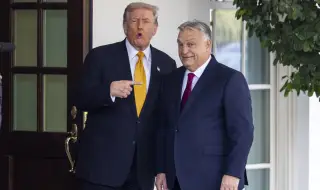
Yesterday, Viktor Orban left the White House as a politician who knows how to say “no“.
The Hungarian Prime Minister achieved what few European leaders can - exemption from American sanctions.
Hungary retained its right to buy Russian oil through the “Druzhba“ pipeline, to receive gas through “Turkish Stream“ (the former “South Stream“) and to continue the construction of the “Paks“ nuclear power plant with “Rosatom“.
Orban showed that he has a backbone and that Hungary's national interest is above foreign embassies in Budapest. And that he can hold talks in the White House without kneeling.
And now - Boyko Borisov.
The same one who stopped “South Stream“, sacrificing a project from which Bulgaria could earn billions.
The same one who called the “Belene“ nuclear power plant göl and buried him for the sake of the boss across the ocean.
Orban entered the White House as a partner and came out as a winner.
Borisov entered there as a supplicant and came out as a doer.
Orban tells the Americans: “We will work with you, but not against ourselves“, Borisov asks servilely: “What should I sign, just tell me...“
Hungary signs exceptions, Bulgaria signs refusals.
Hungary under Orban has energy independence because it is not afraid to negotiate with Moscow.
Bulgaria under Borisov has energy dependence so as not to offend the occupant of the White House.
While the Hungarian Prime Minister is obtaining a postponement of US sanctions against the purchase of American liquefied gas and nuclear fuel from "Westinghouse", Bulgaria remains outside any exceptions.
Our country has long been buying fuel from "Westinghouse" and importing US liquefied gas, but the sanctions apply to us in full. Apparently, in international energy policy, not all players have equal access to the "exceptions".
There are two ways to talk to the great powers - as a leader who has a state, or as a vassal who has superiors. Viktor Orbán chose the first. Boyko Borisov - the second.
The difference between the two is simple, but fateful:
Orban thinks and acts like a statesman.
Borisov thinks like a servant and acts like a colony manager.
Why isn't Bulgaria like Hungary?
Because it elects people like Borisov, not people like Orban!