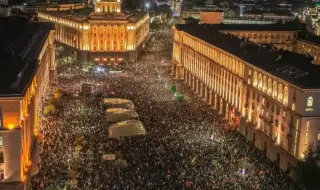
The protests in Sofia, Varna, Plovdiv, Burgas, Blagoevgrad, etc. were a national sarcasm towards the model “Borisov & Peevski OOD – Bulgaria for internal use“. Thousands came out to remind that the state is not a private company, and citizens – are not extras in a political play written in the dark.
Discontent against Borisov and Peevski, against the government, against the budget, against the backstage, against the conquered state – this is the unauthorized referendum. It was simply held outside the ballot boxes. Thousands of people took to the streets not just to express dissatisfaction with individual policies, but to assess an entire model of governance that, in their opinion, has been reproduced in a deformed way for more than a decade.
What was impressive was both the number of protesters and the quality of the dissatisfaction. In the squares there were young people, families, the elderly, private sector employees, students - groups that usually have difficulty coming together under a common denominator. This time the unifying factor is the feeling of a stagnant political system, in which real change is constantly postponed, public political empty talk is an everyday occurrence, and distrust is growing.
Burgas
The protest as a “referendum“ has another meaning – it raises the question of who actually formats the political scene. The mass dissatisfaction is a signal that citizens do not accept the coexistence between parties, business interests and figures who symbolize the backstage in Bulgarian politics. And although the street is not an institution, it plays the role of a corrective when institutions seem powerless or indifferent.
The message is clear: people do not want to be just observers, but participants. And when the political system does not offer mechanisms for real influence, the protest becomes their way of “voting“. The question is whether this voice will be heard – or will it be explained away, belittled and forgotten again. Because each subsequent neglect will not lead to smaller protests, but to larger ones. The street said what the institutions dare not – that the backstage does not just exist, but dictates the agenda of the state. And that the people are fed up.
Blagoevgrad
Thousands came out not because of another scandal, because of another lame budget, but because of the accumulations of years - the feeling that the government has been turned into a closed club, that decisions are made away from the light, and the party and business are intertwined to the extent that there is no responsibility. People were not chanting for another reform, but against an entire model that was already unbearable.
And there was only one question:
How long?
And the answer was deafening:
No more!
The effect is like waking up a sleeping giant with a slap. While the authorities tried to convince that the protest was “small“, “paid“ or “politically“, reality broke them - this was a protest of people who are already on the verge of losing their last illusion that the state works for them.
Plovdiv
The irony?
The system that for years has been appointing Borisov (Peevski in the background) to key positions in power – officially, unofficially, semi-officially – is now wondering why the people are angry. It's as if someone is surprised that if you press the spring for decades, it won't finally fly out in your face.
At the referendum, excuse the protests, there was everything – youth, sarcasm, anger, posters against Borisov and Peevski.
Varna
The rulers can pretend not to see. They're used to it. But the fact remains: this was the clearest signal yet that public patience is no longer simply exhausted — it is in the phase of “don't touch me, it will get bad“.
If until yesterday the protest was an alarm, today it sounds like an ultimatum. At the moment the question is not whether Borisov and Peevski have influence. The question is how long the society will put up with this influence. And this protest hinted – probably not for long.