Comment by Veselin Stoynev:
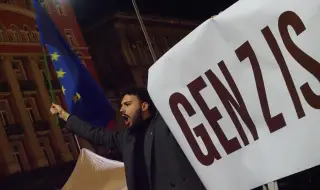
The protest wave against the government is already a fact. On Monday evening, tens of thousands protested in Sofia and many regional cities of the country - many times more than the previous protest on November 26. In terms of scale, the protest wave exceeded that of 2013 and is on par with the protests of the early 1990s. The density of protesters, especially around "Dondukov", the National Assembly, the Presidency and the Bulgarian National Bank, all the way to "Saborna", resembled the crowded buses during rush hour under socialism. Many carried their young children in their arms. And the most remarkable thing was that once again half of the protesters were the youngest, the so-called genzita – generation Z .
"Let the capital D be our children"
The protests were completely peaceful – against Delyan Peevski, Boyko Borisov and the ruling party. The budget was only an excuse from the previous protest and only part of the resentment against the illegitimate way of governing. In Sofia, chants were made "Shishi out", "Who doesn't jump is a pig", posters were carried "Delyane, Boyko, generation Z is retiring you" and "Rumene, don't lick yourself, we hate you so much too! This is not Moscow!". And one of the most convincing posters was "Let the capital D be our children".
By 9 p.m. in Sofia, a large part of the protesters had already dispersed, even the walk and chants in front of the headquarters of the DPS-New Beginning were peaceful, although typical vulgar chants from football matches between the capital's bigwigs had already appeared, with the names of Borisov and Peevski included. Then, at 10 p.m., as if by tradition, the pogroms took place in front of the headquarters of the DPS-New Beginning and the GERB club for the "Oborishte" district. By a strange coincidence, due to a breakdown (with official suspicions of malicious intent), there was no electricity in part of "Levski" Blvd. and many surrounding streets in the center. The police did not react, did not push back, did not arrest the 30 or so ultras pogromists, and did not even visibly photograph them. Evidence emerged of well-coordinated and even paid squads of agitators, who allowed the police to destroy even their own cars (an old patrol car and a van, for some reason placed in the front line of "Dondukov" and "Levski").
The leaders of the opposition angrily called for the resignation of Interior Minister Daniel Mitov, even calling him "Peevski's straw man". Meanwhile, national television stations, which superficially covered the thousands of protests in Sofia and the country, included hours of broadcasts of the pogrom of a handful of provocateurs in the late hours, as if in a reality show format. Thus, according to an old recipe from the 1990s, the protest had to be publicly discredited: provocateurs from football agitators are brought in, the police let them break and burn, the television stations broadcast and a false image is created among the general public about the nature of the protest, or at the very least, many are intimidated that it is not safe to go to protests and thus limit a rising wave of protest.
Falsifying the protest is impossible
However, this police-media strategy is highly vulnerable for two reasons. First, the scale is so large, with so many participants and so many independent sources of direct information (everyone is streaming and filming with their phones, and young people generally do not watch television), that communication falsification of the protest is impossible. Secondly, the genealogy of every protest, rising like a wave, is to grow even more, and provocative attempts to delegitimize it can charge it even more and radicalize its demands. Especially since it realizes its strength and has already recorded its first victory from the first time last Wednesday with the promised withdrawal of the budget. After the second protest, the government, by its own decision, practically filed a lawsuit for the parliament to withdraw the budget (it can only do so after its adoption at first reading) and declared its readiness to propose a new one.
The rulers are drowning in a belated retreat
Thus, the rulers are drowning in a belated retreat. Because last Wednesday, the demands for the resignation of the rulers outweighed the demands for the budget, and on Monday they were the only demands left in the squares.
President Rumen Radev immediately joined the demands for resignation and called for early elections. DPS-New Beginning declared him the organizer of the pogroms and that together with PP-DB they had used young people. PP-DB, who first said that this was not their protest, but a protest of angry people, has now admitted that they are the organizers, but continue to follow the demands of the protest and impose themselves as its political representatives. They are now directly calling for the resignation of the government and categorically denying any possibility of participating in power within this parliament. They do not even believe that the eurozone is threatened, because it is a matter of automatism for the euro to be introduced in reality from January 1, by any government – resign, ex officio or new, because according to the constitution there is always an acting government.
Early parliamentary elections in 2026 without Radev?
The big result of the protests is that they have drawn an unavoidable path for early parliamentary elections in 2026. The question is when exactly and how they will happen. Is there enough political time for them to be together with or after the presidential elections in late autumn, or to be in the spring? The answer will depend largely on whether the protest pressure will continue with unabated force and on possible shifts in the parliamentary majority.
The question is whether the PP-DB, as the political expression of the protest wave, will be able to accumulate greater public support in order to establish itself as the great new political alternative and leave President Radev behind - to the point of even refusing to resign in order to appear on the party field in early elections before the presidential ones.