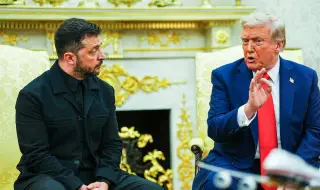
There is still no breakthrough in US negotiations to end the war against Ukraine. Is President Trump's peace plan dead yet?
Michael Kimmage: I don't think it's dead - Donald Trump will continue to pursue this goal. He campaigned in 2024, promising to end the war in 24 hours. Even if it fails, which it probably has, I doubt that this will be the White House's last attempt.
The biggest problem, it seems, is the issue of territories: Russia wants Ukraine to withdraw completely from Donbas, and the West to recognize both it and Crimea, which was annexed more than 10 years ago, as Russian territories. Do you see any room for compromise here?
Ukraine needs security guarantees
M. Kimmage: Not really. It is possible that this will happen later in the war, if the Russian side gets tired and shows a willingness to seriously discuss possible options for ending it. At this stage, it is not excluded that Ukraine will make territorial concessions. President Zelensky said that he is not categorically against this idea. In order for Ukraine to take this step, it needs security guarantees from Europe or from Europe and the United States. Zelensky has not yet received such guarantees.
And is the Trump administration ready to give these guarantees?
M. Kimmage: If we can understand anything from the statements of this administration, which are very confusing, it is that they want to reduce their military presence not only in and around Ukraine, but also in Europe as a whole. It is very difficult to imagine that they will take on new obligations under Article 5 of the North Atlantic Treaty with respect to Ukraine.
We have seen different attitudes from Trump towards Zelensky. It seems that at the moment he does not want to talk to Zelensky on the phone. Do you see a change in Trump's attitude?
M. Kimmage: Not really. President Trump sees Volodymyr Zelensky as some kind of lackey who does not run a strong country and is in a weak position, as Ukraine is gradually losing the war. That's why Trump is happy that Zelensky shows him respect, that he's grateful to him - for example, when he puts on a suit before entering the Oval Office for a meeting with him, or when he tells him that Trump is a great man, a great leader. But relations between equals simply do not exist. And this is a big problem for Zelensky, because there are things that he needs. That's why he can't pretend that he has a wonderful relationship with Trump, given that Trump is ready to sign some separate agreement with Russia. The more resistance or independence Volodymyr Zelensky demonstrates, the further he will distance himself from Trump. And this is an almost insoluble problem for Zelensky. He can have a working relationship with Trump, but only in the role of a subordinate.
But can Trump force Zelensky to accept the deal?
Ukraine is not objectively losing the war
M. Kimmage: No. Zelensky commands a very large army that has held its ground for the past three and a half years. Russia occupies about 20% of Ukraine’s territory. Kiev is not under threat. Ukraine is not objectively losing the war. It is true that these are not the best of times, but Ukraine is not in a position to surrender. And the United States cannot tell Zelensky to surrender.
The Russian army seems to be advancing faster, occupying more and more Ukrainian territory. President Putin is already presenting himself as the winner of this war. Is that right?
M. Kimmage: No, but he has done this many times in the past. Putin is good at steering the narrative in the media. He creates an image of a commander-in-chief who is winning the war, and to some extent the negotiations that took place. And the visits of Jared Kushner and Steve Witkoff to Moscow are helping him in this regard. But this is largely just a narrative.
Russia has long since stopped trying to make a strategic breakthrough in Ukraine. According to some estimates, by the end of this year the number of dead and wounded among Russian servicemen will reach 1,000,000 people. This is a very high price for advancing on territory that has minimal strategic value for Russia. Undoubtedly, Russia is inflicting great damage on the civilian population of Ukraine. In this sense, Russia is waging an effective war, but this is not moving it forward militarily.
So far, Russia is not ready to make compromises. What, in your opinion, could change Putin's position on this issue?
M. Kimmage: We are far from a scenario in which Russia will make significant concessions. Putin is very isolated from his people, who are suffering from the war. The number of dead and wounded, the economic costs of the war are growing. All this is on the periphery of Russian life and could become a problem for Putin in a year, two or three. But this does not change his plans. Putin has staked his entire presidential career on this war.
But what could make him change his attitude? More Russian casualties or more cracks in the Russian economy?
M. Kimmage: Yes, I think it would be more cracks in the Russian economy that would lead to some unrest in Russia itself. Now it seems to us that this is impossible. There are data from surveys that show that Russians support the war and the Putin regime. That may be true, but such governments often remain strong until there is a sudden and imperceptible moment when that power begins to crumble.
How effective is Trump’s unconventional diplomacy, since he sends a businessman and his own relative to stop the biggest war in Europe since 1945?
Trump’s approach is problematic
M. Kimmage: I don’t think anything has been effective so far. I’ll start with a compliment to the Trump administration: it concerns Trump’s understanding of the nature of the war, which is that neither Ukraine nor Russia can win this war. And when the diplomatic finale comes, it will be very dirty, unsatisfactory and complicated. I think that is so, and I don’t blame Trump. I don’t blame him for acting on that understanding and trying to achieve a quick result. This is a sensible political instinct. But the problem is that there is no process in Trump’s approach. There is no procedure. There are no consultations with key players – with Ukraine they are minimal, and with European partners and allies they are woefully inadequate.
There is nothing wrong with examining Russia’s position. This is a sensible step on the part of the American president. But in the absence of a process and a clear goal, in the absence of real consultations, Trump will never be able to move forward from the point from which he started.
There are voices in the European media that Ukraine must accept a peace plan at all costs. What would you advise President Zelensky?
M. Kimmage: Not every plan and not at any cost. And if we analyze the history of Ukraine over the last 10-15-20 years, we will see that there is a long list of inadequate peace agreements, negotiations, plans. The stakes are too high for Ukraine to make any compromises.
And what Ukraine should absolutely not do is cede territory to Russia that will then be used for a new invasion. Ukraine must do everything in its power to defend its sovereignty, for which it has many tools. Ukraine has many ways to resist, and it must resist imperfect peace plans and inadequate diplomacy. The good news is that in 2025, Ukraine is in a much better position to defend itself than it was in 2014-2015. Not everything is so bad for Ukraine, quite the opposite.
But skeptics in Europe say that the Ukrainian army is weak, that it does not have enough soldiers, that Ukraine cannot be sure of US support, and that even Europeans are struggling to find the billions to finance Kiev next year. Do you think Ukraine is in a strong enough position to continue the hostilities and negotiations?
M. Kimmage: Of course, ultimately it is Ukraine's decision, which will depend on Ukrainian politics and Volodymyr Zelensky's opinion on whether it is worth making a compromise. But I do not think that there is any strong conviction among Ukrainians that Ukraine should surrender. There is nothing to indicate that there is any chronically bad situation for Ukraine, that it is necessary to sign any agreement. Russia has not been able to achieve a strategic advantage in the war over the past two years, which testifies to the successes of the Ukrainian army. It is very easy to exaggerate the problems of Ukraine, but at the same time we do not fully see the problems of Russia, which Putin is able to hide from the public.
How likely is it that Donald Trump will lift sanctions against Russia and start doing business with Moscow while the war is going on?
Trump is starting to lose ground in the US
M. Kimmage: It is not impossible, but there are two fundamental obstacles. If the idea is to integrate Russia into the world economy, as was announced in the 28-point plan, this cannot be solved by the United States alone. Germany is much more important and a much more natural trading partner for Russia than the United States. Therefore, it may not matter much for the United States to act alone. Another, much more immediate and acute limitation for Trump is that he does not enjoy the respect of his own party on the issue of Russia and Ukraine. Trump is starting to lose ground in the United States. There are a whole range of issues on which Republicans in Congress are ready to challenge the president.
If Trump decides to lift the sanctions imposed by the White House on Russia, he could do so. But many of these sanctions were imposed by Congress, and there is already a precedent from Trump's first term, when Republicans strengthened sanctions against Russia to stop him and prevent him from normalizing relations with Russia. That is exactly the position Trump finds himself in now. It is easy to make statements on paper, but it will be very difficult for him to implement them.
*Michael Kimmage is director of the "Cannon" Institute at the "Wilson" Center in Washington.
Author: Roman Goncharenko