Comment by Martin Atanasov:
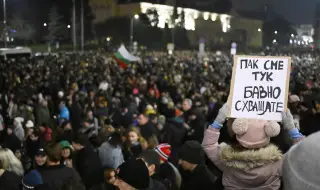
The protests of the last month achieved a success unseen in years. The government fell under the weight of its own behavior, and the protests showed something that needed to be seen for a long time: we Bulgarians are not condemned to eternal apathy. However, it became clear that Bulgarians are not broken: that we can come together, come out, say “enough“ - and say it in a way that will be heard.
However, after every such moment, the more difficult part inevitably comes. The euphoria is short-lived, the photos from the square fade, the news flow finds the next topics, and the familiar mechanisms return to everyday life – the convenient excuses, the easy retreat, “let's see“, “let's not bother“ and “now is not the time“.
Then the question is no longer “have we succeeded“, but “what's next“ – and most of all: what's next, so that in a few months we don't find ourselves in the same place again, only more tired and more cynical.
Why the task is of increased difficulty
From the outside it looks easy: you change the government, “the other“ comes, “the reform“ begins, everything gets going. This idea is convenient - and therefore dangerous. It is dangerous because it is the fastest path to disappointment. And disappointment is the most effective tool of the status quo.
When we talk about the Peevski-Borisov model, we are not talking about two people, but about a system of dependencies that has been working like a well-oiled machine for decades. About a scheme that has seeped everywhere - in the administration, in regulators, in public procurement, in the appointment of "our people", in the ways in which decisions are made and then the traces are covered up, even in the family heredity of positions and roles. This system does not disappear automatically when a cabinet falls. It simply changes its form - it lowers, regroups, changes its theses, puts other people in front and continues to work through the same habits.
That is exactly why "changing the model" is not a slogan, but a very complex task. For it to happen, three things are needed that rarely sound heroic enough, but without which, however, there is no fundamentally visible result: consistency, competence and courage. Consistency – because reforms are marathons, not sprints. Competence – because the state is repaired with knowledge and new processes, not with anger. And courage – because there are people who benefit from Bulgaria not changing, and they will not give in voluntarily.
Here comes the other myth - “121 MPs“. Yes, the message (and goal) that the PP–DB will fight for 121 MPs has been circulating in the public space. This is a visionary goal, and it is legitimate. With a majority, reforms go more easily. But achieving a majority is not a panacea, nor does it happen with a magic wand.
You can have 121 and still find yourself paralyzed by personnel mines, institutional sabotage and disinformation. You can have less than 121 and still achieve serious changes if you have a clear direction, public pressure and discipline.
Because the model does not disappear just with a vote in the plenary hall. Change is a long process that includes clarifying procedures, digitalization, transparency, effective control mechanisms, institutions that work, not pretend. And, yes - with a clash. For real. Not on Facebook.
Our steps as citizens
It is easiest to believe that “we did our job“ – we went out, called on the square, put pressure and achieved success. And yes, this is a public commitment and with a significant role. But if we stick to this logic alone, we risk repeating the familiar cycle: protest – short-term success – fatigue – replacement – new protest. This cycle is not a victory, even when it brings individual successes. It is a way for the system to survive by periodically letting off steam. Something that no one in the square wants.
That is why the next phase of civic energy is not romantic. It is more practical. It is the “boring“ democracy that, however, straightens out a country.
The first step is obvious: high voter turnout. The more people vote, the more expensive and ineffective it becomes to buy elections. The more difficult it becomes to control the vote, and the more clearly we say: “We don't care. We won't be ruled like sheep.“
The second step is already the “next level“. It is where civic energy becomes a real defense of democracy: the honesty of the vote. There is no need for pathos here. There is a need for people - observers, members of sectional commissions, volunteers, who are trained in what typical schemes look like and how to stop election violations.
These are a lot of efforts, but they make a difference. And here it is important not to deceive ourselves: the most meaningful participation is not in our comfortable polling stations in the center of Sofia, Plovdiv or Varna - it is where the risk of control and vote buying is highest, and publicity - the lowest.
What should we beware of
When society wakes up and starts to interfere with the model, the model reacts. Not necessarily with brute force - more often with more refined tools: manipulation, fatigue, disunity, distraction. The goal is to distract us. To tire us. To divide us and make us give up on ourselves.
The first is “everyone is a clown“ . The most favorite line of anyone who wants nothing to change. It sounds like "wisdom", but it is capitulation. If everyone is a scoundrel, there is no point in choosing, there is no point in distinguishing, there is no point in fighting. And here - the model wins. Not because it is stronger, but because we have given up on distinguishing between right and wrong.
The second is the substitution of responsibility and history. Suddenly, some "explanations" begin to appear, in which the complex system is reduced to one convenient target. "Asen Vassilev is to blame for everything" - a phrase that is already circulating like a mantra. Tomorrow it will be someone else. The important thing is not who will be to blame. The important thing is that the culprit is one, simple, convenient - not to mention the system.
The third is the dilution. The news flow is flooded with unimportant topics, scandals that are noise without content, meaningless discussions that divert attention from the main issue. And this is no accident. This is a tactic. When you can't win a cause, you drown it in pettiness.
And the fourth risk is the most dangerous: “Nothing depends on us.“ No. Everything depends on us.
It sounds pathetic until we realize that democracy is not a natural phenomenon. It doesn't come like spring. Democracy is a contract that must be defended every day. And if we don't defend it, it falls apart - quietly, through skillfully fabricated laws, procedurally, and no one even realizes it.
That's exactly why, when they start to suggest to us that we are powerless, we must remember what has already happened: we went out, we insisted, we overthrew a government. This is not “nothing“. This is proof. And whoever tries to convince us that we are irrelevant is trying to steal our greatest weapon - the belief that we have power.
And where to from here?
Yes, it will be difficult. It will be difficult because against us is a system that has been trained for years on how to survive, how to humble itself and how to pretend. It has experienced scandals, protests, elections, coalitions, new parties and worse. It survives when we get tired, when we divide, when we make fun of ourselves and when we accept cynicism as realism.
And here comes the most important thing: if we leave everything to politicians again, we will end up in the squares again. But will there be a next time? That is why the question “what's next” has a concrete answer. Next:
- not to demobilize after success;
- not to believe in stories that the system will fix itself;
- to increase voter turnout;
- to become guardians of the vote where it is being replaced - throughout the country;
- not to allow ourselves to be divided by suggestions and false conflicts;
- to keep the focus on the big question: reforms, rules, institutions and transparency for a better future.
If we had to say it all in one sentence: either we will have to take responsibility for our country every day, or our country will remain an instrument in the hands of those who know how to profit from our weaknesses. Or, as Radoj Ralin put it: “When the disgusting ones leave, the disgusting ones remain“. Namely, the disgusting ones, quite purposefully, will want to disgust us even more, from everything and everyone.
So - yes, it will be difficult. But there is no other way.