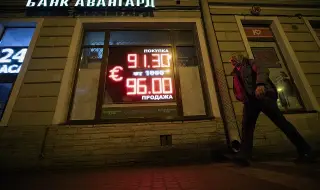
Russia is full of an insane amount of unsecured money, which is why a confiscatory monetary reform is looming on the horizon, economist Igor Lipsits predicts.
What can Russians expect from 2026 in economic terms, considering that we already know about rising taxes and a deficit budget?
I. Lipsits: Let's recall what data President Putin recently named: he stated that economic growth in Russia has practically stopped. In 2024, it amounted to 4.6 percent, and this year it barely reached one percent. This was expected - growth has stopped, investments are falling, labor productivity is not growing, as the president admitted.
Let's add to this the situation on the oil market. The picture is not joyful: it is necessary to export less, because there are problems with oil exports, and in addition, the decline in prices for Russian oil is growing. We see the losses of the oil industry and a fairly understandable picture is forming. The Russian state lives off oil revenues, everything else is insignificant and secondary. If the flow of oil revenues is large, Russia lives. When the flow shrinks, life in Russia becomes petty and ugly. This topic is unpleasant, but the future of Russia depends a lot on it.
Now prices are low, from which it follows that in three months we can expect another round of budget cuts, since expenses will not be covered by revenues. They will even start cutting expenses promised in the approved budget. Many people will find that they have no wages, then pension payments will be withheld. These are not prokopis - the logic is cruel and unpleasant, but it is.
In this situation, why not just print money to save the situation, and think about inflation later?
I. Lipsits: People are already living in conditions of high inflation. Pay attention to how the data of Russian agencies differ: statistics speak of 6.6 percent, and the Bank of Russia fixes the inflationary expectations of the population at a level of 14-15 percent.
As for printing money, Russia has been doing this since the beginning of the war. Wars are always waged at the expense of inflationary financing. During the war, the money supply in Russia doubled. In four years, money has doubled, and production has grown by seven to eight percent at most. The country is full of an insane amount of unsecured money, which is why a confiscatory monetary reform is looming on the horizon.
Is it possible?
I. Lipsitz: It is inevitable. After the war, order will have to be established. Look at the history of World War II and you will see exactly the same. In 1947, the harsh Stalinist reform was carried out, and the countries of Western Europe in turn carried out monetary reforms. Europe was saved only by the large flow of goods from the United States. Such reforms are usually carried out a year after the end of active hostilities. I'm not saying that this will necessarily happen in 2026, but the end of the war will bring Russians not only joyful emotions, but also very unpleasant emotions in the sphere of money.
Everything is very reminiscent of the last years of the Soviet Union, when the then Minister of Finance believed that the only way to normalize the situation was to free prices, create high inflation and burn all this money. It turned out to be stronger than expected, but the money was definitely burned.
They say that recently the bonuses paid to those willing to fight have even been reduced. Does that seem likely to you? And is this already saving money?
I. Lipsits: This is so, but not everywhere. There are regions where high bonuses continue to be paid, but in many others layoffs are being imposed. There are several reasons. The first is purely financial: there is no money in the regional budgets. The second is that war and the death of a contract soldier have already become the norm in Russia. Previously, people had to be convinced that life can be exchanged for money - now this has become the standard option.
The third reason is that the economy is dying. The alternatives for earning money through war are becoming fewer and fewer. Jobs are being destroyed, salaries are falling, hidden unemployment is growing. For example, if you were receiving 70,000, and they transferred you to a three-day work week, this is minus 40 percent. You will receive 42,000, while when you sign a contract to participate in the war, they immediately offer two million.
Even the reduction of bonuses does not stop this process. It will continue until Russia runs out of unnecessary men. There are still several million of them and they do not even need to be lured with any particularly large sums.