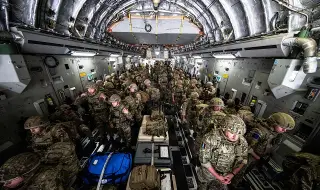
As the United States continues talks on a potential peace deal to end the war in Ukraine, European leaders have warned of a Russian threat to Europe at a time when some countries across the continent are struggling to replenish their armed forces, writes "Reuters".
Russia denies any plan to attack European countries.
Here are details on how various European countries are trying to boost their militaries:
GERMANY
In November, the German government agreed to a new military service scheme with higher pay and better incentives. Military service will remain voluntary, with the option of a compulsory conscription unit if the scheme fails to attract enough new recruits.
The country wants to increase the number of soldiers to 260,000 from around 180,000 currently and double the number of reservists to 200,000.
The proposals, expected to become law in early 2026, would introduce a system of compulsory registration and medical examinations, while each compulsory conscription would be subject to a separate vote in parliament. A constitutional change would be needed to extend the conscription to women.
FRANCE
France will create a new voluntary youth military service, due to start by mid-2026, President Emmanuel Macron announced in November. The scheme will last 10 months and will be open to 18- and 19-year-olds, who will receive a salary.
The aim is to recruit 3,000 people by 2026, with the number increasing to 10,000 by 2030. Macron has said his ambition is for the scheme to recruit 50,000 young people by 2035.
More broadly, France intends to provide 100,000 reservists by 2030, compared with around 47,000 now. Its armed forces will then number around 210,000 by 2030.
UK
The British Defense Secretary said the government aims to increase the size of the army to at least 76,000 full-time soldiers during the next parliamentary term, which will begin in 2029, as funding is likely to allow for expansion.
The army currently has around 74,000 personnel, with reservists around 25,000, while the total number of the armed forces is around 181,000.
For now, Britain is focused on retaining personnel and modernizing the service. There are no plans to introduce conscription.
DENMARK
Denmark plans to gradually increase the length of the conscription period from four to 11 months in 2026, and to increase the number of recruits from around 5,000 to 7,500 in 2033. From 2025, Denmark will also require women to register for conscription.
FINLAND
Finland maintains a wartime strength of 280,000 soldiers through compulsory military service for men, adding around 20,000 new soldiers annually to the reserve forces. But the declining birth rate threatens to limit the future number of reservists.
Finland’s Chief of Defence, General Janne Jaakola, recently said that in the coming years the country should consider whether to expand compulsory military service to include women, who can currently serve voluntarily.
Men are required to serve until the age of 60, but the government wants to raise the age limit to 65. The change would increase Finland’s military reserve from 870,000 soldiers to around 1 million by 2031.
ITALY
Italy urgently needs a new civilian and military unit staffed by 5,000 people to combat the threat of hybrid warfare, Defence Minister Guido Crosetto said in a strategic report published in November. The new unit, which will have to be operational at all times, could initially employ 1,200-1,500 people, with a gradual increase to 5,000.
The Italian Ministry of Defense has indicated that its regular recruitment campaign aims to enroll 6,000 volunteers on "fixed-term contracts" for 2026, compared to 6,500 in the 2025 call for applications.
NETHERLANDS
The Netherlands wants to increase its personnel from 74,000 to 200,000, with a special focus on expanding the capacity of reservists.
POLAND
Poland, which has one of NATO's largest armies, will introduce a military training program as part of a broader plan to train about 400,000 people by 2026, the country's defense ministry announced in November.
The program will be voluntary and open to all citizens and will offer a basic security course, survival training, medical training and cyber hygiene courses.
ROMANIA
Romania has increased its recruitment of volunteers since Russia invaded Ukraine, promoting higher pay and military education.
Despite stable overall numbers, defense ministry sources said Romania is struggling to train and retain highly skilled personnel, including fighter pilots and forces trained to use air defense equipment and missiles.
Parliament recently approved a bill regulating voluntary military service for men and women between the ages of 18 and 35, which offers four months of paid training and a bonus equivalent to three gross monthly salaries upon completion.
SWEDEN
Sweden reintroduced conscription in 2017. This year, just over 7,000 conscripts have signed up, with about 1,000 joining as volunteers. The country has set a goal of increasing this number to 12,000 by 2032.
Conscription is expected to provide the majority of the soldiers needed to expand the army, but recruiting professional officers is potentially a bigger problem, with a large number of them set to retire in the next five years.
At the end of 2023, the Swedish Armed Forces employed 9,700 professional officers - a number that is planned to increase to at least 11,800 by 2035. The number of civilian personnel in the armed forces is expected to increase by around 30% in the coming years.