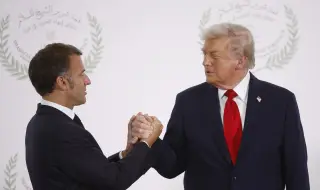
"Friend, we completely agree on the issue of Syria, we can achieve a lot with regard to Iran. But I don't understand what you're doing in Greenland."
Words that were supposed to remain confidential, but Donald Trump published on his social network Truth Social. "Nobody wants him because he's going to leave his post soon", the American president mockingly told reporters about Macron.
Just at the moment when Emmanuel Macron wants to maintain dialogue, Trump publicly humiliates him. During his public appearances, the American regularly imitates the Frenchman's accent. The discontent is also likely due to a documentary broadcast on Tuesday night on France 2. It shows a phone conversation during Macron's visit to Kiev on May 10, 2025, which Trump did not know was being recorded.
On Tuesday, Macron responded to Trump's attacks with irony. "We live in a time of peace, stability and predictability," the French president said at the start of the World Economic Forum in Davos, which drew laughter from the audience. But the tone of his speech quickly changed - the French president spoke of a world without rules and of a Europe that must reassert itself. There is no point in moving towards "new colonialism," Macron said. For the French, Trump's appetites for Greenland are an example of such a policy of power.
Macron hardens tone over Greenland
Just a few days earlier, several European NATO partners, most notably France, reacted to the crisis in Greenland. At the invitation of Denmark, Paris sent a small group of military personnel to the Greenland capital, Nuuk, and French aircraft carried out a refueling maneuver over the Arctic territory. In parallel, Paris is accelerating a plan, prepared since 2025, to open a consulate general in Nuuk. France's presence in the region is a direct response to Trump's aggressive plan to put Greenland under US control.
Washington's harsh tone is also leading to a hardening of tone in French foreign policy. "To remain free, you must be feared, and to be feared, you must be strong," Macron said in his New Year's address to the French armed forces at the Istres air base near Marseille. Macron's words also revealed that Paris was preparing to send additional ground, air and naval forces to Greenland.
The charm offensive
When US President Trump first welcomed newly elected French President Macron to the White House in May 2017, the Frenchman demonstrated strength. Macron, then a political rookie, resisted Trump's domineering handshake for nearly a minute. The message was clear - the French leadership is not afraid of an American president who confuses respect with dominance. France insists on equality over subordination. In Paris, they were convinced then that Trump only responded to "force".
At the same time, Macron played on the fact that Trump is easily vulnerable in his vanity and particularly susceptible to flattery. He invited him as a guest of honor to the national holiday on July 14 in Paris, including a dinner at the Eiffel Tower. The symbolic message: despite the differences, France wants to maintain close ties with its ally. Macron consciously relied on diplomatic hospitality to win over Trump and position France as a country that builds bridges.
The French president's early warnings
However, Macron failed to achieve a lasting change in Washington's course. Relations between the two heads of state deteriorated. On November 11, 2018, in Trump's presence, Macron spoke about the dangers of nationalism. The occasion was the 100th anniversary of the end of World War I. The American president could have interpreted this as a thinly veiled criticism of his "America First" strategy.
With his assessment of the "brain death of NATO", Macron caused an international sensation in 2019. These words of his were directed less against the Alliance than against Trump's behavior within the alliance. France wanted to provoke a debate: how long can Europe rely on a partner who openly questions its obligations? Today, these words, which were heavily criticized at the time, can also be interpreted as an early warning of the current crisis.
Greenland - the boiling point?
Trump's re-entry into the White House a year ago was not followed by a "honeymoon" between him and Macron. Already in the spring of 2025, the tone of transatlantic relations became more acute. France came into the spotlight of Trump's customs policy after Macron again advocated a common European tax for technology giants. Trump first threatened punitive tariffs on French wines and luxury goods, and later included other European products in the list.
France and the EU reacted with harsh rhetoric and prepared countermeasures. Paris insisted that Europe should not rely only on appeals and negotiations, but, if necessary, resort to hard trade instruments. Macron said then that Europe "will not allow anyone to dictate to it how to exercise its fiscal sovereignty".
On Tuesday in Davos, the French president specifically named the EU's tool against economic blackmail, known as the "trade bazooka". It allows for retaliatory measures, such as tariffs or restrictions on market access.
Macron's weaknesses - at home, but also in Europe
On the international stage, Macron has demonstrated strength, but it contrasts with his position in France itself. In domestic politics, the French president is limited, the country has no budget for 2026, and in Europe he has yet to find a majority to support his course.
While Macron wants to load the European "bazooka", Berlin is putting on the brakes. German Chancellor Friedrich Merz, a staunch transatlanticist, is betting more heavily on de-escalation in the crisis over Greenland. While Macron speaks of "economic blackmail" and insists on tariffs, the Chancellor appeals for reason and hopes to pull Trump out of the diplomatic abyss through negotiations. Thus, Berlin and Paris are once again fighting for leadership in Europe.
Can Europe set the pace?
Even more strongly than in his first term, Macron's initiatives are increasingly met with resistance from Washington. His previous strategy of balancing dialogue and confrontation seems to have reached its limits. The question is whether Europe can set the pace at all.
Jacob Ross, an expert on France at the German Foreign Policy Association DGAP, sees a structural problem in Europe's strategy towards Trump. Emmanuel Macron may be reacting to Trump, but neither he nor other European heads of state and government have so far managed to formulate their own agenda that sets the pace, rather than just responding to Washington's provocations.
Author: Andreas Knoll