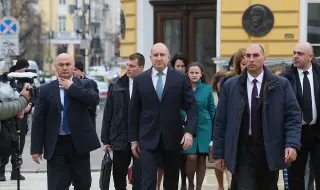
Radev will register a party after the elections, his project will be European, but with a sovereignist slant and will form a coalition with the parties fighting against the oligarchy. What else did we learn from his interview on "Panorama"? By Daniel Smilov.
The first interview on Rumen Radev's party political platform was more remarkable for its length than its content.
Radev was given a huge amount of airtime on BNT - 40-45 minutes - and he was invited alone to the studio, without being able to be replicated by other participants (or even by the presenter). Such a privilege for a fledgling party is inappropriate. This is an inequality paid for with taxpayer money, through which public television becomes a sponsor of Radev's political project. It is true that there must have been viewer interest, but such an obvious disproportion in coverage is unfair to the other participants in the party race. The CEM should at least come out with a statement on this issue.
What did we (not) learn from Radev's interview?
The name of the party project, the people in it and the technology for participating in the elections were not disclosed. It became clear that the party will be registered after the elections, which means that Radev will appear in a coalition with the registration of existing parties;
It was stated that Radev's party will fight for a free, democratic and European Bulgaria. This formula, if the words in it really matter, should mean that the party will be democratic and European-oriented;
The main topic that Radev would like to highlight is "the fight against the oligarchy". He did not name the main political figures of this oligarchy, but one could assume from his words that they are the ruling parties from GERB and DPS so far. Radev did not mention any other Bulgarian politician - neither Peevski nor Borisov. The connection he made between the oligarchy and inequality in Bulgaria was good;
Regarding Europe and the EU, Radev did not say anything that would put him directly in confrontation with the idea of European integration. He mentioned the country's participation in all European structures as a good thing, insisting that Bulgarian decisions be made with national interests in mind. This is both banally true and gives grounds to "patriots" and "sovereignists" to hope that Radev will oppose the EU. The hopes of the "sovereignists" were inspired by his request that all decisions be made in Bulgaria. This contradicts the principles of the EU, which assume that some decisions should be made together with other countries;
Regarding the euro, Radev said that he was not against it, but against the way in which it was introduced. Radev called for a referendum when he realized that the government did not provide enough aid for the poor when the country entered the eurozone. At the time, it was not clear why he called for an unconstitutional referendum instead of more aid for the poor. And in general, his claims that Bulgaria had not fulfilled the Maastricht criteria for the eurozone were amateurish;
The only European politician mentioned was Orban, and in a positive connotation - as someone who helped us with North Macedonia and energy. Both claims in this direction are at least controversial. Obviously, Radev will try to position himself as some kind of "Bulgarian Orban", which in turn calls into question the formula "free, democratic and European Bulgaria";
As for Ukraine, Radev repeated his thesis that Crimea is de facto Russian, but legally it is not. Then, referring to his training at an American military academy, he defended the position that Ukraine's counteroffensive in 2023 was a strategic mistake. To some extent, this is a true statement, which, however, does not take into account the delay in military aid from the West, which allowed Russia to create strong defensive lines. Here, Boyko Vassilev did not enter the debate in essence, because Radev's thesis since 2022 was that Ukraine should not be provided with military aid, since its resistance is doomed. However, Ukraine has been fighting for four years despite this Radev expert forecast, and Russia has not even taken over Donbass yet. The real question about Radev's position is why he thought that the West, and we as part of it, should not provide assistance to an attacked country that needs it for its survival? And what would the Bulgarian national interest gain if Russian troops had reached Romania?
For "Botaş" both the questions and the answers were superficial. Vassilev correctly noted that the losses from unused quantities are enormous. Radev countered that the project could be profitable in the future. The whole problem, however, is why a caretaker government obliged Bulgaria to use and/or pay for huge quantities of gas from Turkey for 13 years. Russia's strategy to turn Turkey into a hub for its gas exports was clear. Isn't this actually a triple deal: Bulgaria is committing to pay for large quantities of gas from Turkey, and Turkey is committing to take similar quantities of gas from Russia. Turkey is happy as a mediator, and Russia is overcoming its isolation as a supplier, and Bulgaria is paying, even without using the agreed quantities;
Radev was quite evasive about Donald Trump's Peace Council, but he still said that the country's inclusion in it did not happen as it should;
Radev was evasive about possible coalitions, but it became clear that he would form a coalition with parties that fight against the oligarchy. This opens doors for him to PP-DB and "Vazrazhdane", MECH and "Velicie". Regarding the judicial reform, he hinted that votes from GERB may also be needed;
Radev said that he will not submit proposals to change the constitution, which is generally good news;
He will not raise taxes, there is no left, no right, and he can be called a populist, as he himself said with irony.
Questions that remained unanswered
As for his first political interview as a party leader, Radev's behavior was military-style, stiff and disciplined, which may appeal to voters disgusted by the Hashlash language and the loose party aesthetic. His campaign strategy will obviously be maximum fluidity, diverse and internally contradictory statements, and an abstract positioning of the project as "European", but with a sovereignist bias. The lack of specificity may be its Achilles' heel. Here are some important questions about the new political project that remained unasked or unanswered:
Can Bulgarian sovereignty be protected without the EU and NATO?
Is there a need for a common European defense?
Is there a need for a unification of European financial markets?
Is it good for the major European countries to offer the others a project for deeper European integration?
Should Europe support Ukraine, including with military aid?
Should Ukraine be part of the EU?
Is it in Bulgaria's interest for North Macedonia to be outside the EU?
Does Radev approve of Orbán's domestic policy towards civil society in Hungary?
Does he approve of Hungary's policy towards the EU and the Balkans?
Which European family will Radev join? joined with his formation?
This text expresses the opinion of the author and may not coincide with the positions of the Bulgarian editorial office and the State Gazette as a whole.