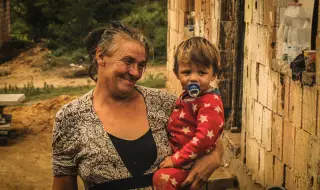
A large part of the children in Hungarian homes are of Roma origin, but most potential adoptive parents in this country do not want a Roma child. Katalin and András are an exception. They have three daughters, to whom they are biological parents, but they really want to have a boy, and that's why they decided to adopt Mark. He is of Roma origin and was immediately given to a home to be raised.
Katalin and András adopted him when he was 2 years old. His ethnicity doesn't matter to them at all - the important thing is that he is healthy. Both parents have always been honest with Mark about his ethnic origin.
"I am adopted. But they love me very much."
From the very beginning, Katalin and András were aware that they would most likely be offered a Roma boy, since most children in Hungarian homes are of Roma origin. "We took it as something completely natural: if they offered us a Roma boy, then we would have a Roma boy for a son", says Katalin. And Mark himself, who is already six, says: "I am adopted. But they love me very much".
Not everyone in Hungary thinks like Katalin and András. According to experts, only about a fifth of potential adoptive parents in the country have no preference regarding the child's origin.
Although the Hungarian adoption system does not allow for the child's origin to be noted or disclosed, it is common practice for applicants to state in their application that they do not wish to adopt Roma children.
Despite widespread prejudice in Hungarian society, Mark's new family has always been respectful of his Roma identity. "We highlight the positive aspects - what Roma are good at, what talents they have, etc." says Katalin. And her husband András adds: "It is especially important for me that he is proud or at least thinks positively about the fact that he is Roma".
"My whole world fell apart"
Things are completely different with Eva (name changed), who was also adopted - in the 1990s. It was only when she was 10 that she learned that she was of Roma origin - her biological mother was Roma.
"Then my whole world fell apart. Roma have a very negative image in society and that is why I definitely felt ashamed."
To this day, Eva is afraid of prejudice. That is why she continues to hide her ethnic origin. Only two family members know the truth.
"I don't want to be attacked, and my loved ones to be hurt. I don't want to be insulted and harassed," says Eva.
Zuzana Szekely is a psychologist at Moseskorb, an organization that supports adoptive parents and adopted children. In her experience, prejudice against Roma is deeply rooted in Hungary.
"We had a case where the adoptive parents had not set any requirements regarding the child's origin. However, due to the reaction of their neighbors, who also have an adopted child, but with lighter skin, the potential adoptive parents changed their mind and refused a Roma child."
"It has to come from the heart"
Katalin and András say they have been lucky and have not encountered any prejudice or hostility so far. However, they advise prospective adoptive parents to honestly consider their decision.
"If someone realizes that they have reservations about adopting a Roma child, it is better not to do it, because it has to come from the heart," says András.
In Hungary, there are currently more children waiting to be adopted than potential adopters. And most of these children are Roma.
Author: Laura Szaplonczay