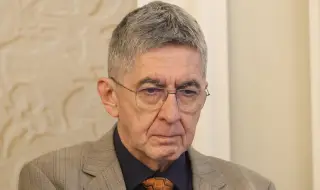
Author: Mina Kirkova
Bulgaria has recorded a drop of several points in the Corruption Perceptions Index of "Transparency International" over the last two years. In your opinion, what is the reason for this record low score for 2025?
Boyko Stankushev: Over the last two years, the drop is actually five points. And we have collapsed to 40 points (ed. note out of 100 possible) - together with Hungary. Even people who are not interested in corruption and have no idea about it already know what it is due to. It is due to the fact that in Bulgaria the judicial system does not work, that there is a deep state, that there is a symbiosis between the ruling and criminal mafia circles for the purpose of benefiting, distributing large financial resources - we are talking about billions. The reason is that the fight against corruption is practically not being waged, it is only being talked about. I can say that on none of the main points that could define that there is a fight against corruption, there is no progress. On the contrary - this so-called fight is purely facade.
Bulgaria is the country in the EU with the most acute deficit of justice
And I dare to make a pessimistic forecast that it will get even worse in the future until the judicial reform is carried out to guarantee justice. Bulgaria is the country in the European Union with the most acute deficit of justice. And every Bulgarian citizen will tell you this - regardless of their ideological leanings, which political platform or party they gravitate towards.
This is the general attitude, which, by the way, also coincides with the position of business in Bulgaria - 89% believe that corruption is widespread. If, say, the "yellow vest" and the "urban right" imagine something, nearly 90% of business cannot imagine it. After all, this is the vector that still feeds Bulgaria relatively decently and that is why we are not as poor as we could be. But the price that business pays to survive is great, because in principle, when entering into one or another project to implement some business, they always calculate costs that are caused by the corruption risk. And practically every single one of them, except for those who gravitate around the ruling party, mainly around Borisov and Peevski, calculate an additional cost - to pay for the opportunity to get as close as possible to winning a public procurement competition. Otherwise, nothing happens.
We are obliged to accept the conclusions of this report, known as the Corruption Perception Index, because this is not said by an organization, but by a team that has processed information from 13 independent sources. This is a verdict. This is very scary, because it is the sad truth and I do not see at the moment any inclination on the part of the institutions that are called upon to fight corruption to start doing so. However, things will not start if only some changes are made there. Things will start when the long-awaited reform in the judicial system is carried out, by first releasing and replacing the entire Supreme Judicial Council, and accordingly the so-called. a prosecutor general who is not a prosecutor general at all, etc.
In light of the Petrokhan tragedy, society is currently demonstrating widespread distrust in institutions. In your opinion, is this also related to the high level of corruption in the country?
Boyko Stankushev: The corruption environment, which is based on very well-structured, invisible underground power channels, in which there is synergy between criminals of international stature with magistrates, with employees in the special services and politicians, has led to the fact that in the institutions that are called upon to fight corruption - in the Ministry of Internal Affairs, in the State Security Agency, everywhere, in fact, the majority of people have an acute lack of professionalism, they are also severely dependent and we cannot rely on and believe that these people will do their job.
In recent days, we have observed how many people have become entangled in the promotion of a previously invented thesis based on a stupid scenario and it has come to the point where representatives of different institutions contradict each other on key points in this entire sad story. Have you noticed that at least to this day, as far as I know, no one tells us who the supervising prosecutor is, no one tells us who the investigator is, and the heads of the services speak? But the people who should by law be assigned to conduct the investigation are not speaking. The mess is complete and they are so helpless in their quest to politicize things that they did not even think, when constructing this scenario, to leave themselves some loopholes for maneuvering when asking such questions. Because we citizens can do nothing in this situation except ask questions.
But how can everyone, except for a few brave ones, ask questions, after in recent years we have witnessed increasing repression against independent journalism, attempts to investigate civil society organizations - to intimidate them with the fact that because of their funding the law on the so-called "foreign agents" will be adopted, and some other things that have already happened in Hungary. Here for now, this process has somehow seemed to have stopped, I suppose because we are on the eve of elections, so as not to anger all the media.
At the end of last year, the enormous civic energy led to the overthrow of the government. Now the next parliamentary elections are coming up. Do you think that after them there is a prospect of any decisive changes on these issues?
Boyko Stankushev: Everything depends on the ratio of votes in a future National Assembly and most of all on what inter-party agreements will be concluded on the issues for which majorities will be needed.
There will be some thematic majorities, on which I assume there will be some progress. For example, I dare to hope that a very serious attempt will be made - hopefully successful - for reform of the judicial system, where, no matter how diametrically different they may seem at times, representatives of "Vazrazhdane", of the PP-DB, of the hypothetical party of Rumen Radev and some others, such as the APS, for example, could join forces. On other issues, of course, they will not be together. There is no other possible answer at this stage. If the elections are sufficiently clean and transparent and unmanipulated, as they were in 2021 to a significant extent, this could change the political picture.
You can't see with your own eyes how you are being robbed and do nothing
Regarding civic energy - it always appears in Bulgaria with a long delay, because the Bulgarian is amazingly patient - in many cases downright sheepish, but it appears where, as the grandmothers used to say - the knife is pressed to the bone. When it becomes unbearable. I can't say whether it will be decisive that in recent years hundreds of thousands of young people who don't remember the past at all have acquired voting rights. Their attitudes have hardly been studied yet, and these are people with a different value system, a different psyche, a different view of the world, and different ideas about themselves.
I count on pragmatism to speak in every Bulgarian citizen. Because you can't work and not get better. You can't see with your own eyes, hear with your own ears how you're being robbed, and do nothing. I count on this increasingly rational attitude and pragmatic behavior to lead to future changes.