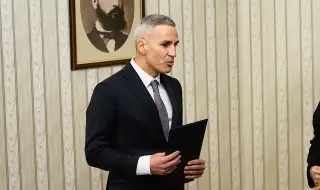
The profile of the prime minister and future ministers promises proven professionalism, an innovative approach to the distribution of portfolios and political neutrality. There is also at least one surprise. Analysis by Vesselin Stoynev.
Andrey Gyurov's caretaker government is unlike any caretaker cabinet so far. The approach to its composition and the distribution of portfolios is innovative and promising. Because it underpins the expertise, integrity and political neutrality with clear civic engagement of the ministers in key positions. And the brighter political biographies of some of them are neglected or “expired“ – referring to party positions in the distant past, or “downplayed in scope“ – referring to “second-league“ formations or “party dissidents“.
Party dissidents
If we start with the Prime Minister's profile, in terms of education and experience he is a proven professional in the field of economics and a high-ranking political figure from the recent past as chairman of the parliamentary group of “Continuing Change“. In reality, however, Gyurov, together with Nikola Minchev, became so popular among PP voters that they were “thrown“ into the European Parliament and the Bulgarian National Bank so as not to be competition to the then leaders. In this sense, Gyurov is more of a representative of the democratic community as a whole than of his former party, with which he is no longer affiliated, not only formally. And in a sense, he is a PP dissident who remained faithful to the idea of change.
Agricultural Minister Ivan Hristanov was also among the bright figures of the PP - as a fighter against the mafia at the "Captain Andreevo" border checkpoint in his capacity as deputy minister in this ministry in the "Petkov" cabinet. However, he later created his own political project. Now he will have the opportunity to continue his anti-corruption activities and rhetoric from a high bell tower.
Transport Minister Korman Ismailov also has a biography of a "former" - expelled from the DPS 15 years ago, created his own formation, and later participated in the Reformist Bloc. It seems that among his main tasks will be to limit the appetites of powerful companies in the transport sector that are close to the DPS-New Beginning.
Georgi Klisurski, who takes over the Ministry of Finance, has experience as Assen Vassilev's deputy minister for budget, debt and municipalities, but left the PP, disgusted by the tapes with Sofia Deputy Mayor Barbutov. Now he himself is Deputy Mayor for Finance, Healthcare and Concessions in the Sofia Municipality. It seems that his task will be to announce the current implementation of revenues and expenditures, to revise the inheritance for privileged municipalities and projects and to propose an extended state budget by the middle of the year.
Second-line party members and former party members
Hasan Ademov, who takes over the social ministry, is an active politician from the APS, but above this profile shines far brighter the halo of one of the greatest experts in social and health legislation, one of the fathers of the social and health insurance model from a quarter of a century ago, and one of the most respected members of parliament from all previous parliaments.
Foreign Minister Nadezhda Neynski has a bright political and professional biography of foreign minister, party leader and ambassador. However, this biography refers to times and formations that are not relevant today or the party abbreviation has a different scope and meaning (SDF). At the same time, Neynski is the embodiment of decades of successful pro-European and pro-Western Bulgarian path and with his experience and name can be not only a request, but also a hope for its continuation in today's turbulent geopolitical times, in which even a few months of interruption or meandering, as long as the life of a caretaker government, can prove fatal.
Energy Minister Traycho Traykov was also a minister in Boyko Borisov's first cabinet, but was expelled from it because of his anti-Russian positions in the energy sector. He was also a presidential candidate from the Reformist Bloc, and is now the mayor of a capital region from the PP-DB. In energy, Traykov, with his biographical profile, will have to hold back pro-Russian interests and influences and defend right-wing economic views in a sector often subject to populist arbitrariness.
In the first cabinet “Borisov“ Minister of Education, as well as now acting minister, was Sergey Ignatov.
Technocrats by continuity and due to lack of others
As a sign of continuity in the government, the fact that Atanas Zapryanov remains in the post of Minister of Defense can be seen. He was also an acting minister in Glavchev's cabinet. His profile is more of an expert, and turbulence in the rearmament projects, which he has long led, could prove fatal if there is a power shake-up in the ministry.
Yulian Popov is a representative of the broad right-democratic center and has previously headed the Ministry of the Environment both as an official and as a regular minister. Green policies, energy security and climate diplomacy are his role at the international level. However, domestically, he will have to show more difficult diplomatic skills.
The director and chief conductor of the Sofia Philharmonic Orchestra, Nayden Todorov, seems to have already signed up for the post of Minister of Culture, as soon as a caretaker government is formed. Now, however, he will once again have to face a theatrical problem - after the scandal with fictitious appointments that marked his previous mandate, he is now facing a protest from theaters.
With a bright technocratic profile is the Minister of Regional Affairs, Angelina Boneva, who is a high-ranking expert on European programs and regional development in the ministry. The task before her seems to be how to both pick up the slack from delayed projects and prevent them from being inherited from the previous cabinet in privileged municipalities.
The youngest member of the cabinet and therefore with the poorest biography is Maria Nedina, who holds the entire post of deputy prime minister with the portfolio of European funds, but without a ministerial portfolio. Her only contact with the state government so far is as an advisor to the acting deputy prime minister Atanas Pekanov and head of the cabinet of two acting ministers.
Expert-civilian ministers
On the key task of the acting government - to ensure fair elections, the prime minister's approach is significant. For the first time in our country, there will be a deputy prime minister for fair elections and the post has been entrusted to the election expert Stoil Tsitselkov, who has been advocating clear civil positions on issues of electoral rules and practices for years. Being a minister without portfolio, his role will obviously be to coordinate the work of the executive branch at the central and regional levels on the organization of the elections and interaction with the CEC.
The key interior minister for the prime minister and the president is a surprise - judge Emil Dechev, former deputy justice minister. He was strongly disliked by GERB and MRF while he held this post and has repeatedly spoken out quite sharply in parliamentary committees about a lawyer.
The key figure in this bloc is Andrey Yankulov, former prosecutor, deputy minister of justice, and now a lawyer. In addition to taking over the currently important ministry of justice (due to the need to propose a new acting prosecutor general to replace Borislav Sarafov, who usurped the post), he will also be deputy prime minister - which emphasizes the role of the rule of law in the work of the cabinet, and most likely Yankulov will also oversee the Ministry of Internal Affairs (unless the prime minister himself leaves this key department under his care).
The prospects for the cabinet
In short and at first glance, the profile of Andrey Gyurov's caretaker government is party-neutral, but not apolitical. Party neutrality is guaranteed by the fading and/or dominance of the professional over the party component in the ministerial biographies, and through a balanced spectrum of the origin of party ties. However, by its design, the cabinet makes a claim for an active civic-political beginning, with which it has a serious chance of making a clear difference in the way of governing so far.
The government will certainly be subjected to fierce attacks, and may also turn out to be a victim of excessive expectations. A caretaker cabinet after Glavchev can hardly fail. The “Gyurov“ cabinet it may simply do well, but it may also raise the bar so high that many in Bulgaria will say to themselves at the end - hey, can't it remain as a regular government?
This text expresses the author's opinion and may not coincide with the positions of the Bulgarian editorial office and the State Gazette as a whole.