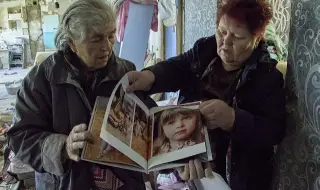
The abuse and rape of these women, and thousands of other Ukrainian women, is so horrific that words often fail to express it. Many of the crimes remain behind a wall of silence. The film "Footprints" gives a voice to the victims.
"I have always wished that my students would never have to take up arms," Ukrainian language and literature teacher Lyudmila Mefodievna, who has 45 years of experience, told DW. After pro-Russian armed groups arrived in her village, one of the soldiers tortured the elderly woman and raped her. Leaving, he left a cartridge on the table and threatened her: “I will kill you if you cry!“.
The teacher's story, along with others like it, is told in the Ukrainian documentary “Follows“ presented at the “Berlinale“. In it, Lyudmila Mefodievna says that for a long time she could not talk about what she had experienced. But her family insisted - so that the testimony of the crime could be heard. “They beat me, strangled me, cut me with a knife, knocked out my teeth, broke my ribs. They took my health. Thanks to the support of the remarkable women I met, I was finally able to start talking. I started to tell the story. Because I want the whole world to know about the crimes committed by Russia, about the torture and abuse of Ukrainians“, are the words of Lyudmila.
"Blood in Ukraine is flowing like a river"
The woman tells DW that after the occupiers came, most of her students went to defend their homeland. “Many of them died, some were captured, others returned from the front with serious injuries. It is very painful to see and experience this. Right now, blood is flowing like a river across Ukraine. Mothers are crying over the bodies of their sons, their husbands, their relatives. In our family alone, four men died, leaving behind small children.“
The Ukrainian women featured in the film are members of the organization SEMA Ukraine, which helps women who have experienced violence. Olga from Kherson was held captive for a hundred days with her son and husband. “I was ashamed to talk about what they did to me. Getting to know the organization became my second life. Now we help other women and men. Because men have also experienced sexualized violence - although they hardly talk about it.“
72-year-old Nina can barely speak and almost immediately starts crying, remembering how the war destroyed first her home, and then her life. “I hoped to live peacefully in the village, plant fruit trees and wait for grandchildren. But the tanks came and the land began to burn. And then the beasts came.“ The woman's face contorts with shame and grief.
The voice as a weapon
It is precisely shame that prevents victims of violence from testifying against their aggressors. Therefore, victims of sexualized violence during the war are practically excluded from official statistics. When talking about victims among the civilian population, it is customary to mention the dead, the wounded, and the captured. “Those who have experienced sexual violence, including in captivity, often go unnoticed, do not receive help from the state. Many suffer from stigmatization, and some cannot cope with what they have experienced“, notes SEMA Ukraine. “Our voices are the weapon that will punish criminals“, they say there.
“When I started talking about my experience, I often saw how people seemed to shut me out. When I tried to talk about the most terrible thing, I encountered blank looks. They stopped listening to me. This is a kind of internal defense mechanism: when it is too painful and unpleasant to listen, a person simply does not perceive what is said. I believe that this film can lift this barrier. And that after it, it will be impossible to "close your ears" again, Irina Dovgan, the founder of the SEMA Ukraine organization, told DW.
The film also tells her story - how in 2014 she was captured by pro-Russian armed groups in Donbass because she was helping the Ukrainian military. After several days of torture and violence, they tied her to a pole in the center of Donetsk, wrapped in the Ukrainian flag and with a sign that read "She is killing our children". The residents of the city walked past her to spit on her and insult her. However, she was somewhat lucky - her photo on the pole was distributed by the world media and in the end they were forced to release her.
“I hope the world will support us and understand that we do not need sympathy, but a joint struggle. So that this does not happen again in the future and the criminals are punished. Otherwise, the evil will return again and again,“ says Irina Dovgan. After what she experienced, she finds the strength within herself to unite and support other injured women.
How the film "Follows" was born
The film's director, Alisa Kovalenko, was also tortured and raped, but found help at SEMA Ukraine. She, too, could not talk about her experience for a long time, and she describes her meeting with other women who had gone through the same torture as a turning point. "For the first time, we sat down together and started talking. It was healing - we felt that we were not alone. And we gradually began to break down the wall of silence."
Kovalenko's goal, which is also joined by director Marusya Nikityuk, was not to shock viewers: "Our cinema is about dignity, about the world that is born despite evil. We did not want to traumatize either the heroines or the viewers, which is why many of the stories did not make it to the screen. We never told, for example, how women in captivity starved and four of them shared one small piece of dough a day, or how they were forced to sing the Russian anthem to be allowed to visit the toilet. But these testimonies exist - in books, in human rights documents, in memory," says Kovalenko.
"The war is gradually becoming a background. The tragedy in Ukraine is becoming a statistic, and statistics - a routine. That's the scary thing," the film's directors note. "Traces" brings back the names of the women. These are no longer numbers - these are specific women who look the viewer in the eye and speak. Tragedy should have names, not become statistics."