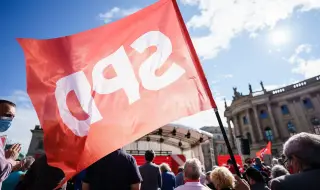
In 2026, new parliaments will be elected in five of the German states, and the German Social Democratic Party (SPD) does not have much reason for optimism. Surveys show that in two of these states the Social Democrats could be removed from power after many years of rule, and in two others they will receive single-digit results. However, in three of these five states the elections will not be held until the fall.
However, there is also a lack of success at the federal level, where the SPD has long fluctuated between 13 and 16 percent approval. What happened to the former People's Party, which at its best managed to win over almost every second voter in Germany?
The Social Democrats lost the workers
To understand what went wrong with the SPD, you have to look far back in time. It was founded in the second half of the 19th century as a classic workers' party, the political representative of the practically disenfranchised factory workers. Their lives were marked by long working hours, job insecurity, low wages, a lack of labor protection and a housing crisis.
For a long time, they were the classic voters of the SPD. The Social Democrats advocated a policy that promised education, career development and success regardless of origin. But the classic working class no longer exists - well-paid workers have long since formed the middle class of society.
Where are SPD voters headed
According to an analysis by the Forsa public opinion research institute from November 2025, today only nine percent of ordinary workers and the unemployed would vote for the Social Democratic Party. People who feel socially disadvantaged sympathize with the far-right "Alternative for Germany" (AfD), which has been declared partially extremist. In February 2025, data was published according to which 38 percent of workers prefer this party.
Sympathizers of the SPD have also switched to the Left Party, which is particularly bitter for the Social Democrats, since the Left Party also arose from dissatisfaction with the social policy of their party under the leadership of former Chancellor Gerhard Schröder.
As head of the Social Democratic Party, Schröder won the 1998 Bundestag elections with almost 41 percent of the vote. His credo: elections are not won on the left spectrum, but in the center of society. Against the backdrop of high unemployment and a collapsed economy, he imposed a radical reform of the welfare state: state benefits were cut, protection against dismissal was reduced, and the low-wage sector was expanded.
More than half of voters have abandoned the Social Democrats
The conservative CDU/CSU parties welcomed the reform program, as it was a success for the German economy. However, serious disputes arose within the SPD: the left wing of the party rebelled and refused to support Schröder's policies. In 2005, prominent former SPD members and trade unionists founded their own left-wing party.
In just ten years, the German Social Democratic Party lost almost half of its voters, who switched to both the Greens and the CDU. Its leader and Chancellor of Germany, Angela Merkel, has steered the party towards the political centre, and critics have likened this to the social democratisation of the CDU.
No profile in the grand coalition
It has become increasingly difficult for voters to make a meaningful distinction between the CDU/CSU and the SPD, especially after the political parties ruled together between 2005 and 2021. During this time, the SPD made many political compromises and increasingly lost its profile.
The demands for policy change came from the party's left wing, due to the massive loss of trust among voters. More left-wing social and tax policies were supposed to help. Wealthier people and those who earned well had to pay higher taxes and fees, and cuts to social benefits had to be prevented. But in the coalition governments in which the Social Democrats participated, almost none of this could be implemented.
Sholz's governance and its negative consequences
Before the 2021 Bundestag elections, the SPD had 16 percent approval according to surveys. But then the CDU made big mistakes, and the Social Democrats caught up and eventually won. The party hoped that it was back on the road to success.
However, the opposite happened: serious disputes and deadlocks quickly arose in the coalition led by the Social Democratic Chancellor Olaf Scholz. The coalition collapsed prematurely and the SPD's reputation was further damaged. It received only around 16 percent of the vote in the 2025 Bundestag elections, and Manfred Gülner of the Forsa polling institute described the situation as "an existential threat" to the SPD.
The new Social Democrats' program is oriented to the left
However, the Social Democrats have once again entered a coalition with the CDU/CSU as the junior partner in it and are now facing the same old problems: they are once again at risk of not being able to profile themselves independently. The party is developing a new program that will include a very left-wing social policy. But can these policies be imposed on the coalition partner?
Under the leadership of Friedrich Merz, the CDU has become significantly more conservative again and has moved to the right. In the context of empty state coffers and the state of the economy, cuts in social spending are required, and a major reform of the welfare state - pensions, healthcare and care - is needed.
How much longer will the current coalition last?
The SPD also believes that these reforms are necessary, but insists that they do not harm anyone, i.e. that no one is worse off because of them. Therefore, the rich should be subject to higher taxes and social security contributions. The population supports the proposal, and recent surveys show that approval of the SPD is rising slightly.
However, the conservatives reject raising taxes. With local elections in Baden-Württemberg and Rhineland-Palatinate approaching in March, the coalition partners are trying to avoid open conflict, but the government seems increasingly paralyzed in domestic politics. The only thing they agree on is a proposal to ban children under 14 from using social media.
It can be assumed that there will be some movement in the coalition after the first two local elections. The worse the results the Social Democrats achieve in the two states, the more pressure is expected to increase within the party to separate from the CDU/CSU.
Author: Sabine Kinkarz