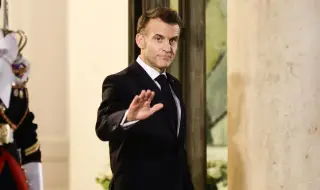
This week, French President Emmanuel Macron delivered two key speeches, with which he once again placed France at the center of the geopolitical scene. One speech was long planned, and the other was due to a coincidence, summarize French media, including France Presse, “France 24“, BFM TV, “Le Monde“ and “Figaro“, etc., writes BTA.
On March 3, Macron delivered an 8-minute address to his compatriots, dedicated to the topic of the sharp escalation in the Middle East. In his address, broadcast on French television, Macron stated that Iran bears the main responsibility for the current war. This responsibility, according to the French leader, stems from Iran's dangerous nuclear program and from the order that the regime in Tehran issued to Iranian security forces to shoot at its own people during the large January protests. But Macron also said that "the United States and Israel have decided to launch military operations against Iran, which are carried out outside international law - something that we cannot approve of", Agence France-Presse, Brut and BFMTV point out.
"But the fact remains that history never mourns the executioners of its own people", Macron added, stressing that none of the responsible representatives now eliminated in Iran will be pitied. He already adopted this diplomatic position during the American operation in Caracas on January 3, when American special forces captured Venezuelan President Nicolas Maduro and his wife and took them to the United States to be tried on charges of narco-terrorism, notes France Presse.
In his statement on March 3, Macron also warned Israel not to undertake any ground operation in Lebanon, because this would be a dangerous escalation and a strategic mistake. At the same time, he acknowledged that the Lebanese pro-Iranian Shiite movement “Hezbollah“ had made a big mistake by striking Israel first. Macron was referring to “Hezbollah“'s actions in support of Iran shortly after the start of the Israeli-American strikes on Iranian targets.
“Faced with this war, which is in the process of expanding and for which no one knows today when it will end, France must make decisions for its security, for that of its citizens and its bases, as well as for the security of all its allies in the region,“ Macron also said, mentioning Qatar, Kuwait, the United Arab Emirates, Jordan, Iraq and Iraqi Kurdistan as allies. Macron announced that against this backdrop, it was sends the aircraft carrier “Charles de Gaulle“ and its escort ships to the Mediterranean Sea.
At the time he announced this, “Charles de Gaulle“ was quite far from the hot zone. It was in Northern Europe, where it stayed for a while in Malmö, Sweden, as part of a NATO mission aimed at strengthening the security of the Arctic and showing the United States that Europe can defend Greenland, which is part of Denmark and which Trump wants to acquire precisely with the argument that Denmark and Europe cannot guarantee its security, which also poses a danger to the United States. It was while it was in this region that “Charles de Gaulle“ found itself in a dangerous situation after a drone was located near it. The unmanned aerial vehicle was neutralized by Swedish forces, and it was later reported that it was a Russian drone. The French authorities defined this as a provocation.
In his speech on On March 3, Macron announced that Rafale fighter jets, air defense systems and a long-range radar detection system had been deployed to the hot zone, without revealing where exactly all this was located. Macron also said that the same evening the French frigate Languedoc and its air force would go to Cyprus to guarantee the security of this ally of France in the EU. "We must stand by our friends and allies in the region for their security and territorial integrity," the French leader stressed, explaining that this was a strictly defensive position taken by Paris.
The French leader clarified that his country was not acting in this way in support of Trump and Netanyahu - two leaders with whom Macron has strained relations in recent months. He exchanged sharp remarks with Trump over Greenland in January, and he came into conflict with Netanyahu when decided to recognize the independence of the Palestinian state in September.
In his remarks, Macron confirmed that two French bases in the Middle East had suffered material damage during limited strikes and that French forces had shot down drones in legitimate self-defense. He did not elaborate.
Macron also said that he wants to form a coalition that, with common means, including military ones, will secure the essential sea routes and the world economy. He was referring to the Strait of Hormuz and the Suez Canal, recalls Agence France-Presse.
In his speech, Macron also announced that the first evacuation flights of French citizens from the Middle East would arrive in France that very evening. In this regard, Paris is a little behind its neighbor Italy, which began evacuating people from the region on Monday. Because of this delay, the French authorities have drawn an angry reaction from a certain segment of French citizens in Dubai - French influencers, who announced that they felt abandoned and did not hide their panic in the first days of the conflict. However, some of them later softened their tone and said that they felt protected in Dubai. This change is believed to be due to the fact that local authorities have the legal right to sanction those who report misleading things about the country's security.
According to the French Foreign Ministry, 400,000 French citizens are in the countries of the region affected by the conflict.
In his speech on March 3, Macron also said that in France itself, security around certain sites and in public places would be strengthened through military patrols as part of Operation Sentinel, which has been in effect since the 2015 terrorist attacks.
In addition to all the measures announced on March 3 that France would take, on March 5, Paris announced that it had accepted American aircraft to use the French base in Istres, but only if they were performing a support mission and not participating in combat operations. It was initially reported that France had agreed to use its bases in the Middle East for the purpose, but Paris denied this information, BFMTV reported.
France has only one aircraft carrier, the Charles de Gaulle, which usually carries 20 Rafale fighter jets and two radar-evading aircraft. The nuclear-powered aircraft carrier has a crew of nearly 2,000. It is 261.5 meters long and has a displacement of up to 42,500 tons when fully loaded, France 24 and the French edition of Euronews recall. The Rafale aircraft on board the aircraft carrier can carry Scalp missiles air-to-ground with a range of over 500 km, anti-ship missiles “AM39 Exocet“, as well as bombs with laser or GPS guidance. The aircraft can also be loaded with air-to-air missiles “Meteor“. The aircraft carrier itself is equipped with anti-aircraft missiles “Aster 15“, 20-mm guns “Jiat“ and electronic warfare systems. The aircraft carrier has participated in a number of missions, including in Libya in 2011, against “Islamic State“ in Syria and Iraq between 2015 and 2019, and in “Enduring Freedom“ after the attacks on the United States on September 11, 2001.
France is present with bases in the hot region. It has three military bases in the UAE under a 2008 agreement, the French Ministry of the Armed Forces website states. Paris has a naval base in Abu Dhabi, an air base within the Emirati air base "Al Dhafra" 60 km from Abu Dhabi, which is home to "Rafale" and "A400-M" fighter jets, and a military base in the "Zayed" military city 65 km from Abu Dhabi, which is home to "Leclerc" tanks, VEB SEI armored personnel carriers and "Cesar" self-propelled howitzers. More than 900 French military and civilians are based at these three bases, two of which were targeted by Iranian attacks. Through these bases, France can direct its possible operations in the Middle East and the Indian Ocean, be ready to intervene in any crisis in the region requiring the use of French armed forces, fulfill commitments to partner countries, act jointly with their forces and ensure the security of French citizens and French interests in the area.
France also continues its participation in the international anti-jihadist coalition in Iraq and Syria within the framework of the French operation “Shamal“. For this operation, 600 French soldiers are deployed on the ground, which could reach 1,100 if French frigates, periodically sent to the Red Sea and the Gulf, are also included in the operation, recalls Agence France-Presse.
France also participates with 700 soldiers in the multinational UN force in Lebanon, commanded by Italy and including a total of 7,500 soldiers from a total of 48 countries, recalls Agence France-Presse.
In addition to all this, France also has a military base in Djibouti. The 1,500 French soldiers stationed there assist Djibouti in the defense of its territory, airspace and territorial waters and are ready to provide support, if necessary, in land and sea rescue operations or in operations in support of French forces and allies in the Middle East, recalls the website of the French Ministry of the Armed Forces.
Following the measures announced by Macron on March 3 to protect French citizens in the Middle East and to protect EU ally Cyprus, other European countries followed the French example and announced similar plans to provide military assistance to Cyprus and the Gulf countries, clarifying that they are not and will not join a war, summarize Agence France-Presse, “France 24“ and BFMTV. This assistance was announced after the regional interests of these countries and the security of their allies were directly threatened by the Iranian response to the Israeli-American actions.
Great Britain announced that it is sending the warship “Dragon“ to the Eastern Mediterranean, equipped with the “Sea Viper“ missile system, capable of launching 8 missiles in less than 10 seconds. The country will also deploy "Wildcat" helicopters equipped with "Martlet" missiles capable of shooting down drones. They will be stationed in Cyprus. In addition, London announced the dispatch of 4 "Typhoon" fighter jets to Qatar. British Prime Minister Keir Starmer also allowed the US to use 2 British military bases, but for specific defensive and limited purposes, after initially refusing to play a role in the war, for which Trump accused him of being “not Winston Churchill“.
Greece sent 2 frigates and 4 F-16 fighter jets to Cyprus and allowed the US to use the military base in Souda on the island of Crete.
Spanish Prime Minister Pedro Sanchez clearly opposed the war in the Middle East and entered into a verbal conflict with Trump, who threatened his country with economic punitive measures. Madrid received Macron's support in this verbal confrontation. But in the end, Spain announced that it would send its most modern frigate “Christopher Columbus“ to defend Cyprus.
The Netherlands announced that it would help Cyprus with naval assets. Germany has declared readiness for defensive measures in the region.
Yesterday, Italian Prime Minister Giorgia Meloni clarified in a radio interview that Italy is not at war with Iran and will not be involved. A similar clarification was made during a second hearing in parliament within a few days by the Italian Ministers of Defense and Foreign Affairs, Guido Crosetto and Antonio Tajani. Rome then stated that it would send naval assets to Cyprus in the coming days. Rome has also committed to providing air defense systems, and according to Italian media, these systems may include the modern SAMP/T system that Rome has already sent to Ukraine. The Italian Defense Minister stated that the Italian bases could be used by the United States to provide logistical support for aircraft that are not intended for combat operations. This use could take place within the framework of existing bilateral agreements. Crosetto stressed that the current war finds Italy in the same scenario as other countries and pointed out that of course all this is outside the rules of international law, writes “TG Com 24“. Regarding aid for the Gulf countries, Italy is discussing the topic with other European countries, Crosetto said.
The decisions announced by Italy yesterday followed a telephone conversation between Meloni and Macron. During the conversation, the two leaders discussed the impact of the conflict in Iran on the southern Mediterranean region and globally. They focused in particular on the impact on freedom of navigation, said a statement from Meloni's office about the conversation. The two leaders also stressed the common commitment to support the Gulf countries affected by unjustified Iranian attacks, as well as to support the security of Cyprus. They also stressed their shared commitment to avoiding a military escalation in Lebanon and agreed to maintain contact on the development of the crisis, the statement quoted by ANSA and “TG Com 24“ adds. Macron also held a similar conversation with Greek Prime Minister Kyriakos Mitsotakis, the two Italian media outlets and Agence France-Presse reported.
In parallel, the Italian Chamber of Deputies approved a resolution submitted by the majority, which commits the government to participate in the common European effort to support, if requested, EU member states in defending their own territory against missile and drone attacks from Iran. The resolution "also confirms compliance, in the use of military facilities located on national territory and made available to the US armed forces, with the legal framework defined by the international agreements in force". The resolution also talks about “the deployment and redeployment of air and missile defense systems and surveillance systems, within the limits of what is permitted in the geographical area of the operation, and these systems will be deployed to protect Italian citizens, to support partner countries in the Gulf region and to protect strategic infrastructures in the region, in order to protect fundamental national interests“, writes “TG Com 24“.
The day before Macron delivered his speech on March 3 on the escalation in the Middle East, through which he “infected” several European countries to take some action, on March 2 the French leader delivered another key speech. It was announced at the end of last year and was expected with great interest. The Middle East escalation, however, overshadowed it slightly.
On March 2, at the French base on the Ile Long peninsula near Brest, in the Finistère department in western France, which houses one of France's four nuclear submarines and Rafale fighter jets, Macron announced major changes to France's nuclear deterrent. He stressed that the interests of France - one of the two nuclear powers in Europe along with Britain - "cannot overlap only with national borders" and stressed that European deterrence, since the era of General de Gaulle, has had a French character. "Given the increasing risks, we must move to a completely new stage - to extended deterrence," Macron said in the presence of Prime Minister Sebastien Lecornu, key ministers and all the heads of France's strategic forces. "Our partners are ready," he stressed, mentioning eight European countries in this regard - Britain, Germany, Poland, the Netherlands, Belgium, Greece, Sweden and Denmark. "Germany will be a key partner in these efforts," he added. The two countries announced the creation of a joint nuclear task force. Macron announced that France would increase the number of French nuclear warheads, without specifying a specific figure, and that there could be a "temporary deployment" of French aircraft armed with atomic bombs on the territory of allies in Europe. France will no longer publish data on its nuclear arsenal, as it has done so far, the president said. But he stressed: "This is not about entering into an arms race. This has never been our doctrine."
For comparison, Russia and the United States each have over 1,700 nuclear warheads, China - about 600, and Great Britain - 225, according to the Swedish think tank Stockholm International Peace Research Institute, quoted by Agence France-Presse.
On March 3, Macron also proposed “conventional participation of allied forces in French nuclear activities“, such as strike exercises, in which Britain already participates. France, Germany and Britain “will work together on very long-range missile projects“, Macron added, at a time when Russia is innovating massively in this area.
In his speech, Macron stressed that regarding the French nuclear umbrella deployed over France's allies in Europe, “there will be no sharing of the final decision, nor of its planning or execution“. “The final decision to use nuclear force belongs solely to the President of the Republic”, he stressed. Since its inception, the French deterrent, desired by General de Gaulle, has been completely independent and based on the judgment of one man - the president of France - of a threat to the country's vital interests, Macron recalled.
“If we have to use our arsenal, no country, however powerful, can resist it“, he added, which was taken as a warning to distant China and North Korea. Macron also mentioned the Russian nuclear threat in his speech in connection with the war in Ukraine. He recalled that China is making enormous efforts to bring its nuclear forces into line with those of others.
“The global architecture of nuclear arms control is so weakened that it resembles a field of ruins“, Macron said, noting that several international treaties are already ineffective or in jeopardy. However, he assured that France's nuclear deterrent will remain “fully complementary to that of NATO”, recalling that the US has nuclear weapons in five NATO countries (Italy, Germany, the Netherlands, Belgium and Turkey), the decision to use them being entirely American.
With his speech on March 2, Macron put France back at the center of the game. He proposed ambitious cooperation in nuclear deterrence to his allies. Macron recalled that France can still play a leading role, said former Belgian Prime Minister, Socialist Elio Di Rupo, who is now a member of the European Parliament's defense committee, reported Agence France-Presse.
The only minor note came from Italy, which has so far rejected Macron's offer, wrote the Italian newspaper “Stampa“.
France has lost a lot of its influence in Europe for many reasons - the domestic political situation, the economy, setbacks in Africa, where France was forced to withdraw its forces from several countries, problems with Maghreb countries, not to mention Lebanon, where Paris's calls for political stability have not yet yielded results, says Nicole Gnesotto, deputy head of the analytical center “Jacques Delors Institute“ . But there is one thing in which France remains very influential, and that is its political ambition in Europe, the expert adds. France is not backing down from the idea of turning Europe into a European power, equipped with all the attributes of traditional forces, including nuclear ones, Gnezoto added, quoted by Agence France-Presse.
According to Tomasz Nagy, an expert at the Slovak think tank GLOBSEQ, Paris has a real chance to show leadership on the subject of nuclear deterrence, provided it goes beyond simple political messages and initiates concrete actions through joint exercises, deployment of assets and regular consultations between allies. All this should make France authoritative in the eyes of its potential adversaries to the point that they have no doubt that if they cross the nuclear red line, France will take action, Nagy added. According to him, all these French ambitions must outlive Macron's presidency, which ends next year, and continue into the next presidency, which is already shaping up to be turbulent, given the rise of the far right and the prospects for its victory in next year's vote.
According to Jean-Sylvester Montgrenier, director of the think tank “Thomas More Institute“, France's proposal in the field of nuclear deterrence contributes to the construction of a European pillar of defense, which, however, should not call into question the existence of NATO. This European pillar would cover a large area in Europe - from the Baltic region and the Black Sea thanks to the participation of Poland to the Scandinavian region and the Great North through the participation of Sweden and Denmark, from Western Europe through the participation of Belgium, the Netherlands and the United Kingdom to Southeastern Europe through the participation of Greece. That is, the area from the Arctic to the Eastern Mediterranean is obtained, the specialist says.
This cooperation should be in addition to the American nuclear umbrella, which relies on the permanent deployment of atomic bombs by American allies. For Germany and other European countries that do not have nuclear weapons, this American umbrella remains an indispensable and most absolute protection as long as the Americans remain the guarantors of Europe's security, although doubts are growing on the issue, notes Agence France-Presse.
The French proposal is the most significant update of the French nuclear doctrine in 30 years, says Bruno Tertre, deputy director of the French think tank Foundation for Strategic Studies and one of the main French experts in the field of nuclear weapons. The last adjustments to the Paris nuclear doctrine were made in 1995-1996 and were made by President Jacques Chirac. Subsequent presidents, whether from the right or the left, have made no changes. So if nothing else, Macron will go down in history for this audacity.
The changes in the doctrine announced by Macron are twofold. First, an increase in the French nuclear arsenal. The purpose of this increase may be related to increasing French defense authority in the eyes of French allies. Sometimes in Europe it is believed that French nuclear weapons are not enough to protect Europe alone. The second change in Paris' nuclear doctrine provides for the possibility of deploying Rafale aircraft with nuclear weapons on the territory of allied countries, which in turn participate in strengthening French deterrence through conventional means. In this case, however, the French president remains the one who makes the final decision on the possible use of nuclear weapons and the allies are fully aware of this chain of command. France also retains freedom of action in defining the vital interests that necessitate the use of these weapons, adds Bruno Tertre.
„The president announced the possibility of deploying elements of strategic forces on the territory of allied countries. He did not say that weapons would necessarily be deployed, but he also did not rule out this possibility“, the analyst emphasized. Such a dispersion of strategic assets would also be an advantage for France itself, since it reduces the vulnerability of allied countries, but also of the assets themselves. If they are concentrated in one place, and not in several places, if they are hit, everything will disappear, but not if they are deployed in several places.
NATO welcomes Macron's desire to strengthen nuclear deterrence, recalls Agence France-Presse. Russia naturally objected.
With these two speeches, delivered on March 2 and 3 respectively, Macron's major speeches since the beginning of the year have reached a total of 6, including those at the World Economic Forum in Davos and the International Security Conference in Munich. Some of these speeches were also supplemented by some unusual side element, which also contributed to the strength of their impact. In Davos, for example, Macron's aviator glasses, worn because of an eye problem, played this role.
Now, for the speech on March 2, the French leader arrived on a presidential plane, escorted by 4 Rafale fighter jets, writes the French publication “Valor actuel“. The publication commented that it was a scene carefully directed by the Elysee Palace, aimed at showing that France can still protect others. The publication claims that the cost of this operation amounted to 80,000 euros.
During his speech on March 3, the anthology in French by Pablo Neruda, entitled “Living on Earth“, was clearly visible on Macron's desk, BFMTV reports. It includes many of the poetry collections of the Chilean poet, who is also a diplomat and has been on missions in Europe, including a consular post in Barcelona. The title of the French anthology recalls one of Neruda's most significant works - "Residence on Earth", written between 1925 and 1935. Neruda at that time was witness to the tensions that gripped Europe and Latin America in a context marked by the rise of totalitarian regimes and the impending civil war in Spain. Far from his first, more accessible poems, the writer then adopted a hermetic and surrealist style to convey the turmoil of his time, notes BFMTV. Winner of the Nobel Prize for Literature in 1971 and a figure of committed poetry, Neruda "did not emerge" accidentally in Macron's office during one of his landmark speeches. The Chilean diplomat and intellectual has repeatedly condemned US intervention in Latin America - especially its support for authoritarian regimes and coups d'état - seeing it as a form of neocolonial economic and political control. He has expressed solidarity with anti-imperialist movements and with defenders of the sovereignty of Latin American peoples, supporting, for example, Salvador Allende in Chile. Given the current geopolitical context, there is no doubt that Neruda's work represents a strong reference point. This is a way for Macron to distance himself from his American counterpart Trump. Literary references have always been a tool for political communication for Macron, notes BFMTV.
A campaign for local elections is currently underway in France. So the parties' reactions to both of Macron's speeches were more muted. They were more animated regarding the speech about the escalation of tensions in the Middle East. On this issue, Socialist Party leader Olivier Faure called for UN intervention. "It is urgent that the transition process in Iran be placed under UN auspices to prevent chaos following tyranny," he said. "The executioner Khamenei is dead. We will not mourn a man who without hesitation ordered the shooting of brave Iranian youth to preserve his power," he added, quoted by the RFI.
“My heart goes out to the Iranian people who have suffered under this bloody regime for 47 years“, said Marine Tondelier, leader of the “Ecologists“. “I truly hope that the Iranians will be able to free themselves from this regime. But bombings have never democratized a country. And I would rather Ali Khamenei had been tried than killed“, she added, quoted by the RFI.
The leader of the far-right “National Assembly“ Jordan Bardella said that “The Iranian regime has been significantly weakened with the removal of Ayatollah Khamenei, and its security structures have been seriously affected”, reports RFI. “We support the actions taken by the US, even if, frankly, we do not like their unilateral nature,“ said in turn Sébastien Chenu, vice-president of the “National Assembly“, quoted by “Politico“.
The leader of the radical leftist party “France Insubordinate“ Jean-Luc Mélenchon condemned the joint military operation of the US and Israel against Iran and recalled that this is done with the argument that Iran is developing a nuclear program that was terminated by the agreement from which it was the US that withdrew during Trump's first term. "If you say you don't want nuclear proliferation in Iran, then nuclear disarmament must be complete in the entire region. No one country can have the right to possess nuclear weapons. Whatever happens, we don't want war. No war! Not against the Russians, not against the Chinese. Not against anyone. There are ways other than war to solve problems, unless the goal is simply to make money," he concluded.
The leader of the conservative right and presidential candidate in France, Bruno Rotayo, said in an interview with "Europe 1" and "Se News" that "the best way to overthrow the mullahs' regime is if one of the official structures - the army or another - goes over to the side of the people of Iran." He added that the strikes on Iran make this scenario much more likely today than a few weeks ago. "Without these strikes, there was no glimmer of hope for the Iranian people, who had already tried everything," he said. "What I see is that Iran poses a threat - whether it is through terrorism, the nuclear program or the export of Islamism around the world," stressed Retayo. He added that he was "happy" that "the head of this Islamist dragon has been cut off by this American-Israeli coalition." Retayo expressed hope that "in the end, there will be no more regime of the mullahs and the Iranian people will take their destiny into their own hands," because "Iran is a very, very great and millennial civilization."