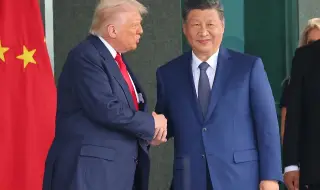
The end of the liberal era began with a silent alliance of three leaders that is crushing the world order. Using tariffs, disinformation and military force, Trump, Xi and Putin are joining forces in a counter-revolution that aims to finally bury the legacy of 1989. This is what Hal Brands, a professor at the School of Advanced International Studies at Johns Hopkins University, wrote in a piece for Bloomberg.
Munich once really mattered. For the generation that survived the Cold War, the annual Munich Security Conference was the mecca of leaders of a Europe whole and free, a meeting place for the Western coalition that dominated the world.
Just five years ago, US President Joe Biden told attendees that democracy must triumph and humanity must never return to the "solid blocs of the Cold War". But this time, the three most important leaders of the moment - US President Donald Trump, Chinese leader Xi Jinping and Russian dictator Vladimir Putin - will not be in Munich. All three see the geopolitical revolution that followed the Cold War as a catastrophe. That is why these very counter-revolutionaries are changing the world today. For most Western observers, the events of 1989 were a miracle.
The fall of the Berlin Wall led to the peaceful reunification of Germany, but also to a divided continent. Soon after, the "evil empire" - The Soviet Union. Markets and democracy swept the globe. The construction of a single, integrated order under Western leadership seemed within reach. Yet for Putin, Xi Jinping, and Trump, this moment of wonder was a dark period. Putin has called the collapse of the Soviet Union “the greatest geopolitical catastrophe of the 20th century,” because it destroyed a great empire and upset the balance of power in the world.
As he told an audience in Munich in 2007, the result was a unipolar America that devastated the entire world, destroying competing spheres of influence and toppling hostile regimes. “No one can feel secure in a world with one ruler and one sovereign,” Putin argued. He spent a quarter of a century trying to destroy the post-Cold War world. He has weaponized globalization, whether by using Russian energy and dirty money to weaken Europe or by exploiting digital technologies for disinformation campaigns and cyberattacks. He has also made a bloody attempt to limit the rise of a US-led Europe. His attacks on Ukraine in 2014 and especially in 2022 have returned large-scale conflict to a region whose peace and unity were the crowning achievements of a more hopeful era.
Putin’s closest ally, Xi, has also been a revisionist since 1989. How could it be otherwise, given that the unrest that toppled communist regimes in Eastern Europe that year spilled over into his own China, almost leading to the collapse of the Communist Party in Tiananmen Square? The Soviet Union collapsed, he later said, because “no one was brave enough to confront internal divisions and ideological weakness.” He used that lesson to push for iron discipline in the Chinese Communist Party. In 2013, his government ordered all cadres to be on guard against the dangerous influence of “human rights,” “universal values,” and “constitutional democracy” that the ideologically dominant West sought to impose.
The irony is that China may have emerged as the biggest winner of the post-Cold War era, given that globalization fueled its economic rise. Yet China, like Russia, was complicit in the collapse of that order. China’s massive exports of cheap goods in the early 2000s shattered the political consensus that supported globalization in the United States. China’s vast manufacturing capacity and predatory trade practices now threaten to deindustrialize entire regions. Export controls on rare earth minerals demonstrate the dangers of interdependence, threatening to shut down factories around the world. Beijing’s growing military might threatens American power and decades of peace in East Asia. Xi Jinping and his aides welcome these upheavals. They preach a grand geopolitical shift as China overtakes America and asserts its influence around the world.
Although Beijing and Washington are rivals, the most powerful of the post-Cold War counterrevolutionaries is Donald Trump. Trump’s revisionism is also ironic, because the events of 1989 left his country in a position of superiority. Yet, according to Trump himself, those events—and the euphoria they fueled—led to the decline of the United States. Globalization led to deindustrialization, open borders, and the rise of a hostile China. Arrogance and overreach in the Middle East eroded U.S. power. Allies exploited it without spending a dime of their own money, militarily or economically. In Trump’s "Definitive National Security Strategy", he argues that America’s recent history is a catalogue of mistakes. And the collapse of the post-Cold War order is key to restoring U.S. power.
"The Man from Davos" has been dethroned by the "Tariff Man" as Trump's protectionism transforms trade relations. Trump is making U.S. allies pay into the American economy through tariffs and asymmetric investment. His administration is attacking the European Union, that symbol of post-Cold War integration, with tariffs, political interference, and taunts about the "disappearance of civilizations." Threats to annex Greenland and Canada put Trump alongside leaders - like Xi and Putin - who dream of violently overturning the status quo. Sovereignty and unilateral advantage are in vogue. Global concepts of mutual benefit are out of the question.
Trump claims that these measures will spark national revival. He is certainly right that some post-Cold War habits—the tendency to view allies as strategic protectorates, the emphasis on globalization over economic security—are outdated.
But it is possible that the chaos Trump is wreaking, not just within the Western community gathered in Munich, could open the door for Xi and Putin, who hated the post-Cold War era because they hated American hegemony. For now, the counterrevolutionaries are winning. Later, they could engage in a bitter struggle among themselves over what the new world order will look like.