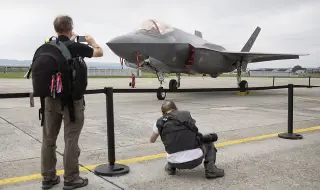
After a US F-35 fighter jet made an emergency landing at an air base in the Middle East last week during the escalating war between the US and Israel against Iran, two sources familiar with the matter told US media that the plane was hit by Tehran while returning from a combat mission - a claim that was also repeated by Iranian state media, writes "Al Jazeera".
If true, it would be the first time during the war that the F-35 - the cornerstone of Washington's air firepower - has been hit by Iran.
Here's what is known about the incident and why it is significant:
What is known about the incident?
After an F-35 stealth fighter jet made an emergency landing on Thursday, Captain Tim Hawkins, a spokesman for the US Central Command (CENTCOM), said that the plane landed safely and the pilot was in stable condition.
"The incident is under investigation," Hawkins said, without specifying why or where the plane landed.
The same day, Iran's Revolutionary Guard announced that it had attacked a US aircraft.
On Sunday, Air & Space Forces Magazine, a publication that covers news about US air defense and national security issues, reported that the pilot suffered shrapnel wounds.
Citing unnamed sources familiar with the incident, the publication said the plane was hit by ground fire.
Iran's semi-official Tasnim news agency has published military footage it claims shows Tehran's air defense systems hitting a US F-35 stealth fighter.
What is the F-35 and what's so special about it?
The F-35 refers to a family of stealth fighters manufactured by the US aerospace company Lockheed Martin.
The official website for the F-35 Lightning II - the aircraft's full name - describes it as "the most advanced fighter in the world." world".
Much of the aircraft's reputation for air superiority comes from its combination of stealth technology, advanced sensors and high-speed computing. The aircraft is designed to be less observable and able to gather more information about its surroundings than earlier generations of fighter jets, feeding data from a 360-degree array of cameras and other sensors directly to the pilot.
"The key to the F-35 is the radar systems," explained John Phillips, a British safety, security and risk advisor and former military chief instructor.
Radar systems are a combination of hardware and software that are capable of detecting and analyzing specific threats and facilitating responses to those threats.
"There is no standard radar suite and they vary from country to country," Phillips noted. "The rumor is that certain countries were only given certain radars by the manufacturer. I believe this is to counter attempts by foreign adversaries, such as China or Russia, to reverse engineer the technology".
Several countries are partnering with the US in the production of the F-35, including Australia, Canada, Italy, Denmark, the Netherlands, Norway and the United Kingdom. They either produce certain components of the fighter jets or have facilities where they assemble aircraft for their own governments to use.
Among the 20 countries that have purchased these aircraft are Japan, South Korea, the United Kingdom, Italy, Australia and Israel.
There are three types of Lightning II F-35, all of which have internally mounted weapons to enhance their stealth design.
The F-35A is the most common model and is the most widely owned by other countries. It can take off and land on a regular runway, like those used by commercial aircraft.
The F-35B is used by Italy, Japan, Singapore, the United Kingdom, and the United States. It is capable of vertical takeoff and landing like a helicopter and takes off from a very short runway, making it a good option for operation from short runways, in mountainous terrain, from beaches, or from small islands.
The F-35C is a supersonic aircraft, meaning it can travel faster than the speed of sound. The U.S. Navy has used this model for long-range stealth operations. So far, only the U.S. Navy has operated this model. Lockheed Martin says the U.S. Marine Corps is also acquiring F-35C aircraft to operate alongside its own F-35Bs. Unlike the F-35B, the F-35C requires a longer runway.
It is not known which of these three aircraft models Iran claims to have shot down last week.
Why would it be so important if Iran shot one down?
US authorities have yet to confirm that an F-35 fighter jet was indeed hit by Iranian fire last week.
On Thursday, US President Donald Trump said: "We fly wherever we want. Nobody even shoots at us".
Although F-35 fighter jets have been deployed in combat operations since 2018, there have been no confirmed cases of enemy fire.
Defense experts said that if Iran's claims that it successfully shot down an F-35 aircraft are true, it would prove that the F-35 is not invulnerable in war.
"This would be important - not because it means that stealth technology is becoming obsolete, but because it would show that even the F-35 is not invulnerable in a dense, adaptive air defense environment," said Ali Vaez, director of the "Iran" project at the International Crisis Group.
"At this point, there is no credible public evidence that a basic air defense system has achieved this on its own," he added.
What US aircraft have been shot down during the war with Iran?
Since the start of the US-Israeli strikes on Iran on February 28, the US has lost 12 MQ-9 Reaper drones. These drones are remotely piloted and are primarily used to gather intelligence in a given area, as well as to "conduct strikes, coordinate and conduct reconnaissance against high-value, transient and time-sensitive targets," according to the U.S. Air Force.
Separately, U.S. officials said five KC-135 refueling aircraft were damaged in an Iranian missile strike on a base in Saudi Arabia on March 14.
On March 1, three U.S. F-15E Strike Eagle fighter jets were shot down in a friendly fire incident involving a Kuwaiti F/A-18. All six crew members ejected safely.
On Sunday, Iran said it had intercepted an F-15 fighter jet that had violated Iranian airspace over its southern coast near the Strait of Hormuz. The US, however, denied this claim.
CENTCOM wrote in X: "FALSE: Rumors claim that the Iranian regime recently shot down a US F-15 over Iran.
TRUE: US forces have flown over 8,000 sorties during Operation Epic Fury. Not a single US fighter jet has been shot down by Iran."
At least 13 US service members have been killed in combat operations against Iran, and about 200 others have been injured.
In Iran, at least 1,444 people have been killed and 18,551 have been injured since the start of the conflict.