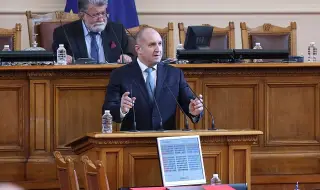
Why did Rumen Radev win so much and why were we surprised by the scale of his victory? The answers seem to be many and clear in themselves, writes Vesselin Stoynev.
Because people want to see someone new and strong who can put an end to the five-year political crisis. Because Radev raised a wave, and the wave is difficult to measure in growth even by respectable sociologists. Because in this wave people freed themselves from fear and addictions and voted for him, lying until the last moment that they would vote for someone else. Because the Ministry of Interior hit vote buying hard, which melted the DPS (up to 230,000 votes) and GERB (lost 209,000 votes compared to the previous elections). Because Peevski went too far to the point of dragging not only himself but also GERB to the bottom, a significant part of which flowed to “Progressive Bulgaria“.
And more answers
Because Radev sucked a lot of electoral blood from the “kopeiki“, “communists“, “chalgari“, even from the “derebei“ (leaving Kardzhali as their last bastion). Because PP-DB, focused on the conquered state and the geopolitical orientation of the country, did not show sensitivity to people's fears of inflation. Because Radev convinced many that prices had risen because of the euro, and not because of the Euro Law of the previous rulers, because of the promised but almost non-existent activity of the regulators, and finally because of Trump's war against Iran.
Because Radev ran a presidential campaign in which he promised almost nothing concrete, and in the middle of it he sharpened it, declaring himself firmly against the "assembly workers" and for "pragmatism" towards Russia and the EU, thereby mobilizing even more Russophile and Eurosceptic voters. Because while he was fighting for the bought vote, the caretaker government signed an agreement with Ukraine and asked the European Commission for help against hybrid attacks in the elections in our country, which Radev successfully described as a blow against his own cause and voters. Finally, because the people are wise and know best what is best. Or because the people are simple and the hoe keeps coming.
Two fronts, two types of coalitions
Even a quick look at the structure of the political conflict and its possible resolution could somehow sort out all these explanations, each of which may otherwise have its own degree of persuasion, without being able to present a credible overall picture. The two key political divisions in our country, creating a political crisis, are corruption and the conquered state, on the one hand, and the attitude towards Russia and the EU, on the other. The main political forces stand on one of the two lines, only PP-DB is on both - against the conquered state and corruption, but also against Russia and for more integration into the EU.
In the new parliament, a political coalition against the conquered state may exist between PB, PP-DB and “Vazrazhdane“ - against DPS and GERB. And a pro-European and anti-Russian coalition could exist between PP-DB and GERB, against PB and “Vazrazhdane“. In the previous several parliaments, especially after the war in Ukraine in 2022, these divisions with other political actors could be overcome only after prioritizing one front at the expense of the other. The assembly between GERB and PP-DB happened because of prioritizing the geopolitical division and outsmarting the anti-corruption, presented as a parallel, not a secondary track, which in the end, however, was nullified.
Which comes first – corruption or geopolitics
Radev is currently successfully solving the same task at the start – prioritizing the anti-corruption vector (against the oligarchy, according to his dictionary), but underpinning it (for now semi-conflictingly) in parallel with the second vector – more sovereignty against the EU and restoration of relations with Russia. And the second front could easily turn out to be strategically first in the way that the anti-corruption one could not easily turn out to be so during assembly. Because then there was an organizational structure of the conquered state, which crossed out judicial reform even at the constitutional level.
Under Radev, the structure of the supposedly secondary front is deep Russophilia, also fueling Euroscepticism. However, these are historically enduring public attitudes that can be easily guided and dosed and satisfied in the range from moderate to extreme. And it is difficult to protest against them - it is one thing to protest against a government because of corruption and the prosecutor general (almost no part of the population supports corruption or the prosecutor general, at most it is permanently apathetic), it is another to protest against a government that turns to the East (and not a few people want exactly that).
A double failure leading to Orbán
Success on both fronts at the same time is impossible, regardless of which side of the trench you are on, and the failure of one weakens the other. You can maneuver on one for a certain time - Borisov built “South Stream“, but then joined the sanctions against Russia and support for Ukraine. Peevski was in the vanguard of aid to Ukraine, but after Trump came to power he turned 180 degrees, hoping to have his Magnitsky sanctions lifted. Both of them eventually fell defeated on the corruption front, regardless of their geopolitical merits.
Orban also successfully corrupted Western companies until his conquered country ruined the economy, becoming entirely dependent on Russian gas, only to collapse a week before our elections. Russian dependence has no Russophile undertone in Hungary (only 70 years ago the Russians were invaders there), which opens up the possibility for the new leader Magyar for truly pragmatic relations with Moscow, until Budapest's relations with Brussels warm up and EU funds start flowing again. Orban, like Borisov-Peevski, fell because of the collapse of the corruption front, which also brought with it the failure of the eastern one.
PP-DB is doomed to failure
PP-DB is doomed to failure in a war on two fronts, regardless of whether it could have won more if the confederate coalition was in better shape. Simply because even if the entire population is ready to go to the anti-corruption front, part of it is also biased towards the eastern one. It is no coincidence that according to some sociological calculations (by “Myara“ and “Trend“, respectively) 100,000 to 130,000 voters from the PP-DB voted for Radev, but in their place more new ones were attracted, so that in the end, according to the CEC data, the coalition is up by 63,000 votes. However, this does not give it greater weight in parliament given the absolute majority of “Progressive Bulgaria“.
Thus, the anti-corruption majority, a significant part of which is also Russophile, gives Radev a flying start to take the path of Orban, as soon as he wins some tactical battles, probably with the participation of the PP-DB, against the conquered state. But on an even faster Orban track, so that “Progressive Bulgaria“, like “Fidesz“, will be conquered from the east.
Party building in power
There is another structural prerequisite for this. With all the great waves of personal political saviors in our country over the last quarter century - those of the Tsar, Boyko Borisov, Slavi Trifonov, and now Rumen Radev, the winner creates a party structure only upon taking power. Only Borisov managed to turn GERB into a stable party-state, while NMSV was shaken from the very beginning and lasted much shorter, ITN was not even able to form a cabinet after its victory, and both eventually came to naught.
Corruption is possible only through power, which is why a ruling party built in power is much easier to be corrupted from within and by external forces. This may not happen if a sanitary minimum of independence of the judicial institutions is quickly achieved beforehand, if decent deputies and ministers are selected, and the “engineering” efforts from the east were only rumors or exaggerations. In any case, however, the structural risk of party building going parallel to the temptations of power and hidden internal and external dependencies is greater than the chance of good intentions and efforts. Therefore, after a shorter or longer period of time, it may turn out that the political crisis returns to its starting points and we will fight against the new oligarchy and corruption, looking again to Brussels or Moscow.
This text expresses the opinion of the author and may not coincide with the positions of the Bulgarian editorial office and the DG as a whole.