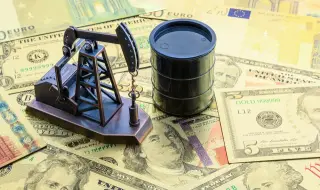
Retaining control of the Strait of Hormuz will be easier for Iran than overthrowing the dollar's dominance in the global oil trade, despite Tehran's efforts to undermine the dollar's hegemony. This is what Sean Matthews writes for Middle East Eye.
Iran's control of the key strait has become a focus of the Iran-US war, with President Donald Trump threatening Iran with total destruction unless it relinquishes control of the "Damn Strait".
Some experts say that because an estimated 20% of the world's energy passes through the Strait of Hormuz, Iran's control threatens the petrodollar system - in which the price of oil is set and sold in dollars by Arab energy producers.
Iran has set up a complex "toll system" to control which ships it allows through the waterway, similar to those of Pakistan and China. Its move to paying tolls in Chinese yuan has fueled speculation that it may abandon oil prices in dollars.
Javad Salehi-Isfahani, an expert on Iran's economy at Virginia Tech, said that "Iran has a huge interest in trying to break the dollar's dominance in the oil trade," noting that Tehran has suffered because the United States has a veto over dollar-denominated bank accounts around the world.
Saudi Arabia, Kuwait, Iraq, Bahrain, Qatar and the UAE, however, are unlikely to abandon the petrodollar despite the fact that Tehran will continue to exercise control over the Hormuz region, said Steve Hanke, a professor at Johns Hopkins University and an expert on the dollar.
The Strait of Hormuz was a highway, he said, but it will become a toll road. "The Iranians will control it, but the royal dollar remains the royal dollar," he stressed.
To understand the influence of the US dollar on oil sales, we need to go back to 1974, when US Secretary of State Henry Kissinger made a deal with Saudi Arabia to price its oil in dollars and invest the surplus in US assets - mainly US Treasury bonds.
This deal had two key consequences: it led to the Eurodollar boom of the late 1970s and helped strengthen the dollar after its position as the world's dominant currency was threatened by President Richard Nixon. Eurodollars are effectively U.S. dollars deposited in foreign, mostly European, banks that are available for global lending.
Just as importantly, Saudi Arabia's decision helped the United States maintain its dominance of the dollar while it suffered a massive devaluation following Nixon's 1971 decision to end the convertibility of dollars into gold.
After World War II, the Bretton Woods system was created, which tied all major currencies to the dollar. The guarantee of this system was the ability of foreign governments to redeem dollars for gold at a fixed rate of $35 per ounce.
Saudi Arabia's decision paved the way for the adoption of the petrodollar by other Gulf states. By the mid-1970s, the Gulf states were the largest source of new U.S. borrowing through government bonds.
David M. White, author of "Middle East Petrodollars: Middle Eastern Petrodollars and the Transformation of American Empire," pointed out that the petrodollar has been "remarkably resilient" over the past half century. He explained that while it has sometimes been portrayed as U.S. exploitation of the Gulf, both sides have had an interest in the deal. "It was more of a courtship than a coercive insinuation," White said.
Saudi Arabia-U.S. ties were tested by the 1973 Arab-Israeli War and the Arab oil embargo that the kingdom imposed in support of the Palestinians. This contributed to the inflationary crisis that rocked the United States after Nixon's "gold rush."
"After 1973, the Saudis and other Arabs were worried that the United States would take punitive action against them. They wanted reassurance of U.S. security guarantees," he added.
The security component of the petrodollar story is one reason many experts say Iran's control of the Strait of Hormuz could topple the system.
The Gulf states still peg their currencies to the U.S. dollar, unlike the euro, which is freely traded, and they hold a significant portion of U.S. debt. As of the end of 2025, the Gulf states held $315 billion in U.S. Treasury securities.
But times have changed since the 1970s. The United States has become more debt-addicted, which has diluted the overall importance of the Gulf, while the country has become a more mature investor.
As Jess Hoversen, a former CIA economist now at Column Bank, writes, Gulf states’ holdings of government securities account for just two percent of U.S. deficit spending now, down from 10 percent during the Reagan administration.
U.S. spending has increased, but the bigger change is that Gulf states have less money to invest in government securities. Instead, they are buying assets like U.S. stocks, European soccer teams, and, more recently, investing at home.
Saudi Arabia runs a budget deficit as it seeks to invest in local industries to reduce its dependence on oil. The Saudi kingdom issued $82 billion of its own debt in 2025.
"The definition of the petrodollar has changed today compared to decades ago," said Brad Setser, a former U.S. Treasury economist who is now at the Council on Foreign Relations. "The Gulf states are now borrowers, not as big buyers of government securities," he explained.
However, Saudi Arabia still has significant reserves of U.S. debt, and if it were to decide to sell it, it would hurt the United States. In January 2026, its reserves stood at $134 billion.
The vulnerabilities of the United States have been exposed in recent weeks. The Financial Times reported that some central banks have sold government bonds in the wake of the US-Israeli war against Iran.
The selling has contributed to a sharp rise in the yield on 10-year US Treasury bonds, which has risen from 3.9% before the war to around 4.4%. Higher yields make mortgages and other loans more expensive for Americans and increase the cost of borrowing money for the US government.
Experts say the rising yields are unusual because countries typically stock up on US Treasury bonds during times of crisis, as they are seen as a safe haven. Bond yields rise when prices fall. The latter is a sign of weak demand.
But the very fact that US government bonds are so liquid, meaning they can be bought and sold quickly, helps explain why it is unlikely that the Gulf states will give up selling oil in dollars.
"All these things that the US is doing geopolitically are negative for the royal dollar in the long term. Sanctions, wars and tariffs make it easier for the dollar's competitors," Hanke said. But he added that "the US is the largest capital market in the world and the most liquid. That is why the price of oil will continue to be determined in dollars.".
The dominance of the dollar has been broken. For example, Russia now sells its oil and gas to China in yuan as a result of sanctions imposed after its invasion of Ukraine in 2022. Iran, which is under crippling US sanctions, also sells to China in yuan.
This separation of the oil market means that the dollar and US debt do not get the boost they would normally get in a war. Gulf states are blocked from exporting oil through the Strait of Hormuz and are not benefiting from higher prices.
"We have a significant increase in the price of oil, but the Gulf states are not benefiting from it. So who are the big beneficiaries? One is Russia, which will not save in dollars,” Setser said.
While some analysts downplay the petrodollar’s importance to the United States, White said the system remains critical enough that Gulf states would face pressure from the United States if they decided to sell their oil in, say, euros or yuan.
“I think there is pressure from the United States to do these transactions in dollars, and so far the Gulf states have been happy to do so,” he said.
Because the dollar is the medium of exchange for the world’s most important commodity, it is embedded in global trade, which means that countries around the world have a demand for the dollar. That keeps the dollar high relative to other countries, experts say.
China, which relies on exports, is helped by the weaker currency, as are European exporters and southern European holiday destinations.
White said Beijing and Brussels may not want to see the end of the petrodollar. "There are some advantages to being a reserve currency, but there are also disadvantages, one of which is that it makes it harder to promote your own exports," he said.
This mix of inertia, conflicting interests and liquidity could lead Gulf states to use the petrodollar.
"There are these challenges on the periphery, but it's hard to dethrone the king," Hanke said.