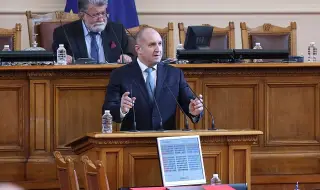
The scale of the victory of "Progressive Bulgaria" surprised even Radev himself, and that is why we have not seen much clarity about the first steps or the general political direction so far. What could be hidden behind the Radev enigma?
The elections are over and the surprise from them was great. Against the background of the sociological surveys, there were no expectations for such a significant victory for Rumen Radev, nor for such a major collapse of GERB. But this is rather the mathematical result of the elections. More importantly, it is still impossible to say what exactly happened - due to the uncertainty of the plans and intentions of the winner. In a very famous radio speech from October 1939, Churchill called Soviet Russia “a riddle, wrapped in a mystery, inside an enigma“. This metaphor is also appropriate for the situation in our country at the moment, although the drama of the beginning of World War II, thank God, is absent. The native riddle actually won the elections and the Bulgarian people will have to solve it in the coming years.
"Progressive Bulgaria"
The success of Rumen Radev's formation is explained by its ability to simultaneously mobilize two types of electorate that want anti-corruption reforms. Some are pro-European, while others are more Russophile and Eurosceptic. PB managed to win voters from both the BSP and “Vazrazhdane“ (and brought them below and around the threshold for entering parliament), as well as from GERB and PP-DB. GERB lost about 200,000 votes, and PP-DB nominally added about 60,000, but people who voted for them also switched to Radev. This is the first element of the riddle: which of these two electorates will turn out to be dominant in PB policies?
The second mysterious element is what Rumen Radev understands by “fighting the oligarchy“ and changing the “Borisov-Peevski“ model. Formally speaking, there is a huge (constitutional) majority in the country for conducting a “clean hands“ operation. This operation should proceed as follows. First, “investigations of corpses“ such as Corpbank, the "Hemus" highway sacks, the "Bozhkov" gambling scandal, Barcelonagate, etc. must be opened and brought to court with the appropriate charges. So far, all this has been blocked at the prosecutor's office level and is being held as an instrument for pressure on politicians.
Secondly, magistrates connected with affairs such as "The Dwarves" and "The Notary" must be removed from the judiciary for undermining its prestige and authority. As well as magistrates such as those from the SJC prosecutor's office, who for a whole year refused to implement a very clear law limiting the term of office of the acting prosecutor general to six months.
Sarafov has already offered the new majority something like an offer for regrouping: he is stepping down, and things remain the same, with the clubs and umbrellas being at Radev's disposal. It is a mystery whether this offer will not be accepted.
The enigma is what the PB will do in the EU and Europe. Most foreign journalists asked this question, fearing that Radev could become a new Orban. Radev himself dispelled these fears with statements about “pro-European“ policy and claims that he will not block the EU on foreign policy issues. Orban's failure in Hungary and the growing disappointment of the global MAGA suggest that Radev is unlikely to turn towards the radical right and Russia. But this will disappoint a large part of his voters, many of whom even expect a referendum on leaving the euro. Radev's refusal to join one of the European party families adds to the enigma. But this refusal also has a price - Bulgaria's self-isolation at a time when we need partners. The future of Europe will be decided now, and if Bulgaria remains in “beautiful isolation“ with a wet look at Russia, at the very least we will fall into the low speeds of European integration on the political periphery of the EU.
GERB and MRF
GERB and MRF are the big losers from these elections. The strange thing about their behavior is that they do not seem to recognize PB as their big opponent. The campaign of the formations was quiet and generally directed more against PP-DB. This behavior is clearly an offer of a hand to Radev for reconciliation or at least mercy (towards the leaders of both formations). A collapse is yet to come in GERB, which has already been expressed in the withdrawal of the mayor of Stara Zagora from the party leadership. Radev's PB started its campaign precisely in Stara Zagora, which was a clear sign that certain processes of absorbing former GERB terrain are underway there. What will remain of GERB after these maneuvers is not very clear.
Sarafov's resignation immediately after the elections is the other side of the offer for negotiation. The services and the prosecutor's office may gradually move to Radev, and Sarafov's resignation (in which his right-hand man took over) is a proposal for this transition to be smooth and without casualties at the highest level.
In any case, GERB (and MRF) have practically given up being opposition parties in the new parliament. If Radev is serious about “clean hands“, it is not clear whether and how they will continue to exist. If they manage to reach an agreement somehow, the two formations will simply be an appointed, decorative opposition to Radev.
What we are witnessing is the creation of a new “party of power“ in the person of PB. This party will gradually seize the resources of GERB and MRF. The clientele and local elites of GERB and MRF are already actively listening to change horses, and a significant part of them have already changed them. Stara Zagora was the first, but it will not be left alone.
PP-DB
In this situation, PP-DB may soon turn out to be the largest and only formation in the National Assembly with opposition potential. This opposition will flow along two lines: possible retreats by PB from pro-European policies and negotiations with GERB and MRF to dilute and nullify anti-corruption actions.
PP-DB began its post-election life in its traditional way with internal tension (more theatrical than real). Usually, this has generated interest in the formation and energy among its electorate. But in the current situation, the internal organization of PP-DB is not what people are concerned about. On the contrary, many voted for Radev, because with him, things with decision-making are clear. So, the time has come for unity and coordination in the coalition, but they are not achieved through the media and Facebook. Unity is not some kind of heroism - it is simply a prerequisite for an effective political entity.
From a strategic point of view, PP-DB is in an extremely convenient situation. If Radev's enigma turns out to be truly pro-European and truly anti-corruption, PP-DB will have the opportunity to implement its political program. After all, the economic program of PB, which was presented during the campaign, is a copy of that of PP-DB. There are differences, but the main elements are the same.
If Radev's mystery turns out to be essentially more pro-Russian and/or replacing one party in power with another, then PP-DB will be the natural opposition in parliament. There will be some symmetry between the positions of PP-DB and “Vazrazhdane“ in the new National Assembly. Kostadinov's people will push the PB in a Russian direction, while the PP-DB will monitor deviations from the European course. If Radev deviates too much, it may turn out that a pro-European candidate will become a serious competitor, even a favorite, in the presidential elections.
This is the Bulgarian path
From an analytical point of view, it is not justified at the moment to make categorical predictions about the character and direction that Radev will take. The scale of his victory surprised even him, and therefore we have not seen much clarity about either the first steps or the general political direction. The fear of disappointing voters is not a good advisor, however, and it will be overcome in the coming months. While Radev thinks and chooses, it is still good to appreciate the great progress Bulgaria has made as a result of its European integration. Whatever one may say, the country is catching up with the most developed countries in the world – we are already very close to Greece in terms of basic economic indicators, and countries like the Czech Republic and Poland are already among the leaders in prosperity in the world. This is the Bulgarian path: talking against it may work to win elections, but it would be extremely irresponsible for it to become the basis for governance.
This text expresses the opinion of the author and may not coincide with the positions of the Bulgarian editorial office and the State Gazette as a whole.