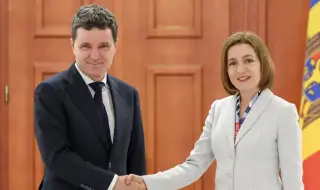
Moldovan President Maia Sandu is increasingly pleading for unification with Romania. What does Romanian President Nikusor Dan think about the issue? Is reunification of the two neighboring countries realistic?
The heads of state of Moldova and Romania, Maia Sandu and Nikusor Dan, clearly have a great deal of sympathy for each other - as can be seen in their joint photos. The two recently traveled together on a Romanian military plane to Yerevan for the meeting of the European Political Community - a gesture that carries great symbolism in connection with the topic that is gaining increasing importance: the reunification of Moldova and Romania.
For the first time, both countries are simultaneously headed by presidents who are positive about unification. Until now, all previous Moldovan heads of state have been against it. In Romania, only Traian Basescu, who held the presidency between 2004 and 2014, supported “unionism”.
“Romania is prepared”
The current Moldovan President Maia Sandu is known for her unionist positions, but for a long time she hardly touched on the topic. Only in recent months, in her interviews with international media, has she begun to speak openly about the reunification of the two countries. In January, she told the BBC that in a referendum on the issue she would vote “yes”. At the end of April, she again declared herself in favor of the unification of the two countries in front of the French “Le Monde”.
Romanian President Nicuşor Dan, for his part, spoke openly about the project and emphasized: “Romania is prepared”. Dan is the first president of Romania who does not treat the "brothers and sisters of the northeast" with patronage - he perceives the neighboring country as an equal partner. This is well received in Moldova.
In addition, Sandu and Dan have good relations on a personal level: both have long been activists against corruption and have fought against state arbitrariness and abuse of power. Like many of her compatriots, Maya Sandu also has Romanian citizenship. She supported Nikusor Dan in the Romanian presidential elections in May 2025 and voted for him.
Common language and common history
This may seem strange - a president who is also a citizen of a neighboring country would vote there and ultimately declare herself the end of her own country. But this shows how closely Moldova and Romania are connected - linguistically, historically and culturally.
In both countries, Romanian is the official language. In 1812, Russia and the Ottoman Empire divided the former county of Moldova. Shortly after World War I, in December 1918, the new elite in the part of Moldova annexed by Russia declared itself in favor of joining Romania.
In 1940, Stalin annexed the territory of Moldova again and created the Moldavian Soviet Republic, which also included Transnistria. In 1991, it gained its independence even before the official end of the Soviet Union.
For a long time, neither there nor in Romania did unionist movements have any significant political role. However, since 1991, Russia has been warning of a possible “fascist reunification” of Moldova and Romania. This was one of the narratives that led to the gradual secession of Transnistria from Moldova.
The number of supporters is growing
In recent years, the number of supporters of reunification has grown significantly. According to data from March this year, in Moldova 42 percent are “for”, and 47 - “against”. In Romania, the idea is approved by 72 percent of the population.
One of the reasons is Russia's war against Ukraine, which led, especially in Moldova, to a change in the mood of many who still harbored illusions about Russia. And over a third of Moldovans (2.4 million) also have Romanian citizenship. Romania is by far Moldova's most important trading partner, and Bucharest is also helping the neighboring country to break free from Russian energy dependence and connect to European energy networks.
The writers' unions of Romania and Moldova issued a joint statement in early May, saying: "It is time for intentions to turn into concrete actions."
But it will take time to get there. There are serious obstacles to reunification in the constitutions of both countries, including Moldova's military neutrality. Most of all, it is unclear what will happen to Transnistria, which is still ruled by Russian separatists.
Kaia Kalas sees no problem
Nevertheless, the topic of unification is gaining momentum. It should be borne in mind that Moldovan voters represent a relative magnitude for the elections in Romania. In 2025, they contributed to the electoral victory of Nikusor Dan against the right-wing extremist candidate Gheorghe Simion, leader of a party called the "Alliance for the Unification of Romania". In this sense, Sandu and Dan play an important role, and in ensuring that the topic of reunification is not left to Romanian right-wing extremists.
For her calls for unification with Romania, Maia Sandu was accused of treason in Moldova. In addition, there are independent critical voices who say that it does not make sense for the president to declare herself in favor of unification with Romania in the midst of advanced negotiations for accession to the EU. But the EU High Representative for Foreign Affairs and Security Policy, Kaia Kallas, does not see a problem with this. She stressed that the issue of unification should be decided solely by the people of Moldova and Romania - by no one else.