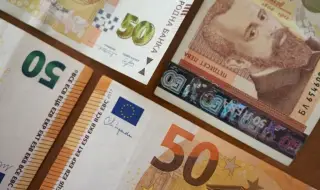
What kind of budget does Bulgaria need: what are the challenges and difficulties, but also the chances? "Active Policies", IME and BESCO launch the "Growth Budget" campaign.
""Expenditures exceed income, many bills remain unpaid, loans are often resorted to", this is how Finance Minister Galab Donev described the state of public finances.
The Deputy Prime Minister announced a number of measures to control the deficit and "turn off the taps" in the budget. Among them are the end of the automatic linking of salaries to the average wage, the ceiling on remuneration in the budget sector, the reduction of the administration.
But why is the spending of state money so short-sighted?
Indexing - a perpetual motion machine for raising salaries
For years, the automatic increase in the salaries of deputies, ministers, members of regulators, employees in leading positions in the state administration and those working in the "Security" sector, which are equal to a certain percentage of the average wage, has been the subject of criticism. Indexing to the average wage leads to an ever-increasing gap in pay compared to those whose salaries are not indexed. And this indexation itself, in turn, contributes to the increase in the average salary and, accordingly, to new increases.
The increase in the salaries of the deputies, who number 240 people, is a very small part of the problem. "There are 550,000 employees in the public sector. A large part of their salaries are tied in some way to the minimum or average salary. These are huge increases that can in no way be covered by the normal growth of budget revenues" Petya Georgieva from the "Institute for Market Economy" (IME) commented to the State Department.
"Budget of Growth" - in search of dialogue and transparency
The IME, together with the "Active Policies" platform and the Bulgarian Entrepreneurial Association (BESCO), launched the campaign "Budget of Growth" for responsible public finances and active dialogue about the state's money. “The perfect option would be for the budget to be created with maximum transparency and publicity”, commented Ivaylo Madzharov from “Active Policies”. “Reforms and analyses are needed to fix the budget. Otherwise, we will do the same thing every year.” And the same means debts, spending money piecemeal, lack of long-term perspective and uncertainty.
”The budget is important for everyone - both for business and for citizens”, says Petya Georgieva. “My impression is that there will not be a very serious conversation about this year's budget. But I hope that this will change with the 2027 budget, which will begin to be discussed in September."
The idea of the organizations behind the "Growth Budget" is for society and experts to actively participate in the preparation of future policies. From "Active Policies", a platform that reaches hundreds of thousands on social networks, they are returning the focus of young people to the budget - the topic that brought a large part of them to the squares at the end of 2025. "We will have educational publications - we want to explain what debt is, what inflation is, what personal inflation is. We will explain how investments can help Bulgaria's development, which sectors are driving the economy forward," says Ivaylo Madzharov.
Investments in the future
The issue of the development of the Bulgarian economy should be on the agenda of both politicians and society, he is convinced. "We need to invest in education and the high-tech sector. Bulgaria can attract data centers and specialists in the field of artificial intelligence," adds one of the creators of "Active Policies."
According to him, the state should pay more attention to the qualification and acquisition of technological knowledge by the entire population: "The ability to learn throughout life is key. Things are changing so dynamically that university education is not enough, investments are needed in annual training of people so that their skills can be adaptable".
Less grey economy, greater collection rate
However, for these investments to be possible, the state must address the problems that have long become a public secret. “The grey area is often underestimated at the institutional level, but it is present daily in people's conversations. It is enough to have done renovations in the last few years to know what amounts are circulating in the grey economy. The state loses, we lose too", commented Ivaylo Madzharov.
“The grey sector accounts for between 20 and 30% of GDP, according to various estimates”, emphasized Petya Georgieva from IME. “The grey sector is being brought to light in various ways related to access to information, this must continue. Inspections must be carried out in these sectors, which are notorious. It is not possible for everyone in an entire sector to have a minimum wage or below the minimum wage”, she added. According to a study by the American consulting company “Kearney”, by 2023 the share of the grey economy in Bulgaria's GDP will be 34.6%, which makes the country an absolute leader in the EU. The same study, commissioned by “Visa”, also places the country in first place in cash payments.
However, in order for more people and businesses to start paying their taxes and social security contributions correctly, both measures from above and awareness from below are needed. “Every citizen should demand from the state that they receive quality services for which they pay anyway. There is so much money in healthcare, for example, and in return we do not receive what we pay for”, says Petya Georgieva.
A vision for the future, instead of regulating the price of tomatoes
Measures such as price controls can hardly break inflation, most experts believe. The recovery of the economy goes through sustainable development, new opportunities and structural reforms.
”It is extremely difficult for a government to combat inflation through administrative measures. What the government currently intends to do, I accept as a response to the expectations of the voters. I do not think that it will have a serious effect, however, because it is very difficult to try to control millions of prices in a market economy”, explains Petya Georgieva. “The increase in incomes over the past ten years has been significant in Bulgaria. This is one of the reasons for the higher inflation. Another reason is external shocks, our economy is open and is strongly influenced by events in Europe and the world as a whole - energy crisis, wars."
Ivaylo Madzharov insists on a longer-term vision and clearer priorities: “What do we want to do in the future? What do we want to produce and how to achieve it?".
Despite the difficulties facing the Bulgarian economy, there are many opportunities. And not only because of hosting Eurovision next year.