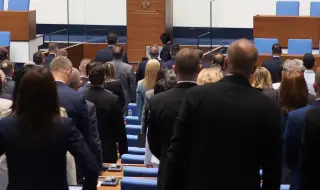
The opposition in parliament reacted as if the changes in the rules of procedure of the National Assembly did not limit the procedural chaos, but directly took away its oxygen. And this is actually the clearest sign of how deeply Bulgarian parliamentarism has been transformed in recent years into a stage for endless procedural tricks, rather than real legislative activity.
The proposals of the ruling party - represented by "Progressive Bulgaria" and Rumen Radev - to limit the time for speeches, reduce procedural grips and strengthen the role of the speaker of parliament caused a hysterical reaction from almost all opposition parties. They spoke of "dictation", "the end of parliamentarism" and "silencing the opposition“.
But behind this dramatic tone, a much more prosaic fear is visible - that the opposition is losing the opportunity to block the parliament through procedural noise, endless remarks and political theater. For years, the National Assembly has degraded to an institution in which real debate has been replaced by talking for the sake of talking. For hours, deputies did not discuss laws, but produced videos for social networks.
That is why the current reaction looks more like panic over the loss of a convenient tool than an authentic defense of democracy. Of course, any change that concentrates more power in the majority and the speaker of parliament should be monitored carefully. The criticism that the rights of the minority are being curtailed is not without foundation. Some of the proposals actually give greater control over the agenda and procedures.
But the problem is that it is precisely today's opposition that has turned the parliamentary rules of procedure into a weapon of sabotage for years. It has reached absurdities — meetings to fail due to procedural gripes, MPs to read texts for hours without regard to the topic, and parliamentary control to be used more for political show than for control over power.
In this sense, the current dispute is not simply about rules. This is a clash between two models of parliamentarism — one in which the parliament works slowly, noisily and chaotically, and the other in which the majority wants decisions to be passed more quickly, even at the cost of more limited procedural comfort for the opposition.
The most ironic thing is that some of the formations that today talk about “killing democracy“, in previous parliaments, they themselves insisted on stricter rules against procedural terror. For example, parties like the BSP (although they are not in parliament), today talk about “killing democracy“, in previous parliaments they themselves insisted on restrictions against procedural terror. More In 2014, the Socialists officially proposed shortening the time for speeches and limiting procedural remarks, arguing that the parliament had been turned into a stage for “uncontrolled speaking“ and abuse of the people's trust. At that time, BSP MP Petar Mutafchiev explained that procedures should be used only for their intended purpose, and not to block the work of the National Assembly.
Over the years, we have repeatedly seen procedural maneuvers - by GERB and DPS - to block sessions, including through requests to terminate debates, lack of a quorum, and prolong procedural disputes. Now these same parties, together with the PP, DB, and “Vazrazhdane“, are defining almost identical restrictions such as “dictatorship“ and “suppression of parliamentarism“. Political amnesia is obvious - when you are in the majority, restrictions on procedural chaos are called “necessary order“, and when you are in opposition — “encroachment on democracy“. However, political memory in Bulgaria is traditionally short.
The truth is that the Bulgarian parliament has long suffered not from a lack of speech, but from a lack of trust, quality and results. And when society sees the National Assembly as an arena of scandals and a circus, and not as an institution protecting the public interest, then each party begins to use the rules not as an instrument of democracy, but as a club against the enemy.
And this is precisely what makes today's dispute so indicative — not so much about the state of the ruling party, but about the crisis of the opposition itself, which seems to fear most that without procedural chaos it will be left without “political oxygen“.