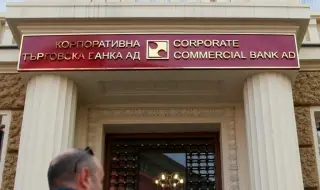
Do you remember the bankruptcy of CorpBank? The main characters in this story are Tsvetan Vassilev and Delyan Peevski. But today it is increasingly sinking into oblivion. In the film "Bankruptcy of CorpBank: Where is the Money" Lyubomir Zhechev recalls how it got there.
The premiere of the film "Bankruptcy of CorpBank: Where is the Money" will be held on May 29. Why is the topic still important 12 years after the bank's bankruptcy?
Lyubomir Zhechev: The bankruptcy of the bank largely predetermined the development of political life in Bulgaria after that. It turns out that many people do not remember anything about those events. Generation Z, which is talked about so much, came out in December 2025 to protest against the embodiment of the bankruptcy of CorpBank. However, a large part of them only know that it was a pyramid scheme. They neither know who the main people involved were, nor how the bank functioned and how it merged with the state. I think it is good to recall this, which is the purpose of the film.
You say that many people do not remember what the bankruptcy of CorpBank represents. What do you think it represents?
Lyubomir Zhechev: The bankruptcy of CorpBank represents the state taken over by the oligarchy. We need to go back to the 1990s - banks have failed in Bulgaria more than once, and this has always happened for no reason. The goal was to steal money, acquire businesses for next to nothing, and ordinary depositors would suffer. It embodies the corruption model that has been talked about so much for decades, mainly in the person of Delyan Peevski.
Peevski, Borisov, Stanishev, Dogan, Oresharski: many owe answers
There are other individuals besides Peevski who are connected to the events at that time. Who owes the biggest answers?
Lyubomir Zhechev: Delyan Peevski, Boyko Borisov, Tsvetan Vassilev, although he has spoken out repeatedly. People like Sergey Stanishev, Plamen Oresharski, Ahmed Dogan, without whom Peevski would not be what he is today, owe answers. All those who held high state positions in those years. As well as those at lower levels - like Biser Lazov (Tsvetan Vassilev's personal accountant - editor's note), who is the main witness for the prosecution. Journalists and public figures who visited Tsvetan Vassilev's offices and about whom legends abound that they received envelopes of money. Newspaper publishers who received loans but never returned them.
Let's not forget the prosecutor's office - Sotir Tsatsarov as the chief prosecutor at the time and Ivan Geshev as the main supervising prosecutor.
Lyubomir Zhechev: Yes, Tsatsarov, Geshev, Petyo Petrov - the Euro, who is one of the investigators in the case. Many people have something to say, but most of them are silent.
What was the most interesting conversation you had while preparing the film?
Lyubomir Zhechev: You'll see it in the film. Otherwise, the meeting with Ivan Geshev was also interesting. In his office there was quite impressive upholstered furniture and paintings, collector's swords, revolvers. An interesting environment for sure.
While some of the main actors from that time are no longer in the spotlight today, Peevski is still active. But still: after the protests and Rumen Radev's victory, are we observing the disenchantment of his image?
Lyubomir Zhechev: After Radev's coalition took a majority, it would be logical for Peevski to lose some of his influence. But for a person to be very influential in Bulgarian politics, he often bears the same marks. First of all, to have connections with State Security. The second is to have influence in the services, which seem to be used mainly to collect compromising material, with which to then control and blackmail political opponents. The third thing is the control of huge cash flows and the behind-the-scenes control of business. Legends are circulating about how rich Peevski is. We will recall his impressive career in film. It is very curious what can bring a 24-25-year-old young man with great political ambitions closer to a 45-46-year-old banker, so that they see each other every day, so to speak.
"If the model does not change, this can happen again"
Is this the biggest piggy bank of the Bulgarian oligarchy since the 1990s?
Lyubomir Zhechev: There have always been some banks that serve the government. Many claim that the managers of state-owned enterprises in the first years of the bank decided to deposit hundreds of millions. Then, with them, the bank's management circumvents the letter of the law in order to grant loans with which to acquire assets.
Is Tsvetan Vassilev a tragic character?
Lyubomir Zhechev: I don't believe his version that he is a victim. Yes, the bank was taken away from him through behind-the-scenes intervention, but for many years before that he was part of the same influence. The main characters in this story are Tsvetan Vassilev and Peevski, but if the model doesn't change, this could happen again.
When filming your previous film about the Historical Park, you had problems with the institutions. Was it easy for you to film the story about CorpBank now and what were the biggest stumbling blocks?
Lyubomir Zhechev: The biggest stumbling blocks are that a large part of the people who have the most to say are either not there or do not want to speak. The topic has been largely forgotten. However, I think the film has enough value because it is aimed at people who don't know enough about history.
If you had to explain to a child what CorpBank is in one sentence, how would it sound?
Lyubomir Zhechev: CorpBank is the story of some bad guys who completely legally set up a bank, and then not very legally use it to give themselves money and buy all kinds of toys, for which ordinary people foot the bill.
The premiere of "CorpBank Bankruptcy: Where is the Money" is on May 29 at 7:00 PM in Hall 1 of the National Palace of Culture.