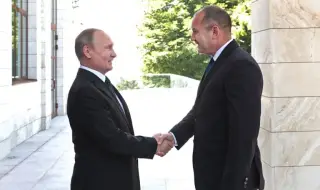
There is a kind of consensus in the EU that Ukraine cannot surrender. That is why Rumen Radev's proposal for a pan-European turn in politics and military aid to Ukraine raises questions. By Ivaylo Noizi Tsvetkov.
Nearly three weeks after taking office, Prime Minister Rumen Radev went to the heart of Europe - to Paris and Brussels. His statements from there put him in a kind of "super position", if we borrow a term from quantum mechanics. Most of you know in general what I am talking about - the – "super position" is a physical category according to which a system can exist in multiple states, locations and configurations simultaneously.
The most important question: who attacked whom?
I will not call for help from Max Planck or Einstein, but I will offer another parallel to the first international requests in the foreign policy of the new prime minister - this is a kind of "Schrödinger", which means that the Bulgarian position on the war in Ukraine remains ambivalent. His very proposal for a pan-European turn in politics and military assistance to Ukraine raises questions. And at the same time, Radev's statements on Bulgarian soil can be interpreted as saying that in order to have "peace", Ukraine must retreat, because (as if the Ukrainians do not know) it is at war with "the greatest nuclear power". Is it true that despite the Russian losses and the protracted invasion of the territory of a neighboring independent state, the only way out is for the attacked state to surrender?
I understand Radev. He was educated in an environment where the USSR was the greatest power in the world, and Putin is trying to inherit it and seize whatever he can from the post-Soviet space, and he would never admit the failure of this doctrine. I also understand his military arguments: Putin's Russia cannot be stopped by conventional means, it can attack Romania tomorrow (because of the Russian drone in Galati and the expulsion of the Russian consul from Constanta; and why not us, as one Czech expert suggested). But there is something else here, and it is called a moral case, no matter how understandable Radev's version of Realpolitik is.
And this moral case is simple, it is related to the most obvious question in the world: who attacked whom. And here let's not divide into tribal groups, but be realistic: Putin is losing this war, not necessarily instrumentally, but in the context of his attempt at global influence. But he will not stop as long as he is alive. Does this mean, however, that we should try not to irritate him, that we should give him Donbass up to Mariupol and Crimea, because otherwise he can shower us not only with "Oreshnik", but also with other nuclear missiles, if he feels pressed against the wall?
That is, we fall into a paradox - we are both for "peace", and we are for peace on Putin's terms, because - in military terms and in any case - only the right of force works. And the bombed and killed Ukrainian civilians?
I will not engage in an argument in absentia. But I do not like this "Schrödingerian" position. For no other reason than because the hybrid Russian propaganda in Bulgaria is monstrous, and the new government has not yet made any statements that it will actively fight it.
There is a kind of consensus in the EU that Ukraine cannot surrender
And what should be done? Since I have denied any tribalism, I think the following: that Radev's soft position in the long term could lead to problems with the European family of which we are a part. Still, I believe in the reason of this new government, no matter how much I sometimes disagree with it.
And what will happen? Very simply - Rumen Radev will soon understand that the exercise of power in our country is mostly through extreme populism and a – – "Potemkin" state, which mainly poses as a supreme institution.
And that there can be even more and more state, because this is directly related to the populism of power. Small and medium-sized businesses, culture, healthcare? Dogs ate them.
I hope I will be refuted. And most of all - to change this attempt to maneuver between Europe and Russia.
I have nothing personally against Rumen Radev, I just fear that there are probably people around him who influence his ratio and that damage may be done to our participation in the current European "concert", in which there is still a kind of consensus that Ukraine cannot surrender.
And a joke for the end: the current government is probably reducing the risk of Putin attacking us at the expense of Latvia.
***
This text expresses the author's opinion and may not coincide with the positions of the Bulgarian editorial office and the DV as a whole.