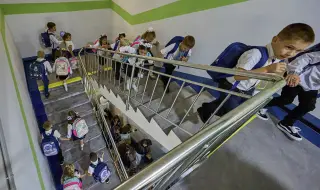
Ukrainian youth are increasingly resorting to violence and bullying of their classmates, trying in this way to cope with their own traumas. Videos are increasingly appearing on Ukrainian Telegram and TikTok channels in which a student is the object of ridicule and beating, and all this is duly filmed.
Many Ukrainian youth suffer from anxiety disorders
"This great cruelty among children amazes me. This is physical violence. And everything is posted on social networks, provoking a new wave of violence,", Ukraine's education ombudsman Nadezhda Leshchyk told DW. According to her, this problem is exacerbated during war. “At the beginning of the war, there were fewer such cases, but due to Russia's full-scale invasion of educational institutions in Ukraine, not enough attention was probably paid. Then, with each subsequent year, the cases increased.“
Leshchik notes a number of factors that have a negative impact on the mental state of children: air raids, shelling. Many children are waiting for their parents to return from the front or have lost them. There was also a problem last winter with mass shelling, the lack of electricity and heat, due to which schools and other educational institutions worked remotely - all this led to insufficiently good social interaction between children.
The educational ombudsman points out that domestic violence also increased during the war. “War causes a certain depression, post-traumatic stress disorder in children, parents and teachers, and also increases cases of violence in educational institutions.“ Leshchyk refers to studies according to which 75 percent of students experience stress - depression, phobias and fear.
"Because of the war, people are more prone to various negative emotions"
Teachers from Kiev schools told DW that adolescents react differently to stressful situations - some withdraw into themselves, others become aggressive. Children, on the other hand, are increasingly involved in conflict situations in which they bully and humiliate each other.
Regarding the insults that children exchange on social networks while playing video games, 14-year-old David from Kiev's N45 lyceum commented: "Children do this in the name of self-affirmation at the expense of others, and the war definitely has an impact. "Probably someone has experienced trauma and is expressing it in this bad way."
15-year-old schoolgirl Yana notices that because of the war, "people are in an unstable mental state and are more prone to various negative emotions." "When a person is angry, it is easier to offend someone else. And the offended person can more easily succumb to the insult."
The girl adds that it is easier to offend someone online than in real life. "Sometimes in real life there are people who can prevent bullying. But in a personal chat this is impossible," says Yana. Her family left Donetsk region for Dnepropetrovsk in connection with the war. And she had to stop going to school there because the kids she tried to befriend bullied her because she was from Donetsk.
Russian special services incite Ukrainian children to violence
Because of the war, mobile phones are not banned in Ukrainian schools - so that children can contact their parents during an air raid. That is why they also have constant access to social networks, namely in chats, as Kiev police say, negative communication takes place - harassment, humiliation, etc.
"Children can just write something offensive. They don't understand that it can be very offensive to the other person and affect their emotional state," police inspector for youth issues Yana Voncharenko told DW.
She and her colleagues talk to many children and teach them to recognize negative content on Telegram and TikTok in order to react correctly. There are many suspicious channels on the network, created specifically for the youth audience, where disrespect for parents, violence, humiliation of other children, etc. are directly or indirectly cultivated. Police officers point out that children often find it difficult to recognize real friends on social networks, which is also used by Russian special services.
Ombudsman Nadezhda Leshchyk says that Russian agents are inciting Ukrainian youth to violence, involving them in committing terrorist acts, for which they are offered money. According to Ukrainian police data, in 2025, 24 minors aged 14 to 17 were identified as being involved in terrorist acts commissioned by Russian special services.
However, not all young people succumb to Russian propaganda and cooperate with Russian agents - some, alone or together with their parents and teachers, inform the police about suspicious addresses. A ninth-grader from Kiev, Maria, told DW that Russian aggression has also made teenagers more careful. “The war has radically changed my attitude towards myself and towards us as a nation, towards our language. Before the war, we often perceived ourselves as one with the Russians, but now it has become clear who is who.“
Where there is violence, there is also stability and security
Educational Ombudsman Leshchyk admits that Ukrainian schools cannot cope with the negative impact of the war on their own - the workload is too great. She calls on all participants in the educational process - teachers, school psychologists, parents - to to be careful and not to miss changes in the psychological state of children.
School psychologists from Kiev told DW that children often do not share their problems with their parents or do not want to upset them even more, if, for example, the father is in captivity or has died. Children do not always share with teachers either. Therefore, as experts emphasize, the task of schools is to teach children to be psychologically resilient and to create a safe and comfortable school environment for them, so that they can at least somewhat distract themselves from problems. “Because in a world where there is a lot of violence, it is very important to remember that there is still stability and security - there are places where you can find friends and ask for help“, school psychologist Marina Panchenko told DW.
Authors: Jan-Philip Scholz | Alexandra Indyuhova